Free Developer Value Snapshot
Can you prove what changed?
Answer 7 questions about one completed project.
In 2–3 minutes, find:
- your strongest evidence
- your biggest proof gap
- your next move
Free · 2–3 minutes · No inflated claims
Choose your experience
Your Developer Value Snapshot
Your current professional story is
Your lead was saved. Snapshot email delivery is being processed.
You have the diagnosis. Now decide whether to build the proof.
Turn that diagnosis into usable proof
The Blueprint turns that next move into a finished proof asset.
Bring two completed projects. The Blueprint helps you separate what you personally owned from what the team owned, the decisions you influenced, what changed, and the strongest evidence you can honestly support.
You get:
- Proof Profile
- Two Project-to-Proof stories
- Positioning through-line
- Reusable LinkedIn / résumé / interview language
- Evidence gaps and opportunities
- Focused four-week plan
No inflated claims. No fake impact metrics. Personal contribution stays separate from team outcome.
Founding price: $9. Planned standard price: $19.
Recommended learning
See what stronger professional proof looks like.
Make the work understandable without making it bigger.
The Blueprint turns technology lists and task descriptions into credible stories that show the problem, your contribution, the decision you influenced, and the strongest result your evidence supports.
Worked on checkout services using Java, Spring, AWS, and PostgreSQL. Fixed bugs and improved performance.
Implemented retry handling and failure monitoring for a checkout integration that required repeated support investigation. Chose capped exponential backoff to limit repeated load during provider outages. After release, failed requests were retried automatically; the support team reported fewer manual investigations.
- Names the operational problem
- Separates personal contribution
- Explains a technical decision
- Bounds the observed result
Results-driven full-stack developer with a passion for solving complex problems and delivering scalable solutions.
I help teams turn fragile operational workflows into dependable software. Across checkout reliability and deployment-governance projects, my work has focused on clarifying failure modes, implementing bounded service changes, and making technical decisions easier to explain and operate.
- Removes generic adjectives
- Shows a consistent capability
- Connects multiple projects
- Creates interview talking points
Improved deployment processes with Kubernetes and CI/CD tools.
Built policy checks for a deployment workflow where inconsistent release steps created avoidable delays. Used configuration-based rules so application teams could validate requirements without redeploying the service. After adoption, teams could identify policy failures before requesting a production release.
- Shows the starting problem
- Names the developer's work
- Makes the design choice visible
- Avoids unsupported causality
These examples improve clarity — not seniority, authority, or impact the developer cannot substantiate.
Building Better Developers
What honest professional proof actually looks like.
Show the problem you stepped into
The strongest project stories start before the code: who was stuck, what was breaking down, and why it was worth fixing.
Make your judgment visible
Tools matter, but your value usually shows up in the choices you made when the answer was not obvious.
Separate your work from the team result
Clear ownership builds trust. Name what you handled, what others owned, and where your decisions changed the path.
Use proof without overselling it
You do not need inflated numbers. You need the best honest evidence available and a story that stays inside what it supports.
Developer Leverage Blueprint · Founding release
Bring two projects. Leave with proof.
The Blueprint transforms two completed projects into a Proof Profile, positioning through-line, two Project-to-Proof stories, reusable proof formats, evidence opportunities, and a focused four-week plan.
Developer Leverage Blueprint$9
Founding price. Planned standard price: $19.
Start with the free Snapshot first. You can review your result before deciding whether to continue.Complete the Snapshot before continuing to paid Blueprint access.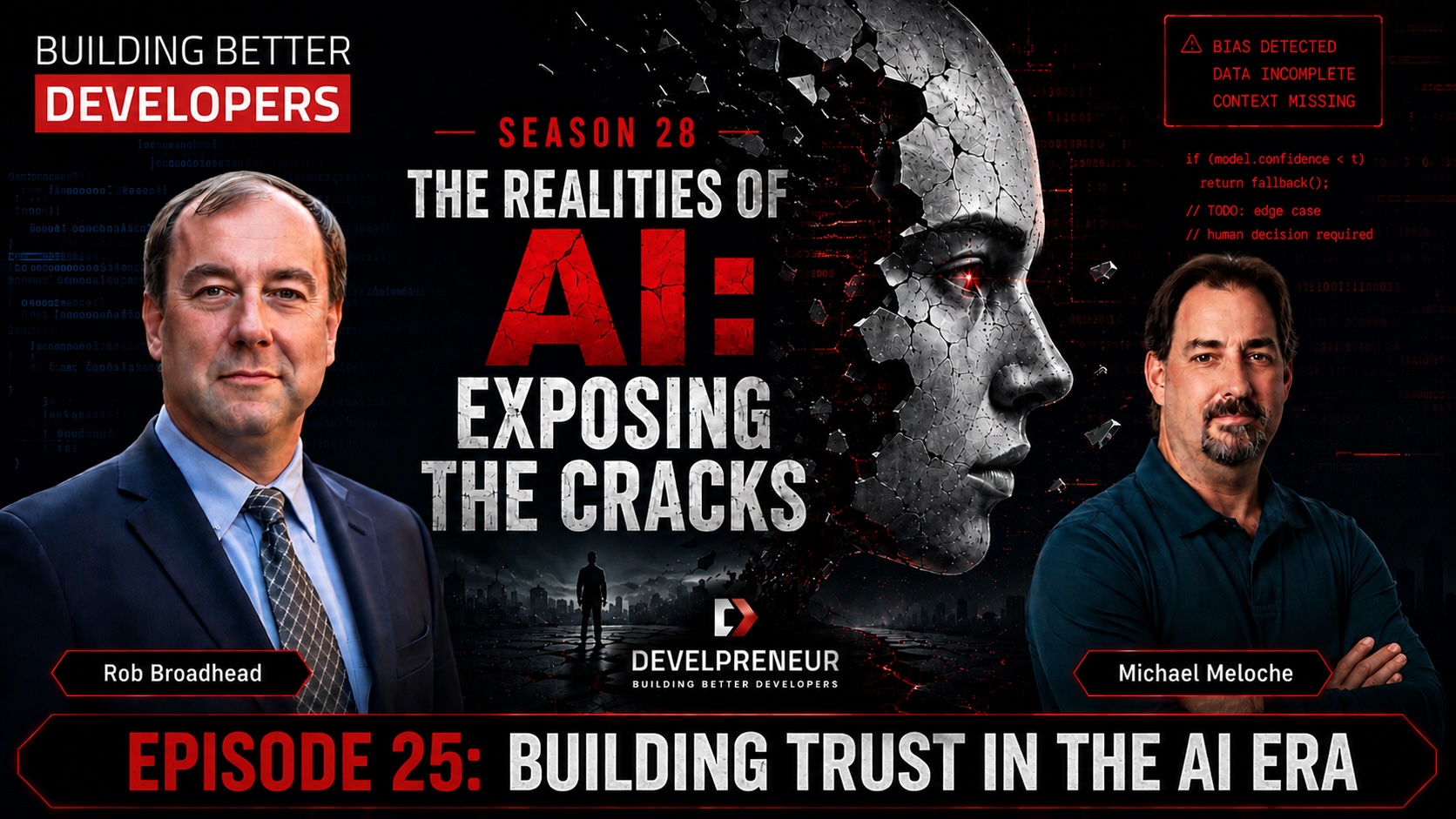
Learn while you build.
Building Trust in the AI Era | Amit Zandberg
What happens when the technology helping you build your business also threatens the way customers discover it? This episode looks at trust, AI, and how builders should think about credibility as the web changes.
Latest from the podcast · Posted August 20, 2026Before detailed project intake
Protect confidential information
Do not enter source code, credentials, customer names, non-public financial figures, security vulnerabilities, proprietary architecture details, or anything you are not permitted to share.
Use a safe level of detail
Saved drafts are browser-local. Use the same browser and email to continue work you already started.
Instead of: “Customer X lost €42,371 because service Y exposed endpoint Z.”
Write: “A customer-facing workflow had recurring reliability failures that interrupted transactions.”
Returning to saved work?
- Use the same browser and device you started with.
- Enter the email you used for your Blueprint record.
- Check the confidentiality box above.
- If a saved draft appears, click Resume saved draft. Otherwise, click Begin with a blank intake.
Saved Blueprint draft found