
Building a successful business does not always begin with a revolutionary technology or a complicated application. Sometimes, it starts with identifying one frustrating problem and creating a simple way to solve it. For developers and entrepreneurs, the challenge is often resisting the temptation to build everything at once and instead focusing on what customers actually need.
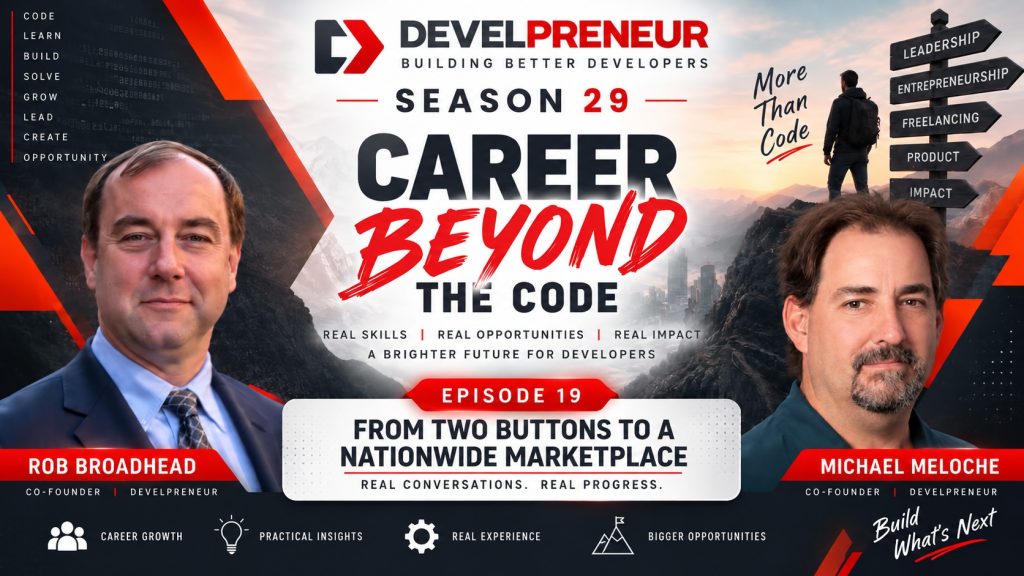
In this episode of Building Better Developers, hosts Rob Broadhead and Michael Meloche welcome Ari Kimmelfeld, founder of Commonplace, a marketplace designed to make buying and selling large secondhand items easier. From fitness equipment and appliances to furniture, saunas, and hot tubs, Commonplace handles much of what makes these transactions difficult, including inspections, pickup, delivery, and payments.
Ari shares how a website with just two buttons evolved into a nationwide business, the unexpected complications of combining software with physical logistics, and why understanding customer problems matters more than building another feature.
About Ari Kimmelfeld
Ari Kimmelfeld is the founder and CEO of Commonplace, a U.S.-based marketplace specializing in large secondhand products, including fitness equipment, furniture, appliances, hot tubs, saunas, and other difficult-to-transport items.
Ari and his wife, Naomi, built the business around making secondhand shopping more accessible by addressing challenges such as inspections, logistics, secure payments, and delivery. The company evolved from TradeMySpin, a narrowly focused service for buying and selling used Peloton equipment, into a broader marketplace serving customers nationwide.
A graduate of Macaulay Honors College at the City University of New York, Ari brings an entrepreneurial approach that emphasizes identifying customer pain points, testing simple solutions, and improving operations through real-world experience.
Through Commonplace, he continues to explore how technology and hands-on service can work together to make complicated transactions easier.
Connect with Ari and Commonplace:
- Website: https://trycommonplace.com
- LinkedIn: https://www.linkedin.com/in/arikimmelfeld
Starting Small: The Two-Button Business Model
Ari’s entrepreneurial journey began with a problem he had experienced personally. Having bought and sold secondhand products since childhood, he understood the opportunities available through platforms like Craigslist and Facebook Marketplace. However, he also recognized a major limitation: purchasing something large, expensive, or difficult to transport was rarely convenient.
During the COVID-19 pandemic, many people purchased Peloton exercise bikes for home workouts. As gyms reopened, some of those expensive machines sat unused. Ari saw an opportunity to connect people who wanted to sell their equipment with buyers looking for a bargain.
Instead of developing an elaborate marketplace, he launched a basic Shopify website called TradeMySpin. It featured two simple options: buy a Peloton or sell a Peloton.
That simplicity made the concept immediately understandable. Customers knew what the website offered, and search engines could recognize its purpose. According to Ari, the business attracted significant organic interest as people discovered an easier way to buy and sell used exercise equipment.
For developers, this is an important reminder that a minimum viable product does not need to demonstrate everything your technology can do. It needs to demonstrate that your solution solves a real problem.
Building a Marketplace That Solves More Than the Transaction
Traditional marketplaces do a good job of connecting buyers and sellers, but the transaction itself can still become a frustrating experience. Buyers may need to negotiate prices, inspect products, arrange transportation, and coordinate with sellers who sometimes stop responding.
These problems become considerably more complicated when purchasing a refrigerator, treadmill, or hot tub.
Ari realized that Commonplace needed to provide more than a place to post listings. The real opportunity was to remove the obstacles that prevented secondhand transactions from happening.
Commonplace developed a service model that includes inspections, delivery coordination, payment processing, and installation where appropriate. The company also introduced a pay-on-delivery approach, allowing buyers to reserve an item for one dollar and complete payment after inspecting it.
This was not simply a feature Ari assumed customers wanted. He explains that the team experimented with different purchasing processes before discovering that even a small financial commitment produced better results than allowing buyers to reserve products entirely for free.
The lesson extends well beyond online marketplaces. The best software solutions often emerge from understanding customer behavior rather than making assumptions about how people should use an application.
When Every Order Requires a Truck
As Commonplace expanded beyond Pelotons, its greatest challenge was not necessarily building additional website functionality. It was creating the operational infrastructure necessary to deliver different types of products safely and consistently.
A refrigerator requires different handling than a treadmill, and moving a hot tub may involve plumbing, electrical connections, specialized equipment, or even a crane. Each product category introduces requirements that must be reflected in the business processes and the software supporting them.
Ari explains that Commonplace developed a nationwide network of more than 3,000 trained, vetted, and rated delivery professionals. Its systems coordinate drivers based on location, qualifications, product categories, and job requirements.
Scaling this operation required more than assigning additional deliveries. The company had to develop dispatch processes, driver training, qualification checks, and specialized workflows for individual product categories.
This illustrates a challenge developers frequently encounter when working with real businesses: the software is only one component of a much larger operational system. Building an application that technically functions is different from creating one that consistently supports the people doing the work.
Learning From the Problems That Go Wrong
One of the most valuable parts of Ari’s conversation is his explanation of how Commonplace improves its processes through experience.
The company uses inspection checklists containing approximately 30 to 50 points for individual products. Those checklists can vary based on the manufacturer, model, and category. When something goes wrong during a pickup, inspection, or delivery, that experience becomes an opportunity to improve the next transaction.
A problem discovered while moving a particular hot tub in Texas, for example, can lead to updated inspections and training that help prevent the same issue during a future delivery in Maryland.
Ari describes these lessons as the price of learning. Rather than treating every operational problem as an isolated failure, Commonplace uses those experiences to strengthen the entire network.
For developers, this approach closely resembles continuous improvement in software development. Bugs, failed deployments, unexpected user behavior, and process breakdowns provide valuable information when teams take the time to investigate their causes.
The goal should not simply be to fix a problem once. It should be to improve the system so that the same problem becomes less likely to happen again.
Trust Is Part of the Product
Buying an expensive secondhand item online requires confidence. Customers need assurance that the product is in the expected condition, that delivery will happen, and that someone will help when something goes wrong.
Commonplace addresses these concerns with multiple inspection checkpoints, photographs, videos, delivery coordination, and a parts warranty. Customers can even communicate with delivery crews during pickup to ask questions about an item before completing the transaction.
These additional services create a level of trust that a traditional listing alone cannot provide.
For developers and entrepreneurs, the larger lesson is that customer experience includes everything surrounding the software. A polished interface cannot compensate for unreliable fulfillment, poor communication, or unclear expectations.
Technology becomes more valuable when it supports a dependable service rather than simply adding more functionality.
Building Better Developers: Solve the Problem Before Expanding the Product
Ari’s journey from TradeMySpin to Commonplace demonstrates how a focused solution can grow into something much larger. What began as a straightforward way to buy and sell Pelotons eventually required sophisticated logistics, specialized inspections, payment workflows, and a nationwide delivery network.
The growth did not come from attempting to build an entire marketplace on day one. It came from identifying a meaningful customer problem, building something simple enough to test, and expanding the solution as new requirements emerged.
As developers, we sometimes measure progress by how many features we deliver or how quickly we can write code. However, the real measure of success is whether our work removes obstacles, improves operations, and creates value for the people using it.
Before starting your next project, consider what your version of those original two buttons might look like. Find the smallest useful solution, validate it with real customers, and let the lessons from actual usage guide what you build next.
That is how we move beyond simply writing code and start building better solutions.
Stay Connected: Join the Developreneur Community
👉 Subscribe to Building Better Developers for more conversations on momentum, leadership, and growth. Whether you’re a seasoned developer or just starting, there’s always room to learn and grow together. Contact us at [email protected] with your questions, feedback, or suggestions for future episodes. Together, let’s continue exploring the exciting world of software development.