

There’s a point in every business where doing everything yourself stops being admirable and starts being the bottleneck. The shift from operator to leader doesn’t happen automatically — it requires intention, structure, and systems built to outlast your own bandwidth.
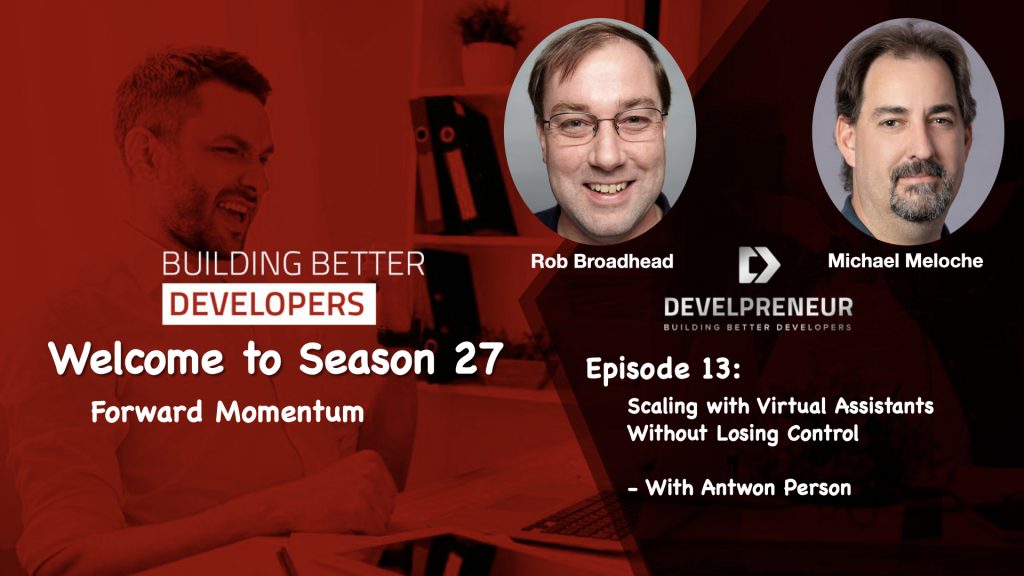
In this episode of Building Better Developers, Antwon Person pulls back the curtain on how he built and managed a virtual assistant team without creating operational chaos. What follows is a breakdown of his approach — and what other entrepreneurs can take from it.
Hire for Zones of Excellence, Not Versatility
A common early mistake: hiring one person and loading them with five different jobs. Graphic design, video editing, admin work, research, social media — all under one roof. It sounds efficient. In practice, it creates hidden friction and inconsistent output.
When Antwon first brought on a VA, he made exactly this mistake. Spreading one person thin created skill gaps and unpredictable work quality. The fix was straightforward but powerful: hire each VA only within their zone of excellence.
- A dedicated graphic designer
- A dedicated video editor
- An admin-focused VA
- Clear roles tied to individual strengths
When roles are specialized, delegation gets cleaner. Expectations become clearer. You stop managing around weaknesses and start building around strengths.
Hiring within a zone of excellence transforms delegation from damage control into real leverage.
Measure Outcomes, Not Hours
Hourly tracking feels measurable — but hours don’t always equal results. Someone can log time without moving the needle. Antwon switched to task-based accountability, and it changed how his whole team operated.
Each VA gets 3–4 clearly defined tasks per day. If those tasks are done, productivity is met. No hovering over time logs. No debate about whether someone “worked hard enough.” The measurement is simple: was the work completed?
This approach aligns activity with outcomes, removes micromanagement, and speeds up delivery. When you focus on outputs instead of hours, performance becomes far easier to evaluate — and conversations about it become far less awkward.
If you’re measuring hours instead of outcomes, you’re optimizing the wrong thing.
Build Culture Into the Process
Delegation without culture leads to detachment. One of the reasons this model works is that Antwon’s VAs aren’t treated as anonymous contractors — they’re treated as part of the company.
Depending on their role, they join client meetings. They participate in weekly team calls. They review KPIs and hear about company growth. Meetings aren’t purely transactional — each week, team members share a personal win, not just a business update.
That one small practice builds real connection. As the company grows, raises and expanded responsibilities create shared momentum. The VAs don’t just complete assignments — they feel invested in the outcome. That emotional buy-in is what reduces turnover and increases ownership.
When to Add an Operations Layer
Here’s a phase many founders don’t see coming: you hire help to free up time, and suddenly you’re spending all your time managing the help.
Antwon hit this wall when daily oversight started consuming his calendar. Tasks slipped through. Delays created friction. The solution wasn’t to pull back — it was to add a layer of leadership between him and the team.
He hired an operations manager. Now the structure looks like this:
- Daily check-in with his admin assistant
- The operations manager communicates daily with VAs
- The full team meets weekly to review KPIs and company metrics
Instead of being the hub for every conversation, he built a management layer. That move shifted him from task supervisor to strategic leader.
When you become the bottleneck, the next hire isn’t another assistant — it’s operational leadership.
AI and VAs: Complementary, Not Competing
The inevitable question: will AI replace virtual assistants?
Antwon’s take is balanced. AI plays a real role — handling website chat, data research, and analysis tasks. It speeds up information processing and cuts down on manual work. But hands-on execution, judgment calls, collaboration, and regulated activities still require people.
Using AI and VAs together isn’t a contradiction. They’re complementary tools. Speed plus human execution is a combination worth building toward.
Build Internal Systems Before Stacking Subscriptions
Tool sprawl is a quiet killer. Early on, Antwon found himself spending $600–$700 a month on software subscriptions — a CRM here, a project tool there, automation software layered on top. For a growing business, that overhead compounds fast.
Instead of continuing to stack tools, he built internal systems. Those systems eventually became an accelerator program, a CRM platform, and a project management and communication tool — all developed in-house.
The lesson: solve your operational problems deeply enough, and you may create value you can offer others.
The Three S’s: Structure, Systems, Strategy
For entrepreneurs in their first 3–6 months, Antwon keeps coming back to a foundational framework. The order matters.
Structure
Mindset and clarity first. Know what stage you’re in and what actually matters right now.
Systems
“Save Yourself Time, Energy, Money.” Without repeatable processes, growth just creates chaos.
Strategy
Work on the right things at the right time. Don’t market before you’re ready. Don’t scale before infrastructure exists.
Most early frustration isn’t about effort — it’s about sequencing. Founders who feel stuck are often working the right things in the wrong order. Structure creates clarity. Systems create stability. Strategy creates direction.
Start Where You Are
For side hustlers and early-stage entrepreneurs, building revenue doesn’t have to start big. Retail arbitrage, selling on platforms like Amazon or Walmart, and low-ticket digital products can all generate cash that funds marketing experiments and creates breathing room.
Low-ticket revenue funds the next step. You don’t need a high-ticket offer on day one. You need momentum — and even a dollar a day is forward motion that compounds.
The Short Version
Delegation works when the right elements are in place:
- Roles are specialized, not generalized
- Productivity is measured by tasks, not hours
- Culture is built intentionally — not assumed
- Operations have a management layer when needed
- Strategy is sequenced, not rushed
Start by identifying one recurring task you shouldn’t be doing anymore. Systematize it. Delegate it. Then repeat. Building Better Developers · All rights reserved
Stay Connected: Join the Developreneur Community
👉 Subscribe to Building Better Developers for more conversations on momentum, leadership, and growth. Whether you’re a seasoned developer or just starting, there’s always room to learn and grow together. Contact us at [email protected] with your questions, feedback, or suggestions for future episodes. Together, let’s continue exploring the exciting world of software development.