
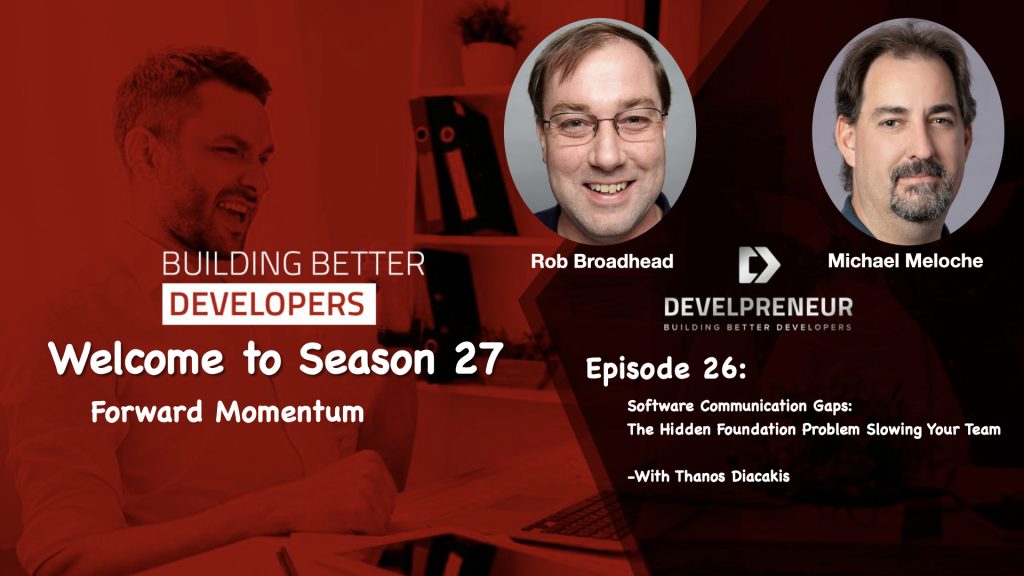

Software communication gaps are the invisible force behind most failed or delayed software projects—and they often start long before a single line of code is written.
In the conversation with Thanos Diacakis, one thing becomes immediately clear: teams don’t struggle because they lack talent or tools. They struggle because they lack a shared language.
About Thanos Diacakis
With over 25 years in software development, Thanos Diacakis has worked with early-stage ventures and tech giants like Uber and Included Health. He led the technical integration of the JUMP Bikes acquisition, scaling the platform to 45k vehicles and over 2 million monthly trips.
Today, he helps teams deliver faster with better quality—without burning out in the process.
Connect with Thanos on LinkedIn: https://www.linkedin.com/in/thanosd/
The Real Cost of Software Communication Gaps
At the heart of most broken projects is a simple pattern: business teams describe what they want, developers interpret it, and both sides assume alignment.
That assumption is where everything breaks.
Thanos describes a familiar scenario: a business writes a multi-page specification, hands it to engineers, and waits weeks for results. When the work returns, it’s “not what we meant.”
This isn’t incompetence—it’s translation failure.
Natural language is inherently ambiguous. Code is not.
Bridging that gap requires more than documentation. It requires a system for continuously refining understanding.
Why Software Communication Gaps Get Worse Over Time
Many teams respond to misalignment by adding more:
- detail
- documents
- requirements
- control
That reaction feels logical—but it makes things worse.
Instead of improving clarity, it increases rigidity. Teams become slower, less adaptive, and more frustrated.
⚠️ Warning: More documentation does not fix misunderstanding—it often amplifies it.
The real issue isn’t a lack of detail. It’s a lack of feedback cycles.
Without frequent validation, teams drift further apart with every iteration.
Closing Software Communication Gaps with Iteration
The solution Thanos emphasizes is deceptively simple: shorten the loop.
Instead of building for a month, build for two days.
Instead of guessing, validate continuously.
This shifts development from a “delivery model” to a “discovery model.”
💡 Insight: Requirements are not defined upfront—they are discovered through iteration.
When teams move from long cycles to rapid feedback loops, something important happens:
- Misunderstandings surface earlier
- Corrections become cheaper
- Trust improves between the business and engineering
This is not just a process change—it’s a mindset shift.
Software Communication Gaps and the Language Problem
One of the most overlooked issues in development is language itself.
Business speaks in outcomes.
Engineering speaks in precision.
Thanos highlights that moving from English (or any natural language) to code requires resolving every ambiguity.
If that resolution doesn’t happen early, it happens later—through bugs, delays, and rework.
🔍 Perspective: Every undefined requirement becomes a future exception.
This is why high-performing teams don’t aim for perfect specs. They aim for fast clarification.
How AI Exposes Software Communication Gaps
AI hasn’t solved communication problems—it has accelerated them.
What used to take weeks now takes hours. But the underlying misalignment still exists.
As discussed in the episode, AI amplifies whatever system you already have:
- Good systems get faster
- Broken systems fail faster
⚡ Action: Use AI to shorten feedback loops—not to skip them.
This is a critical distinction. Teams that treat AI as a replacement for clarity will struggle more, not less.
Building a Foundation That Actually Works
Fixing software communication gaps isn’t about tools. It’s about structure.
Effective teams:
- Start with rough ideas, not rigid specs
- Validate early and often
- Accept that understanding evolves
- Build systems that support iteration
This creates a foundation where both sides—business and engineering—can align continuously instead of occasionally.
Conclusion
Software communication gaps are not a surface-level issue—they are foundational.
If left unaddressed, they compound into delays, frustration, and wasted investment.
But when teams shift toward iterative communication and shared understanding, everything changes:
- Delivery accelerates
- Quality improves
- Teams stay aligned
The goal isn’t perfect communication. It’s continuous alignment.
Stay Connected: Join the Developreneur Community
👉 Subscribe to Building Better Developers for more conversations on momentum, leadership, and growth. Whether you’re a seasoned developer or just starting, there’s always room to learn and grow together. Contact us at [email protected] with your questions, feedback, or suggestions for future episodes. Together, let’s continue exploring the exciting world of software development.