
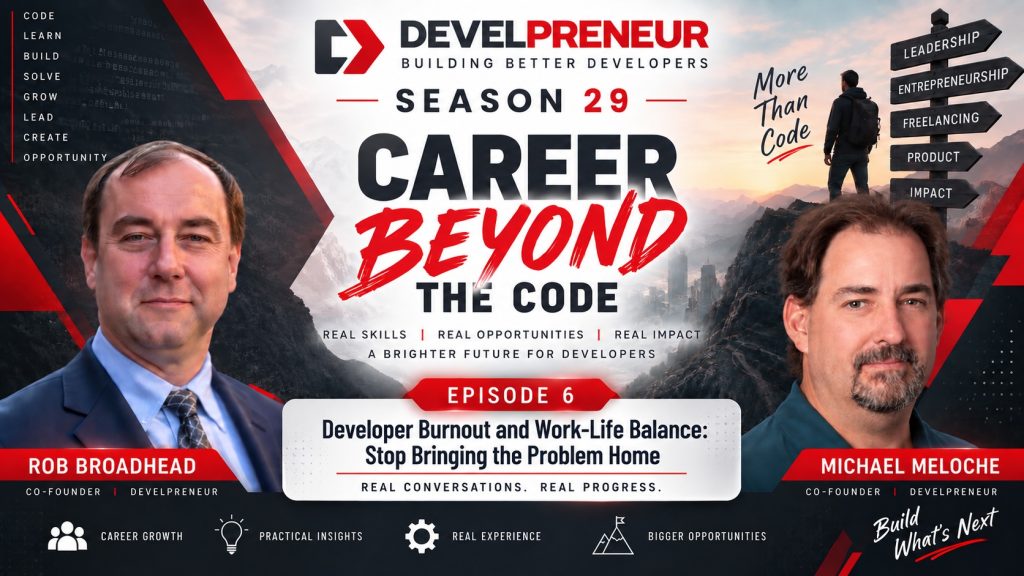

Developer work-life balance is often treated as a productivity problem. We look for better schedules, better tools, fewer meetings, or another technique for getting more done. However, our second conversation with Gaylen A. Wilson raises a different question: what happens when the problem is not how much work you have, but your inability to stop working the problem?
Developers spend their careers learning how to stay with difficult problems. We debug issues that make no sense, work through production failures, deal with changing requirements, and keep digging until we find an answer. That persistence can make us successful. It can also make it difficult to recognize when we have crossed from productive problem-solving into stress, frustration, and burnout.
The challenge becomes even greater when we carry that state away from the computer. Work may have ended, but mentally, we are still debugging. Learning to recognize that transition is an important part of developer work-life balance.
About Gaylen A. Wilson
Gaylen A. Wilson is an author, relationship coach, technology veteran, entrepreneur, farmer, former stockbroker, and heart-transplant recipient whose career has required him to reinvent himself repeatedly. Together with his wife, Heather, Gaylen developed the Monument Method, an approach they use to help couples interrupt destructive conflict patterns and strengthen their connection.
Learn more about Gaylen A. Wilson through his website http://www.monumentmethodinstitute.com/.
Developer Work-Life Balance Starts with Recognizing Your State
Michael brought the conversation back to developers by pointing out something familiar to many people in technology. We can become so accustomed to constantly working the problem that we stop recognizing what it is doing to us.
There is always another release, bug, customer issue, deadline, or technology to learn. We keep pushing because that is what has worked throughout our careers. Eventually, though, we can reach a point where we are no longer solving the problem effectively. We are simply reacting to it.
Gaylen connected that experience to what he describes as fight-or-flight thinking. He had experienced an extreme version during his health problems. As a self-described Type A personality, one of the hardest things for him was accepting that he still wanted to keep going while his body was telling him that he could not. He credited his relationship with his wife, Heather, as an important source of support during that period.
You do not need to reach that extreme before recognizing the same pattern in your career. Sometimes the warning sign is much simpler. You close the laptop, but you are still thinking about the defect. You sit down for dinner and mentally replay a conversation from work. You are supposed to be relaxing, but you feel guilty because you are not doing something productive.
The workday ended. Your brain never got the message.
The Car That Would Not Start
Gaylen shared a story that provides a surprisingly good example of what this looks like.
He had spent two months working on one of his cars and finally got it running. After driving it around the block, he and Heather prepared to leave and visit friends. He pushed the button to start the car, and nothing happened.
For someone who likes solving problems, that was frustrating enough. Gaylen also felt that he was disappointing Heather because they were supposed to leave. He grabbed a multimeter, found the battery was low, and started looking for jumper cables.
He could not find them.
They were actually nearby, underneath a blanket, but Gaylen had become so frustrated that he could not slow down enough to move the blanket and see them. By his description, he had entered full fight-or-flight mode. He found another old set of jumper cables, discovered they were badly corroded, and became even more frustrated.
Developers have our own versions of that blanket.
You have probably stared at a defect for an hour only to discover the problem was obvious once you stepped away. Maybe you rewrote code that did not need rewriting. Maybe you blamed a dependency, the network, the database, or someone else’s code before discovering a simple configuration problem.
The longer we fight the problem, the narrower our thinking can become. At some point, persistence stops being an advantage.
Developer Work-Life Balance Requires an Interrupt
The most interesting part of Gaylen’s story came next. Heather was sitting in the car and did not realize how frustrated he had become. Gaylen finally walked over to her and said, “I need a monument.”
That phrase comes from the relationship framework Gaylen and Heather developed, which they call the Monument Method. They use “monument” as an agreed-upon signal to interrupt an escalating conflict or emotional reaction and reconnect before continuing.
Gaylen said that when Heather turned toward him, his anger quickly disappeared. He then gave her permission to use the same technique whenever she saw him beginning to spiral in the future.
Whether or not you use Gaylen’s specific method, there is a useful concept here for developers: we need an interrupt.
In programming, an infinite loop does not usually fix itself because we let it run longer. Sometimes something external has to break the cycle. Our work habits can operate the same way.
Build an Interrupt into Your System
Developers love systems, so it can help to think about disconnecting from work as something we deliberately design rather than something we hope happens automatically.
Your interrupt does not have to be Gaylen’s “monument.” It can be something simple that signals the transition from work mode to the rest of your life.
- Take a walk after shutting down your computer.
- Write down the next step before leaving a difficult problem.
- Create a short end-of-day routine that closes out unfinished work.
- Exercise before transitioning into your evening.
- Set a fixed point when you stop checking Slack, Teams, or email.
- Talk with someone rather than continuing to replay the problem internally.
- Step away from a frustrating problem before making another major change.
The specific ritual matters less than recognizing why you need it. If you regularly leave work in a frustrated state, simply closing the laptop does not necessarily reset that state. You may physically leave the work while mentally carrying it into everything you do afterward.
That affects more than your evening. It can affect how you communicate with the people around you and how prepared you are to return to work the next day.
You Cannot Debug Everything by Working Harder
Michael asked Gaylen an important follow-up question: what if you do not have someone there to help you reset?
Gaylen described an experience while Heather was away visiting family. He had become frustrated while working with ChatGPT and realized that Heather would normally recognize when he was becoming agitated. Without her there, he experimented with mentally recreating the calming experience they had practiced together.
He said that simply closing his eyes and imagining the familiar interaction helped him calm down. Gaylen attributed that response to repeatedly practicing their method until it had become a familiar signal for him to reset.
The larger lesson is not that developers need to reproduce Gaylen’s exact technique. It is that we can become better at recognizing when our current state is no longer helping us solve the problem.
When you have been staring at the same code for three hours, are you still debugging effectively? When you are angry at a tool because it is not behaving the way you expect, are you still evaluating the problem objectively? When you are rewriting something for the third time late at night, are you improving it, or are you just unwilling to stop?
Developers spend enormous amounts of time learning how to diagnose systems. We should learn to diagnose ourselves, too.
Find Your North Star
Rob connected Gaylen’s Monument Method to something we regularly discuss in software projects and businesses: having a “why.”
Projects need a reason for existing. Without that reason, teams can spend enormous amounts of energy building things that do not actually move them toward their goal. A clear purpose becomes a North Star. When the project begins drifting, the team can return to the original question: what are we actually trying to accomplish?
Developers can apply that idea to our careers. Why are you working so hard? Why are you pursuing the promotion? Why are you building the business? Why are you learning another technology? Why are you putting in the extra hours?
There may be excellent answers to all of those questions. The danger comes when the work becomes its own answer.
Developer Work-Life Balance Requires Boundaries
There is a strange contradiction in successful technology careers. We work hard because we want to build a better life, but the habits that help us succeed can gradually consume the life we were trying to build.
Gaylen argued that professional success, money, and recognition lose much of their meaning if they come at the expense of the important relationships around us. Rob connected that back to the larger theme of Career Beyond the Code: career success needs a reason behind it. Simply pursuing more work, more money, or more achievement does not provide a natural stopping point.
That is why developer work-life balance cannot be solved entirely with productivity hacks. Sometimes you need to recognize that enough is enough.
The defect can wait until tomorrow. The email does not need an answer tonight. You do not have to understand every new AI tool this weekend. The side project does not have to become another full-time job. The people around you should not always receive whatever energy remains after work takes the best of you.
Those are not failures of ambition. They are boundaries that can make a long career possible.
Quality Includes the Life Around the Product
At EnvisionQA, we talk about finding problems before customers do. That mindset usually applies to software quality, requirements, integrations, processes, and the technology supporting a business. However, quality is also about sustainability.
A development process that only succeeds because someone works eighty hours is not a healthy process. A release that depends on heroics every time has a system problem. A developer who cannot disconnect from work indefinitely will eventually pay for that somewhere.
Building better developers should mean more than producing developers who can write better code. It should mean developing people who can solve difficult problems without allowing every difficult problem to consume them.
That is part of building a career beyond the code.
Developer Work-Life Balance Means Knowing When to Stop
One of Gaylen’s final reflections brought both parts of our conversation together. Looking back over a life filled with career changes, financial setbacks, addiction, serious illness, and a heart transplant, he asked himself why those experiences had not left him bitter.
His answer was gratitude.
Gaylen said he realized that he had generally been more grateful for what he still had than bitter about what he had lost. Today, he practices that gratitude more intentionally.
For developers, perhaps there is another lesson in that perspective. We are trained to see what is broken. It is literally part of the job. We find the missing requirement, failed test, security vulnerability, performance bottleneck, integration problem, or defect that everyone else missed.
That skill makes us valuable, but we cannot spend our entire lives looking only for the next thing that needs fixing.
Sometimes building a career beyond the code means recognizing what is already working, protecting the things that matter, and knowing when to walk away from the keyboard.
The problem will still be there tomorrow. You will probably solve it better after the reset.
About Gaylen A. Wilson
Gaylen A. Wilson is an author, relationship coach, technology veteran, entrepreneur, former farmer and stockbroker, and heart-transplant recipient. His professional life has included multiple reinventions, from agriculture and finance to PeopleSoft consulting, computer repair, nationwide technical field work, writing, and relationship coaching.
Together with his wife, Heather, Gaylen developed the Monument Method, a relationship framework centered on interrupting destructive conflict patterns and protecting the connection between partners. Their work grew from their own relationship, Gaylen’s health journey, his involvement in large online communities discussing intimacy and relationship challenges, and their subsequent relationship-coaching education.
Gaylen described his broader philosophy during our conversation as intentionally protecting what matters most rather than allowing the pressures of work and the outside world to damage it. You can learn more about Gaylen, his books, and his work through his PodMatch profile and the Monument Method Institute.
Stay Connected: Join the Developreneur Community
👉 Subscribe to Building Better Developers for more conversations on momentum, leadership, and growth. Whether you’re a seasoned developer or just starting, there’s always room to learn and grow together. Contact us at [email protected] with your questions, feedback, or suggestions for future episodes. Together, let’s continue exploring the exciting world of software development.