
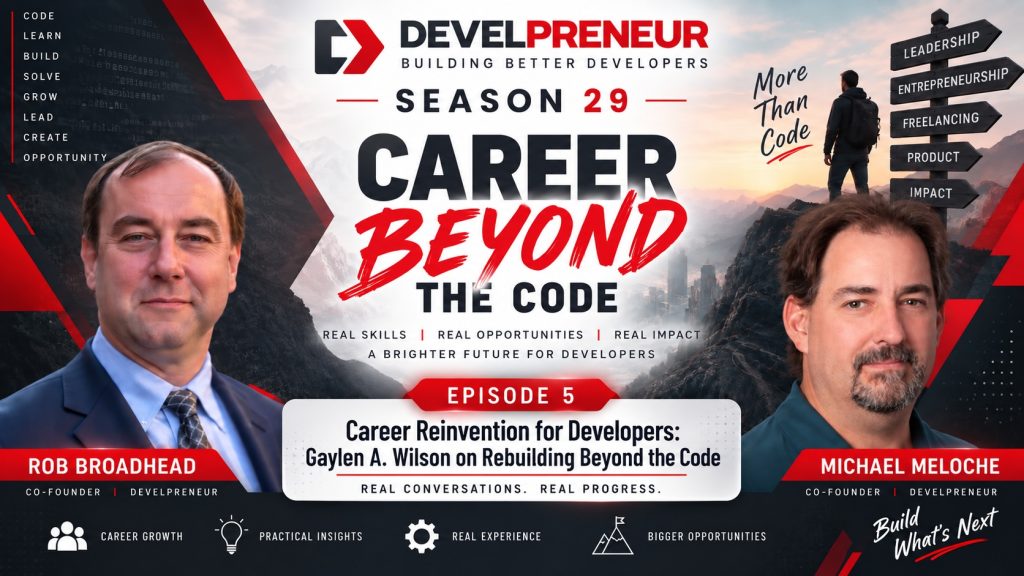

Career reinvention for developers is usually discussed in terms of learning a new language, moving into leadership, adapting to AI, or finding a new job. Our conversation with Gaylen A. Wilson takes that idea much further. His story shows what happens when careers, businesses, health, and even our assumptions about the future stop following the plan.
Season 29 of Building Better Developers is about building a career beyond the code. Usually, that leads us into conversations about leadership, communication, business value, quality, or the skills developers need as they move beyond completing technical tasks. This episode is different. We did not spend much of the first half talking about software development or QA. Instead, Gaylen told us his story, and the longer he talked, the clearer the connection to developers became.
Gaylen’s career repeatedly forced him to confront something most developers eventually discover for themselves: you can master the tools, solve complicated problems, and work incredibly hard, but none of that guarantees life will follow the architecture you designed. His story is ultimately about rebuilding when the plan fails, which makes it an unexpected but valuable example of career reinvention for developers.
About Gaylen A. Wilson
Gaylen A. Wilson is an author, relationship coach, technology veteran, entrepreneur, farmer, former stockbroker, and heart-transplant recipient whose career has required him to reinvent himself repeatedly. Together with his wife, Heather, Gaylen developed the Monument Method, an approach they use to help couples interrupt destructive conflict patterns and strengthen their connection.
Learn more about Gaylen A. Wilson through his website http://www.monumentmethodinstitute.com/.
Your Career Is Not a Straight Line
Gaylen started his professional life far away from software. He became a farmer in his twenties and built a life around agriculture. Then drought and crop failures destroyed the business, eventually forcing him into farm bankruptcy. He had to reinvent himself.
His next chapter took him into finance as a stockbroker. He succeeded there until a company whose investment he had recommended collapsed after, according to Gaylen, misrepresenting its financial condition. He described that experience as another devastating setback. Without healthy ways to process what had happened, his personal life also began to unravel.
Eventually, Gaylen rebuilt again. In 2001, he found work as a traveling PeopleSoft computer consultant. He was earning more than he ever had before and thought he had finally reached a stable point in his career. Then September 11 changed the economy and consulting industry around him. By December, he had lost that job. After months of searching and hundreds of mailed résumés, he eventually took a job as a Walmart cashier because he needed to work.
For developers, there is an important lesson in that progression. We often build our identity around what we do. We become the Java developer, QA engineer, architect, DevOps specialist, technical lead, or whatever role currently defines our career. Then the technology changes, the company restructures, a project ends, AI changes part of the workflow, or the market simply decides that yesterday’s valuable skill is commonplace today.
The ability to rebuild can matter more than the title you are trying to protect.
Career Reinvention for Developers Starts with Transferable Skills
One interesting part of Gaylen’s story is how often skills from one chapter became useful in the next. Farming did not look anything like stockbroking, and stockbroking did not look much like technology consulting. Yet farming had already taught him far more about running a business than people might assume.
When the consulting market disappeared, Gaylen eventually returned to his hometown and put a small advertisement in the newspaper offering computer repair. He had never worked professionally as a computer repair technician. He had simply been interested in computers for years. Within six months, that small side business was outperforming his Walmart job.
Then the market changed again.
As Windows became more reliable and malware-related repair work declined, the computer repair business that had supported Gaylen and his wife, Heather, began drying up. Instead of assuming the old business would somehow return, he adapted. He found platforms connecting technicians with companies needing field work and began traveling throughout rural America installing and servicing technology. Eventually, that work took Gaylen and Heather through all 48 contiguous states.
That is where this story starts to sound much more familiar to a developer.
Technologies disappear. Frameworks fall out of favor. Companies reorganize. Entire categories of work become automated. A skill that was valuable five years ago can become commonplace today. Career reinvention for developers becomes easier when we stop defining ourselves by a particular technology and start recognizing the skills that survive those changes.
Those transferable skills include:
- Problem-solving and troubleshooting
- Learning unfamiliar systems quickly
- Breaking complicated problems into manageable pieces
- Communicating with customers and stakeholders
- Testing assumptions instead of blindly following them
- Adapting when the original solution no longer works
- Understanding the business problem behind the technology
Those are skills that remain valuable even when the code changes.
Developers Are Professional Problem Solvers
There is another reason Gaylen’s story belongs in a developer-focused season. Developers tend to be fixers. Give us a broken system, and we immediately start looking for the defect. We gather information, isolate variables, test assumptions, and keep working until we understand the problem.
That mindset is incredibly valuable. It can also become dangerous when we start treating every problem as something we can overcome simply by working harder.
Michael touched on this at the beginning of the episode while discussing the difficulty of slowing down after a period of long releases and extreme work hours. Even after the immediate pressure disappeared, there was still that feeling that he should be doing something. Rob connected that experience to the larger conversation about how quickly technology is moving and how easily careers can consume the rest of our lives.
Many developers know that feeling. There is always another ticket, certification, framework, side project, production issue, release, or AI tool to learn. We tell ourselves things will calm down after the current deadline. Then another deadline appears.
Gaylen eventually encountered a problem he could not outwork.
When Working Harder Stops Being the Solution
In 2014, after years of traveling for technical work, Gaylen became seriously ill. He initially believed he had pneumonia and continued working. During another extended trip, his condition worsened until a clinic in Corpus Christi sent him for a chest X-ray. He was told he had congestive heart failure and needed to return to Colorado.
His first reaction is revealing.
The jobs were paying well. They already had weeks of work scheduled. Gaylen initially thought they should finish the trip before dealing with his heart. It took two more jobs before the seriousness of the situation finally broke through his drive to keep working.
That moment is an extreme example of a pattern many developers experience in smaller ways. We know we need sleep, but the release needs to go out. We know we need a weekend away from the computer, but production has a problem. We know we have not spent enough time with the people around us, but there is one more thing we need to finish.
The problem-solving mindset becomes a trap when the answer to every problem is simply more effort.
There are times when the correct solution is to stop.
What Are You Actually Building?
Gaylen eventually received a heart transplant in 2018. He described being near the point where he and Heather were preparing for the possibility that he would die when they received the call that a donor heart was available. By the next morning, Gaylen had received a new heart. He viewed the transplant as an opportunity to have more years with the person who had stayed beside him throughout his illness.
That experience changed what success meant to him.
It also gives developers a useful question to ask about our own careers: What are we actually building?
We spend our days building systems for other people. We think about architecture, scalability, reliability, technical debt, requirements, and defects. Yet we do not always apply the same intentional thinking to the systems surrounding our careers.
A successful career should support a life rather than consume it.
That does not mean ambition is wrong. It does not mean developers should stop working hard or stop pursuing difficult goals. It means the career itself should serve something larger. Otherwise, we can become incredibly efficient at building a future we eventually discover we did not want.
Quality Applies Beyond Software
At EnvisionQA, we spend a lot of time thinking about quality and finding problems before customers encounter them. One lesson from this conversation is that the same mindset can extend beyond software.
In software, we do not wait for catastrophic failure if we can avoid it. We monitor systems. We test assumptions. We look for warning signs. We examine recurring defects because they often point toward deeper problems.
Our careers deserve similar attention.
If every release requires heroics, something may be wrong with the process. If every week requires sixty or eighty hours, the workload may not be sustainable. If you cannot stop thinking about work when you leave the computer, that is information worth examining. If professional success consistently comes at the expense of health or important relationships, simply becoming more productive may not solve the underlying problem.
Sometimes the system itself needs redesigning.
Career Reinvention for Developers Is About More Than Technology
Gaylen’s journey moved from farming to finance, technology consulting, computer repair, nationwide field service, serious illness, a heart transplant, and eventually relationship coaching. That is hardly a traditional developer career path, but that is precisely why this conversation fits our season.
Careers rarely follow the architecture diagram we created when we started them.
Technologies change. Businesses disappear. Markets collapse. Health changes. Priorities change. Sometimes we make mistakes, and sometimes circumstances outside our control rewrite the requirements completely.
The developers who build lasting careers are not necessarily the ones who perfectly predict what comes next. They are the ones who learn, adapt, rebuild, and carry lessons from one chapter into the next. That is ultimately what career reinvention for developers is about.
Most importantly, the career is not the final product. The life you are building around it is.
In Part Two of our conversation with Gaylen A. Wilson, we bring his experiences more directly back to developers, burnout, fight-or-flight thinking, relationships, and the challenge of leaving work at work. We also explore what happens when the same problem-solving mindset that makes us effective developers follows us home.
Stay Connected: Join the Developreneur Community
👉 Subscribe to Building Better Developers for more conversations on momentum, leadership, and growth. Whether you’re a seasoned developer or just starting, there’s always room to learn and grow together. Contact us at [email protected] with your questions, feedback, or suggestions for future episodes. Together, let’s continue exploring the exciting world of software development.