
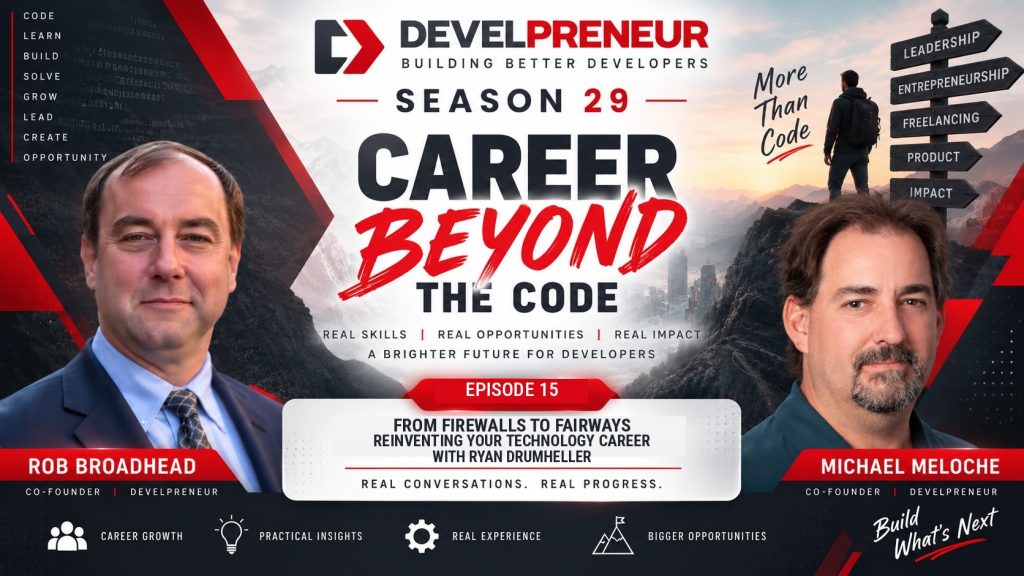

A successful technology career does not always follow a straight path. Developers and IT professionals often start with a clear idea of where they want to go, only to find that layoffs, industry shifts, burnout, and unexpected opportunities can completely change their direction. In this episode of Building Better Developers, hosts Rob Broadhead and Michael Meloche welcome Ryan Drumheller to discuss his journey from hands-on technology work to leadership, consulting, and eventually entrepreneurship.
About Ryan Drumheller
Ryan Drumheller is a technology leader, entrepreneur, author, and co-founder of Dogleg Digital. With more than two decades of experience spanning IT operations, infrastructure, development, technical leadership, and business strategy, Ryan has focused much of his career on connecting technology with the people and organizations it serves.
He graduated from Western Governors University and advocates for professional education, mentorship, and continuous learning. His book, From Firewalls to Fairways: How a Career in IT Led Me to Golf, shares lessons from his career and explores how setbacks and unexpected opportunities can lead to personal and professional reinvention.
Connect with Ryan and learn more about his work:
- LinkedIn: https://www.linkedin.com/in/ryan-drumheller/
- Personal website and book: https://ryandrumheller.com/
- Dogleg Digital: https://doglegdigital.com/
Finding a Passion for Technology
Ryan’s interest in technology began long before he entered the professional world. As a child, he struggled to find a traditional artistic outlet, but computers gave him the freedom to experiment and create. He spent countless hours taking computers apart, putting them back together, exploring early internet technology, and learning how systems worked.
That curiosity eventually led him through technical support, networking, development, engineering, and leadership. While his technical skills opened doors, his ability to connect with people helped shape the next stage of his career.
Michael related to Ryan’s experiences, having grown up during the same era of dial-up internet and bulletin board systems. Their conversation highlighted how early experimentation developed problem-solving skills that remain valuable today.
However, Ryan acknowledged that his curiosity sometimes created challenges in professional environments. He frequently wanted to understand why a problem existed rather than simply applying the requested solution. Over time, he learned to balance his desire to explore with the practical needs of the business.
Building a Technology Career in the Age of AI
As their discussion shifted toward artificial intelligence, Michael asked an important question: How should developers entering the industry today build the experience needed to remain valuable?
Ryan emphasized that AI has fundamentally changed the opportunities and expectations facing technology professionals. While AI can generate code and accelerate development, understanding how systems operate remains essential. Developers must recognize mistakes, evaluate security concerns, and determine whether a proposed solution actually works.
Rather than relying exclusively on one technical specialty, Ryan encourages professionals to develop multiple complementary skills. Understanding different technologies, industries, and business processes creates opportunities that cannot easily be replaced by automated tools.
The objective is not to compete against AI at everything it can do. Instead, developers should combine their knowledge with AI to deliver better results.
When the Traditional Career Path Stops Working
Ryan’s career followed a familiar progression from individual contributor to technical leader. However, professional success did not provide immunity from organizational changes.
After losing one position, Ryan completed approximately 20 interviews and found another opportunity within 35 days. That role allowed him to work internationally, expand his experience, and continue growing professionally.
Unfortunately, another organizational shift eventually eliminated that position as well. This time, Ryan encountered a very different employment market, influenced by economic uncertainty and the rapid adoption of AI.
Michael shared a similar experience involving the elimination of his team following a corporate acquisition. Their discussion reflected a growing concern among experienced professionals: Even a strong technical background and years of demonstrated performance do not guarantee employment stability.
These experiences encouraged Ryan to reconsider what he wanted from the next stage of his career.
Networking Is More Important Than Ever
One of Ryan’s strongest recommendations for professionals navigating career uncertainty is to build meaningful relationships before they urgently need them.
He considers LinkedIn a valuable platform for sharing expertise, discovering opportunities, and connecting with people already working in roles or industries of interest. However, he cautions against approaching every interaction with the expectation of receiving something in return.
Instead, networking should begin with curiosity. Ask questions, participate in discussions, share useful information, and develop genuine relationships over time.
For professionals who feel overwhelmed by networking, Ryan recommends simply starting. A few meaningful interactions can create opportunities that would never emerge from submitting another application.
Turning Career Setbacks Into New Opportunities
Ryan eventually discovered that consulting was not necessarily the professional environment where he felt most comfortable. Although he possessed extensive technical expertise, he found selling his personal services more difficult than communicating the value of a tangible product.
That realization helped him revisit an earlier business idea that eventually evolved into Dogleg Digital, a technology ecosystem designed for the golf industry.
His path toward entrepreneurship was not an immediate success story. Ryan described Dogleg Digital as his fourth attempt at building something. Each previous experience provided lessons about his strengths, his interests, and the type of work he wanted to pursue.
Ryan’s perspective challenges the idea that a career setback represents permanent failure. Experimentation, changing direction, and learning from unsuccessful attempts can all contribute to finding a better opportunity.
From Firewalls to Fairways: Lessons Beyond Technology
Ryan’s book, From Firewalls to Fairways, connects his professional experiences to the lessons learned during a round of golf. Each chapter uses a different hole to explore topics such as career development, networking, salary negotiations, leadership, setbacks, and personal growth.
The golf analogy reflects an important reality: Careers rarely unfold exactly as planned. Sometimes the best opportunity comes from reassessing the situation and choosing a different direction.
For developers concerned about AI, employment uncertainty, or professional stagnation, Ryan’s journey provides a valuable reminder that technical expertise is only one component of a sustainable career.
Learning to build relationships, recognize opportunities, and adapt to change can be just as important as learning another programming language.
Join Rob Broadhead and Michael Meloche for Part 2, where Ryan explains how he turned an industry problem into a product and why AI is changing the way developers build, test, and deliver software.
Stay Connected: Join the Developreneur Community
👉 Subscribe to Building Better Developers for more conversations on momentum, leadership, and growth. Whether you’re a seasoned developer or just starting, there’s always room to learn and grow together. Contact us at [email protected] with your questions, feedback, or suggestions for future episodes. Together, let’s continue exploring the exciting world of software development.