
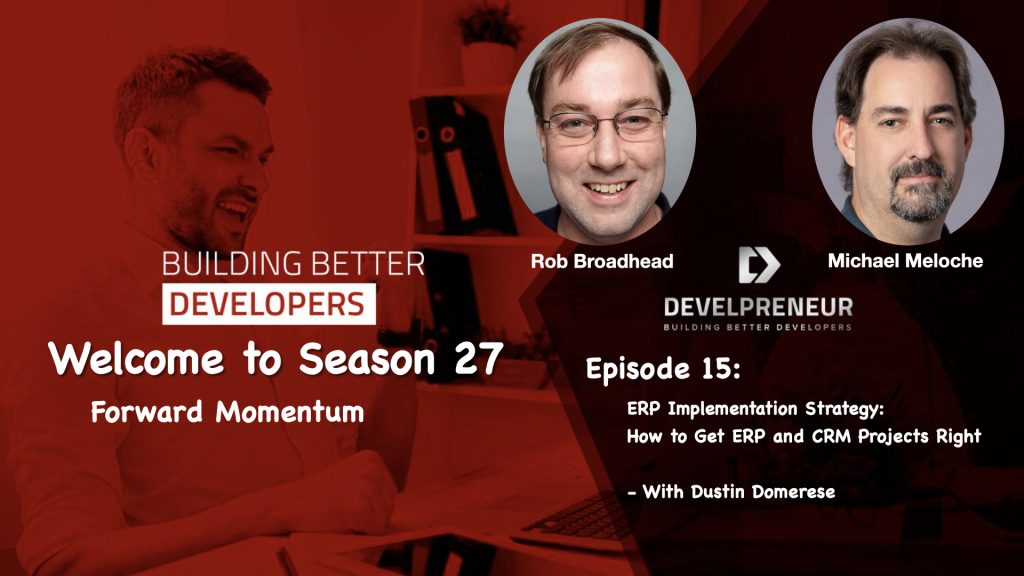

An effective ERP implementation strategy starts long before any software is selected. Most failures happen not during deployment, but during planning—when organizations rush into tools without clearly defining outcomes, aligning teams, or preparing their processes.
In this episode, Dustin Domerese shifts the conversation from failure to execution. Instead of focusing on what goes wrong, he outlines what a successful ERP implementation strategy actually looks like in practice—from defining problems to managing change and delivering results in smaller, meaningful increments.
If the first part of this discussion explains why projects fail, the second part focuses on how to make them succeed.
About Dustin Domerese
Dustin Domerese is a recognized thought leader in the Microsoft ecosystem, specializing in CRM, ERP, and software transformation. He helps organizations recover failing initiatives and build scalable systems that deliver real results.
Drawing on experience with Microsoft, Barclays, EMC2, HP, and multiple successful ventures, Dustin brings a proven track record of guiding businesses through complex technology decisions.
Start With the Business Problem
One of the most common mistakes in any ERP implementation strategy is starting with the software instead of the business problem.
Organizations often jump straight into evaluating platforms—comparing features, vendors, and pricing—without clearly defining what they’re trying to achieve. That approach leads to systems that technically work but fail to deliver meaningful outcomes.
A better approach is to define success first.
People don’t buy software—they buy outcomes. The system is just the tool that gets them there.
For example, improving customer retention or reducing order errors are real business goals. These outcomes can be measured and tracked. Once they are clearly defined, technology decisions become much easier and far more effective.
Without that clarity, even a well-executed implementation can miss the mark.
Align Teams Early in Your ERP Implementation Strategy
A strong ERP implementation strategy requires alignment across the organization—not just agreement, but shared understanding.
Different departments often approach system changes with different priorities. Sales teams may focus on flexibility, operations on efficiency, and finance on accuracy. Without alignment, these competing priorities create friction during implementation.
If every stakeholder defines success differently, the system will never feel successful.
Alignment ensures that requirements, decisions, and trade-offs all support the same outcome. It also reduces rework later in the project, when conflicting expectations typically surface.
This is where many projects begin to drift—long before any code is written or systems are configured.
Build a Team That Supports ERP Implementation Strategy
Technology projects don’t fail because of tools—they fail because of resistance.
An effective ERP implementation strategy depends heavily on the mindset of the team responsible for it. If that team is hesitant to adopt new approaches or reluctant to change existing workflows, progress slows immediately.
This becomes even more important as AI and automation become part of modern systems.
You can’t execute a modern ERP implementation strategy with a team that resists modern tools.
Teams should be encouraged to explore, experiment, and rethink how work gets done. This includes embracing new technologies and finding ways to integrate them into daily operations.
Without that mindset, even the best strategy will stall during execution.
Why 90-Day Cycles Strengthen ERP Implementation Strategy
Traditional ERP projects often take years to complete. The problem is that businesses don’t operate on multi-year timelines anymore.
Priorities shift quarterly. Markets change. Teams evolve.
A strong ERP implementation strategy accounts for this by breaking work into shorter cycles—typically around 90 days.
If you can’t deliver meaningful progress in 90 days, your ERP implementation strategy is too large.
These shorter cycles force teams to prioritize what matters most. They also create opportunities to adjust direction based on real-world feedback.
Instead of trying to deliver everything at once, organizations can build momentum through incremental progress.
Momentum and Adoption in ERP Implementation Strategy
Momentum plays a critical role in whether a system is adopted or ignored.
When teams don’t see progress, skepticism grows. But when they see improvements—even small ones—their perception changes.
People may resist change—but they rarely resist improvement they can see.
Early wins demonstrate value. They build trust in the system and reduce resistance to further changes. Over time, this momentum becomes one of the strongest drivers of adoption.
A well-designed ERP implementation strategy doesn’t just focus on delivery—it focuses on building confidence.
Using AI Within an ERP Implementation Strategy
AI is increasingly shaping how organizations approach planning and requirements.
Teams are using AI tools to generate ideas, define workflows, and structure RFPs. This can significantly improve the quality and speed of early-stage planning.
However, AI introduces new risks that must be managed carefully.
AI can strengthen an ERP implementation strategy—but it can also introduce hidden errors.
Without proper context, AI-generated outputs may include incorrect assumptions or mismatched requirements.
This creates a new challenge: outputs that look correct but don’t align with the business.
Avoiding “Confidently Wrong” Planning
One of the more subtle risks of AI is that it produces answers with confidence—even when those answers are flawed.
Organizations may unknowingly include incorrect requirements simply because they trust the output. In some cases, this leads to mismatched systems, unnecessary features, or poor architectural decisions.
Bad requirements used to be obvious. Now they look convincing.
The solution is to validate everything. AI should support thinking—not replace it.
A strong ERP implementation strategy includes human validation at every step.
The Future of ERP Implementation Strategy
Looking forward, the ERP implementation strategy is likely to evolve alongside AI and custom development tools.
It’s becoming easier to build targeted solutions that address specific business needs. This opens the door for more flexible and tailored approaches.
However, core systems still require stability, trust, and long-term reliability.
Most organizations will continue to rely on established platforms while extending them with custom-built solutions. This hybrid approach balances innovation with stability.
What a Strong Implementation Looks Like
Organizations that succeed tend to follow a consistent pattern:
- They define clear, measurable outcomes
- They align stakeholders early
- They build teams that embrace change
- They deliver value in short cycles
- They use AI thoughtfully and validate results
These principles are simple—but executing them consistently is what makes the difference.
Final Thoughts
An ERP implementation strategy is not about selecting the right software—it’s about making the right decisions.
When organizations focus on outcomes, align their teams, and move in smaller, deliberate steps, they dramatically improve their chances of success.
The tools matter—but the strategy behind them matters more.
Simple Takeaway
If you want your ERP implementation strategy to succeed:
- Start with the problem
- Align your team
- Deliver in smaller cycles
- Build momentum early
Everything else builds from there.
Stay Connected: Join the Developreneur Community
👉 Subscribe to Building Better Developers for more conversations on momentum, leadership, and growth. Whether you’re a seasoned developer or just starting, there’s always room to learn and grow together. Contact us at [email protected] with your questions, feedback, or suggestions for future episodes. Together, let’s continue exploring the exciting world of software development.