
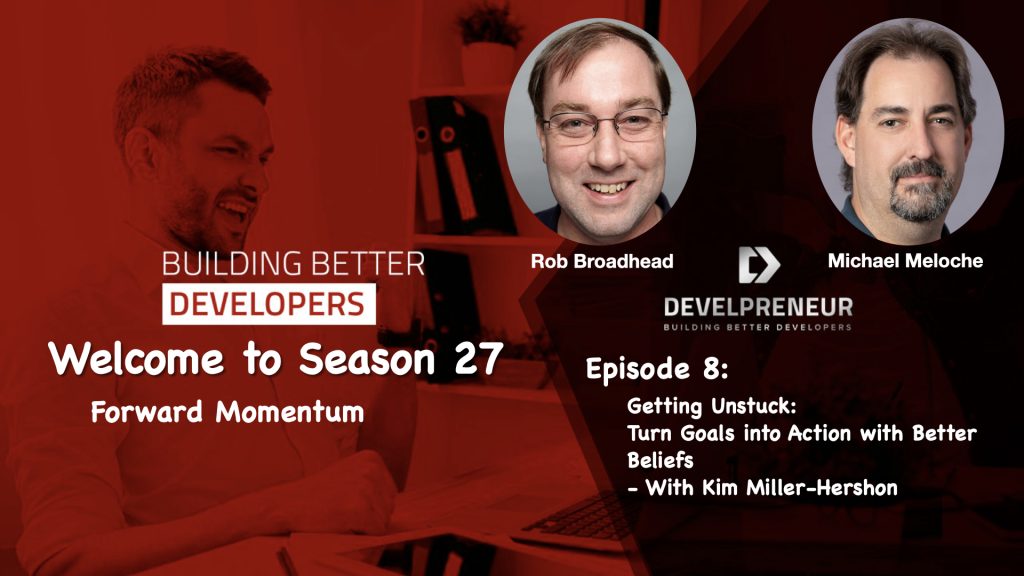

If you’ve ever felt stuck despite having experience, skills, and a plan, the problem usually isn’t effort. Most developers and technical leaders don’t stall because they’re lazy or unmotivated—they stall because their beliefs, motivation, and execution are misaligned. A strong getting unstuck isn’t about pushing harder. It’s about creating alignment so forward momentum becomes sustainable instead of exhausting.
When progress slows, people often default to adding more tools, tighter schedules, or bigger goals. But without clarity underneath, those fixes rarely stick. Real movement starts when you trust the process, understand what’s driving you, and design actions that actually fit how you work.
About Kim Miller-Hershon
Kim Miller-Hershon is an international business coach, corporate trainer, and speaker who helps leaders and entrepreneurs get unstuck by thinking differently and taking action faster. She works with executives and business owners on essential leadership skills, including communication, management, and time management—always with a focus on authenticity. Kim also hosts the Unconventional Wisdom About Conventional Wisdom podcast, where clichés are challenged, and fresh thinking takes center stage.
Follow Kim on Instagram, LinkedIn, and her website.
Getting unstuck starts with trust and clarity
Before any plan can work, trust has to exist—trust in the process, trust in support systems, and trust in your ability to navigate discomfort. Growth almost always involves friction. If everything feels comfortable, you’re probably not changing anything meaningful.
A healthy getting unstuck doesn’t avoid discomfort; it reframes it. Feeling uneasy doesn’t mean you’re failing—it often means you’re stretching. That shift alone can prevent the avoidance and second-guessing that quietly derail progress.
Just as important is clarity. Vague intentions create fragile momentum. When goals are fuzzy, decisions become reactive instead of intentional, and it’s easy to drift back into familiar patterns.
Getting unstuck requires a “juicy why.”
Motivation doesn’t come from ambition alone. It comes from having a reason that’s compelling enough to carry you through the parts of the work you don’t enjoy. Your “why” needs to be clear, personal, and vivid—not aspirational fluff.
Getting unstuck depends on this kind of clarity. When your reason for moving forward is strong, you don’t need constant external motivation. You have something internal to anchor to when energy dips or obstacles show up.
The “Juicy Why” Check
- If your goal doesn’t energize you, it won’t sustain you
- Make your why specific enough that it pulls you forward during hard moments
Getting unstuck fails when plans ignore behavior
Many solid plans fail because they assume ideal behavior. They don’t account for procrastination, avoidance, or the realities of working with other people. A perfect strategy that ignores how you actually operate won’t survive contact with deadlines and dependencies.
A practical getting unstuck adapts plans to real behavior. That means designing systems that work even when motivation drops, interruptions happen, or other people don’t deliver on time. Progress comes from plans that flex—not plans that look good on paper.
Getting unstuck when scaling your role
One of the hardest moments in growth happens when success requires letting go of work you’re good at—or even love doing. For developers and technical leaders, staying close to execution feels productive, but it can quietly cap growth.
Getting unstuck recognizes that scaling isn’t about abandoning strengths. It’s about repositioning them so others can step in, teams can grow, and the organization isn’t dependent on a single person. Letting go isn’t failure—it’s evolution.
Getting unstuck depends on psychological safety
Momentum collapses when mistakes feel personal. Progress accelerates when mistakes are treated as information. Getting unstuck replaces self-judgment with curiosity.
Instead of asking “Why did I mess this up?”, the better question is “What broke, and what does this tell me?” That shift turns setbacks into inputs for better systems rather than reasons to stop.
This is especially critical under pressure, where missed expectations often trigger blame instead of learning.
Curiosity Over Failure
- Debrief outcomes without assigning blame
- Keep what worked, fix what didn’t, and move forward
Getting unstuck for time management under pressure
Deadlines don’t fail—systems do. When work depends on other people, last-minute chaos usually comes from missing contingencies, not poor intent. A getting unstuck plan for reality, not best-case scenarios.
That means identifying dependencies early, building backup paths, and scripting uncomfortable follow-ups ahead of time. When conversations are planned, avoidance drops and execution improves.
Plan B + Script It
- Define fallback options when others don’t deliver
- Script follow-ups so discomfort doesn’t delay action
Conclusion
Getting unstuck isn’t about doing more—it’s about doing what aligns. When beliefs, motivation, and execution reinforce each other, progress becomes repeatable instead of fragile.
If you’re ready to stop circling the same problems and start moving forward with intention, alignment is the place to start.
Stay Connected: Join the Developreneur Community
👉 Subscribe to Building Better Developers for more conversations on momentum, leadership, and growth. Whether you’re a seasoned developer or just starting, there’s always room to learn and grow together. Contact us at [email protected] with your questions, feedback, or suggestions for future episodes. Together, let’s continue exploring the exciting world of software development.