
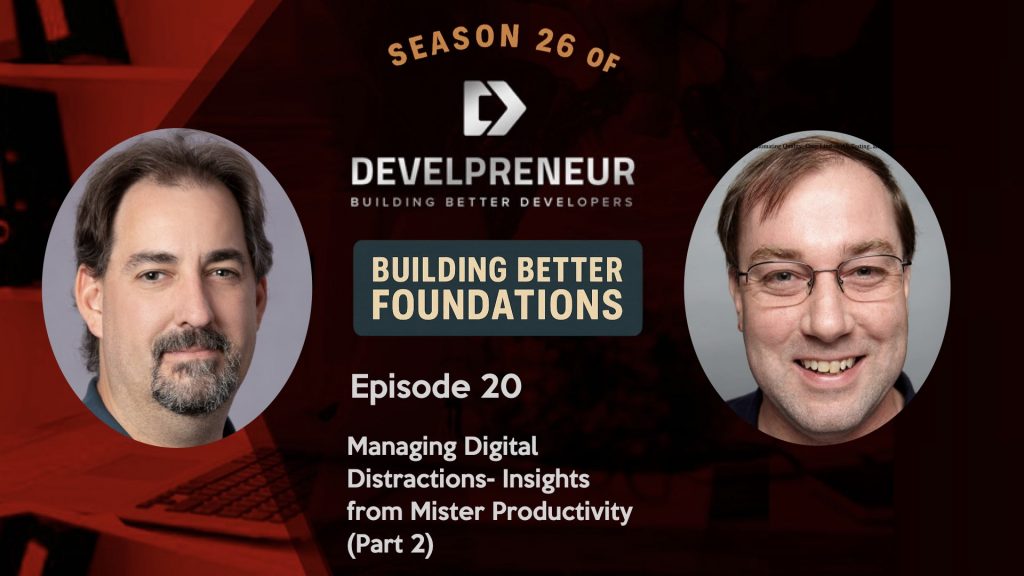

In part 2 of our Building Better Developers conversation with Mark Struczewski (Mister Productivity), we shift from foundational habits to the modern reality of our digital world. With smartphones, notifications, social media, and AI competing for every second of our attention, managing digital distractions has become one of the most important productivity skills of our time.
Mark pulls back the curtain on how our devices keep us hooked—and offers practical, simple steps to regain control of our attention before the noise takes over.
About Mark Struczewski
Today, we’re joined by Mark Struczewski—pronounced STRU-CHESS-KEY—better known as Mister Productivity. This Houston-based coach and host of the Mister Productivity™ Podcast, with over 1,340 episodes and thousands of downloads, equips busy professionals to crush overwhelm and reclaim focus. Drawing on his corporate grit and daily running discipline, Mark shares his proven ‘Distraction Detox’ framework to turn digital chaos into high-impact action. Please welcome Mark!
Twitter/X, YouTube, Instagram, LinkedIn, TikTok, SnapChat
Turning Off the Noise: First Steps in Managing Digital Distractions
Mark starts with a surprisingly bold recommendation: turn off vibration mode—permanently.
Even if your phone is “muted,” vibration keeps your brain on high alert. Removing it creates true silence and removes the physical stimulus that pulls you out of focus.
He also stresses the importance of auditing every app notification you have. Most people tap “Allow” without thinking, and developers take full advantage of that. Mark insists you go through each app and ask:
- Does this notification serve me?
- Or is it another distraction stealing my focus?
In most cases, you’ll turn off 90% of them.
A Notification Is a Demand for Your Attention: If your phone decides what you do next, you’re not in control—your apps are.
Advanced Techniques for Managing Digital Distractions
Beyond simple notification hygiene, we explore more powerful ways to reinforce boundaries.
1. Use Focus Modes Intentionally
Newer smartphones allow you to block almost everything while allowing a short list of apps or people through. It turns your phone into a calmer, quieter version of itself—ideal for deep work.
2. Block Websites at the Router Level
Michael shares how he blocks entire sites like Facebook or news apps from his entire home network. This prevents drifting into distraction, no matter which device he picks up.
3. Silence Individual Contacts
If someone sends constant memes or random texts, you can mute their message sounds without blocking them. Messages still arrive, but they don’t interrupt your work.
These tools aren’t “nanny features”—they’re modern essentials for managing digital distractions in a tech-saturated world.
Social Media Boundaries: Build the Muscle, Not the Habit
One area where many people struggle is social media consumption. Mark shares that he only spends 3–4 intentional minutes on platforms like X or Instagram before moving on.
How? He uses scheduling tools—Meta Business Suite, Buffer, TikTok Studio—to create content in batches and avoid the endless scroll.
His rule is simple:
- Use social media as a tool,
- Not as a default habit.
And if he’s with people in person? The phone goes away—no exceptions. If someone picks up their phone mid-conversation, he stops talking or walks away. For Mark, presence is respect.
True Focus Requires Presence: Being fully present strengthens your attention—even when you’re not working.
The AI Overload Problem
We also explore a growing concern: the overuse of AI tools as substitutes for real thinking. Mark notes that people are starting to treat AI chatbots like best friends, therapists, or decision-makers.
The risks include:
- Reduced mental engagement
- Outsourcing problem-solving
- Losing the ability to think deeply
- Feeling “validated” by an algorithm programmed to agree with you
Studies show that too much AI reliance leads to dramatically lower cognitive activity, essentially putting the brain into a passive state.
Managing digital distractions now includes managing AI—and knowing when to step away.
Why One-on-One Coaching Works Best
Mark explains that when it comes to overcoming distraction and productivity issues, individual coaching surpasses group settings. In groups, people hold back. They don’t want coworkers or managers hearing their real struggles—especially when those struggles involve digital habits.
One-on-one conversations create a safe space for honesty, clarity, and real change.
He even offers a free Productivity Scorecard on his website to help people understand their strengths and weaknesses. But he emphasizes: awareness is only the first step. Improvement requires action.
Ending the Day Right: A Shutdown Routine for Fewer Distractions Tomorrow
Mark ends with one of his most powerful recommendations: a shutdown routine.
This routine creates an intentional gap between screens and sleep—a crucial part of managing digital distractions at night.
His routine includes:
- Turning off screens at a set time
- Listening to calming music
- Journaling a few final thoughts
- Reading a book
- Going to sleep with a quiet, settled mind
A rested brain resists distraction better, thinks more clearly, and starts the next day stronger.
Better Sleep = Better Focus: Managing digital distractions starts with how you unplug at night.
Managing digital distractions isn’t about rejecting technology—it’s about using it on your terms. With the right boundaries, tools, and habits, you can reclaim your focus, protect your time, and build a healthier relationship with the digital world around you.
Stay Connected: Join the Developreneur Community
We invite you to join our community and share your coding journey with us. Whether you’re a seasoned developer or just starting, there’s always room to learn and grow together. Contact us at [email protected] with your questions, feedback, or suggestions for future episodes. Together, let’s continue exploring the exciting world of software development.