
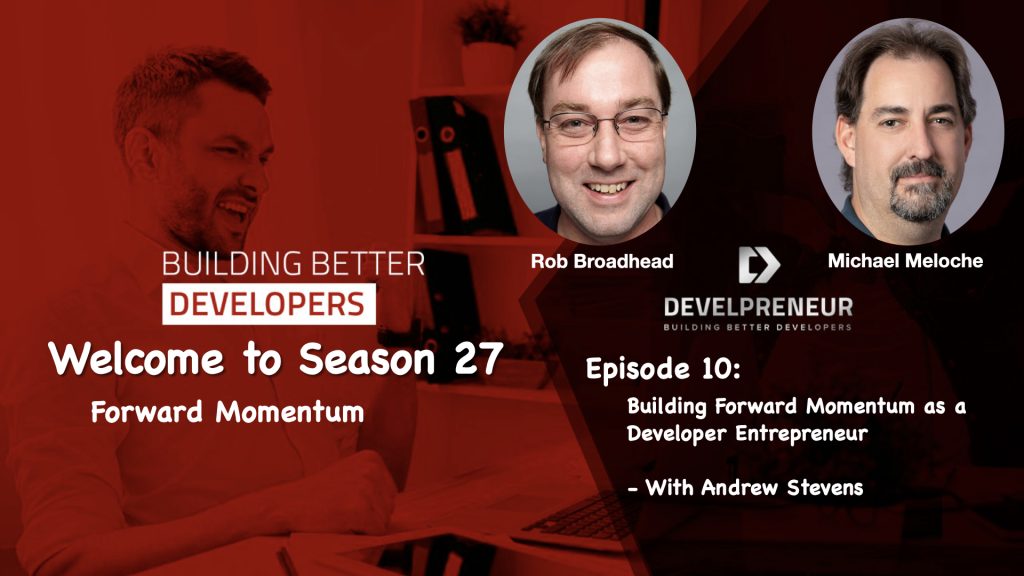

Building forward momentum isn’t about moving fast. Rather, it’s about moving intentionally — especially when transitioning from developer to entrepreneur. In Season 27 of the Building Better Developers podcast, we explore what it truly means to keep progressing when challenges, distractions, and new responsibilities threaten to slow you down.
In this episode, Andrew Stevens — software engineer, multi-time founder, CTO, and board member — shares how building forward momentum has shaped his multi-decade journey through technology and startups. Instead of focusing on overnight success, his story emphasizes sustained curiosity, disciplined execution, and constant recalibration. Over time, momentum is built layer by layer, not in dramatic bursts.
Building Forward Momentum Through Collaboration
At first, Andrew’s entrepreneurial journey didn’t begin alone. It started with collaboration.
During the early dial-up internet era, local ISPs were emerging everywhere. At that point, Andrew joined forces with two complementary partners. While he focused on writing software, one partner handled infrastructure, and another concentrated on sales and commercialization. Because each person owned a specific strength, the venture gained traction quickly.
This alignment created confidence. No single individual carried the entire burden, which reduced risk and accelerated learning.
Building forward momentum often begins with the right partnerships, not total independence.
In other words, developers don’t need to master every business function before launching something new. Clarity about strengths — and awareness of gaps — is far more powerful.
Building Forward Momentum During the Engineer-to-Founder Shift
Eventually, Andrew transitioned into more solo ventures. At that stage, the dynamic shifted dramatically.
Coding was no longer the only priority. Sales conversations, tax planning, customer communication, and financial oversight became daily responsibilities. As complexity increased, the temptation to retreat into technical work grew stronger.
Many developers stall at this point. Technical tasks feel comfortable, whereas business responsibilities feel ambiguous. Meanwhile, operational issues quietly accumulate.
Andrew openly discusses early financial mistakes and process failures. Nevertheless, those moments didn’t stop progress. Instead, they forced adjustments that strengthened the foundation.
Building forward momentum requires correction, not perfection.
Entrepreneurship rarely follows a straight line. Each misstep generates feedback, and each adjustment reinforces resilience.
Building Forward Momentum with AI as Leverage
Alongside structured execution, Andrew emphasizes the strategic use of AI.
One approach treats AI as a tool. He leverages it for rapid prototyping, static analysis, architecture critiques, and test case generation. In addition, AI significantly shortens debugging cycles, particularly when configuration issues arise.
That said, production code still demands human judgment. AI accelerates iteration, but discernment remains essential.
A second perspective positions AI as a channel. Increasingly, users ask AI systems for recommendations before making purchasing decisions. Consequently, products must be structured for discoverability within AI-driven ecosystems. Unlike traditional SEO, this requires thinking about how AI systems reference and surface information.
AI doesn’t replace disciplined builders — it amplifies their capacity.
By reducing research time and accelerating experimentation, AI expands a founder’s ability to test ideas. More testing leads to stronger building forward momentum.
Building Forward Momentum Through Structured Execution
Rather than relying on vague annual goals, Andrew breaks execution into focused horizons:
- Today
- This week
- This month
This framework creates clarity without overwhelm. At the same time, he rejects the illusion of 100% productivity. Just as engineering teams cannot operate at full capacity indefinitely, founders cannot either.
Space must be preserved for:
- Personal development
- Industry research
- Technical skill refinement
- Creative exploration
Even while serving in executive roles, Andrew continues writing code. Staying close to the craft keeps strategic decisions grounded in technical reality.
When skill development stops, momentum quietly declines.
Protecting growth time is just as important as meeting deadlines.
Building Forward Momentum Sustainably
Entrepreneurship can feel isolating. Responsibility compounds, and decisions stack up quickly.
For that reason, Andrew values trusted collaboration — including working alongside his spouse for nearly two decades. A reliable sounding board provides both stability and accountability.
Unfinished edits will always exist. Features will occasionally slip. Competing ideas will demand attention. However, building forward momentum is not about tackling everything at once. Progress comes from choosing the next meaningful step and executing it consistently.
The Real Lesson
Ultimately, building forward momentum isn’t defined by dramatic breakthroughs. It grows from sustained curiosity, strategic collaboration, structured execution, intelligent leverage of tools, and continuous personal development.
Developers stepping into entrepreneurship often expect transformation to feel explosive. In reality, momentum compounds through disciplined repetition.
Keep building.
Keep learning.
Keep adjusting.
Over time, consistent forward motion turns into lasting impact.
Stay Connected: Join the Developreneur Community
👉 Subscribe to Building Better Developers for more conversations on momentum, leadership, and growth. Whether you’re a seasoned developer or just starting, there’s always room to learn and grow together. Contact us at [email protected] with your questions, feedback, or suggestions for future episodes. Together, let’s continue exploring the exciting world of software development.