

Artificial intelligence is rapidly changing what it means to be a software developer. Writing code is becoming easier, AI agents can complete increasingly complex assignments, and developers can accomplish tasks that previously required entire teams. However, the ability to generate software does not automatically mean the software is useful, secure, scalable, or even correct.
That raises an important question for developers at every stage of their careers: If AI can write much of the code, what skills will define the difference between junior, mid-level, and senior developers?
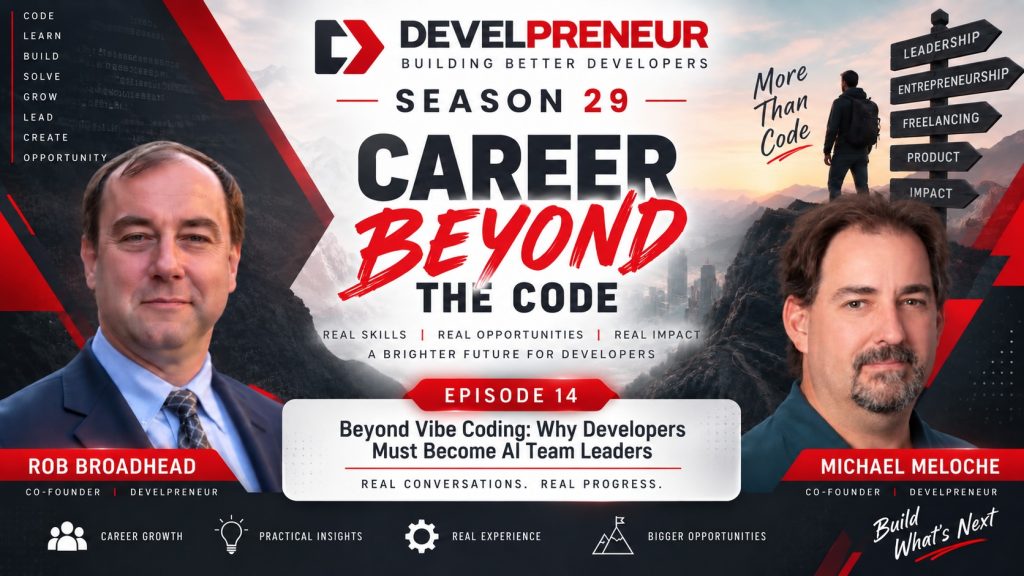
In Season 29, Episode 14 of the Develpreneur Podcast, Rob Broadhead and Michael Meloche continue their conversation about building a career beyond the code. This time, they focus on the evolution of vibe coding, the increasing importance of engineering judgment, and why developers must learn to manage AI agents like members of a development team.
Vibe Coding Is Evolving Into AI-Assisted Engineering
Vibe coding began as a way to describe building applications through natural-language instructions rather than manually writing every line of code. A developer could explain what they wanted, allow an AI tool to generate the implementation, and make adjustments through conversation.
That approach is evolving rapidly.
Developers are beginning to use specialized agents for planning, implementation, testing, documentation, and deployment. Instead of a single assistant generating snippets of code, AI can participate in much larger portions of the development process.
Rob observes that this changes how developers should think about their roles. When several AI agents can work on different assignments, the developer begins functioning more like a development team leader than an individual programmer.
The value moves from typing instructions into a source file to coordinating work, reviewing decisions, and making sure the final solution meets the intended goals.
What Separates a Junior Developer From a Senior Developer?
Traditional career progression has often been tied to experience with programming languages, frameworks, architecture, and increasingly complex technical assignments.
Junior developers learn how to implement features. Mid-level developers begin taking ownership of larger components. Senior developers understand broader systems, evaluate tradeoffs, mentor others, and take responsibility for technical outcomes.
AI complicates that progression.
If a junior developer and a senior developer both have access to tools capable of generating sophisticated code, the difference between them cannot be measured simply by how much code each person produces.
The distinction increasingly becomes the ability to evaluate what AI creates.
Can the developer identify missing requirements? Can they recognize security concerns? Do they understand why one architectural approach is better than another? Can they explain what happens when the application needs to scale? Do they know how to test and verify the result?
These skills have always mattered, but AI makes them even more visible.
Technical Knowledge Is Not the Same as Practical Experience
Michael shares an example from his experience teaching Java boot camps.
Some students could study a certification guide, memorize the material, and pass a technical examination without having much practical experience building software. Others had spent years developing applications and could solve complex problems but struggled with certification tests.
The certification demonstrated knowledge of specific material. It did not necessarily demonstrate the ability to engineer a complete solution.
AI introduces a similar challenge.
Someone who knows how to use AI tools effectively may produce impressive applications without fully understanding the underlying systems. That does not mean their work has no value, but it does mean employers and customers need better ways to evaluate their capabilities.
Developers must demonstrate that they understand what they are building, not simply that they can get AI to build it.
The Software Development Lifecycle Is Becoming More Important
One of the biggest changes AI introduces is a shift in how developers spend their time.
Historically, software implementation consumed a substantial portion of a project’s schedule. Developers spent hours writing classes, creating interfaces, connecting APIs, and implementing business logic.
AI can reduce much of that implementation effort.
However, the remaining stages of the software development lifecycle still matter.
Requirements must be understood. Solutions must be designed. Systems must be tested. Applications must be deployed. Security must be evaluated. Users must confirm that the software actually meets their needs.
Rob emphasizes that developers increasingly need to understand the complete lifecycle, from initial requirements through deployment and ongoing improvement.
Michael points out that this transformation has been developing for years. Organizations have already been moving testing and DevOps responsibilities closer to development teams. AI accelerates the expectation that developers understand more than their individual specialty.
A developer who can connect the entire process becomes increasingly valuable because they can recognize problems that arise between traditionally separate responsibilities.
Quality Assurance Cannot Become an Afterthought
One of the dangers of AI-assisted development is confusing the speed of implementation with the quality of the result.
AI can generate large amounts of code, but that does not guarantee that the code is correct.
It may misunderstand requirements, introduce security weaknesses, create unnecessary dependencies, or produce a solution that technically works but fails to solve the customer’s actual problem.
Michael emphasizes that quality assurance remains essential.
As implementation becomes faster, developers should spend more time verifying what has been produced. Automated tests, integration testing, user acceptance testing, and critical reviews are necessary to ensure that faster development does not produce larger collections of defects.
The opportunity AI creates is not simply to deliver more features. It is to spend more time making sure those features work correctly and provide value.
Learn to Manage AI Like a Development Team
Managing AI agents requires many of the same skills used to lead human developers.
You need to communicate expectations, establish boundaries, review progress, provide feedback, and determine whether the work meets the requirements.
Michael suggests viewing AI agents as team members that need direction and supervision. Even developers who have not held formal leadership positions can begin practicing these skills through AI-assisted development.
For example, you might assign one AI agent to design a feature, another to implement it, and another to review the result. However, someone still needs to determine whether the implementation meets the business need.
That responsibility belongs to the developer.
This process also helps developers develop better technical communication skills. If an AI agent consistently misunderstands an assignment, it may indicate that the requirements were incomplete or unclear.
Learning to provide better direction can improve your interactions with AI and your communication with human coworkers.
Business Value Matters More Than Software Output
Rob returns to a fundamental principle of successful software development: the value of software comes from the problem it solves.
Building another dashboard is not necessarily valuable. Adding another feature does not automatically improve a product. Increasing the number of lines of code does not make an application more useful.
The important question is what changes for the user.
- Does a new feature eliminate unnecessary work?
- Does an automation reduce mistakes?
- Does a dashboard help someone make a better decision?
- Does the application make a business process faster, more reliable, or easier to manage?
These are the outcomes developers should focus on.
Rob uses the simplicity of the original iPod as an example of how removing unnecessary complexity can create a better user experience. More features often introduce more testing requirements, maintenance concerns, and potential points of failure.
The best solution is not always the one that does the most.
Sometimes the most valuable engineering decision is knowing what not to build.
AI Does Not Belong in Every Solution
The increasing accessibility of AI has also created a temptation to use it everywhere.
Michael cautions against online promises that suggest building a collection of AI agents will automatically create passive income or effortless business growth. Those systems require development effort, maintenance, subscriptions, processing costs, and ongoing supervision.
Rob expands on the point by explaining the importance of deterministic software.
Some tasks benefit from AI’s ability to analyze information and handle ambiguity. Others need predictable behavior and repeatable results.
For example, a system gathering specific information from a website may benefit from AI during exploration or when handling unexpected page changes. However, the actual collection of known data fields may be better handled through conventional programming.
Developers should evaluate where AI creates meaningful value and where simpler technology produces a more reliable and economical result.
AI should be a tool selected for a reason, not the automatic answer to every technical problem.
Practice Building and Managing Your Own AI Project
Developers who want to prepare for this changing environment do not need to begin with an enormous project.
Rob suggests choosing a small problem and using AI to develop a complete solution. It could be a personal automation, a simple game, a productivity utility, or an application that addresses a recurring frustration.
The important part is working through the complete process.
Define the requirements. Explain the desired result. Review the proposed architecture. Let AI assist with implementation. Test the output. Identify problems. Correct them. Deploy the application and evaluate whether it accomplishes the original goal.
Pay attention to how often you need to redirect the AI.
Those moments reveal where communication, architecture, and engineering judgment are required.
You are not just practicing prompt writing. You are developing the skills needed to direct technical work.
The Future Developer Is a Solution Provider
The role of a software developer has never been limited to writing code, even if many organizations have measured productivity that way.
AI is making that distinction impossible to ignore.
Developers who focus exclusively on producing code may struggle to differentiate themselves as AI-assisted development becomes more accessible. Those who understand the full software lifecycle, recognize business needs, manage AI agents, and verify results have opportunities to provide much greater value.
The developer of the future needs to be comfortable working across technical disciplines while maintaining the judgment to recognize when specialized expertise is necessary.
Key Takeaways
- AI-assisted development is moving beyond basic vibe coding toward coordinated agent-based workflows.
- Developer seniority increasingly depends on judgment, problem-solving, and responsibility rather than coding speed.
- Understanding the complete software development lifecycle creates stronger career opportunities.
- Faster implementation should create more opportunities for testing, verification, and quality improvement.
- Treat AI agents like junior team members that require clear instructions, boundaries, and review.
- Focus on measurable customer outcomes rather than the number of features or lines of code produced.
- Use AI where it adds meaningful value and conventional software where predictability is more important.
The question is no longer simply whether you can write the code.
It is whether you can define the right problem, guide the development process, evaluate the result, and deliver something that makes a meaningful difference.
That is what it means to become a developer beyond the code.
Stay Connected: Join the Developreneur Community
👉 Subscribe to Building Better Developers for more conversations on momentum, leadership, and growth. Whether you’re a seasoned developer or just starting, there’s always room to learn and grow together. Contact us at [email protected] with your questions, feedback, or suggestions for future episodes. Together, let’s continue exploring the exciting world of software development.
Additional Resources
- AI-Native Development Without the Hype: Kevin Riedl on Building Better Software With AI
- AI-Assisted Rust: Building Reliable Software Through Compilers, Testing, and Modern Tooling
- Simplifying Software Delivery Before AI Amplifies Your Chaos
- Building Better Developers Podcast Videos – With Bonus Content