
Artificial intelligence has changed the way developers write code, search for jobs, and present their professional experience. Resumes can be generated in seconds, proposals can be polished instantly, and technical answers are available with a simple prompt. However, all of this convenience creates a new challenge: How do you distinguish yourself when everyone has access to the same tools?
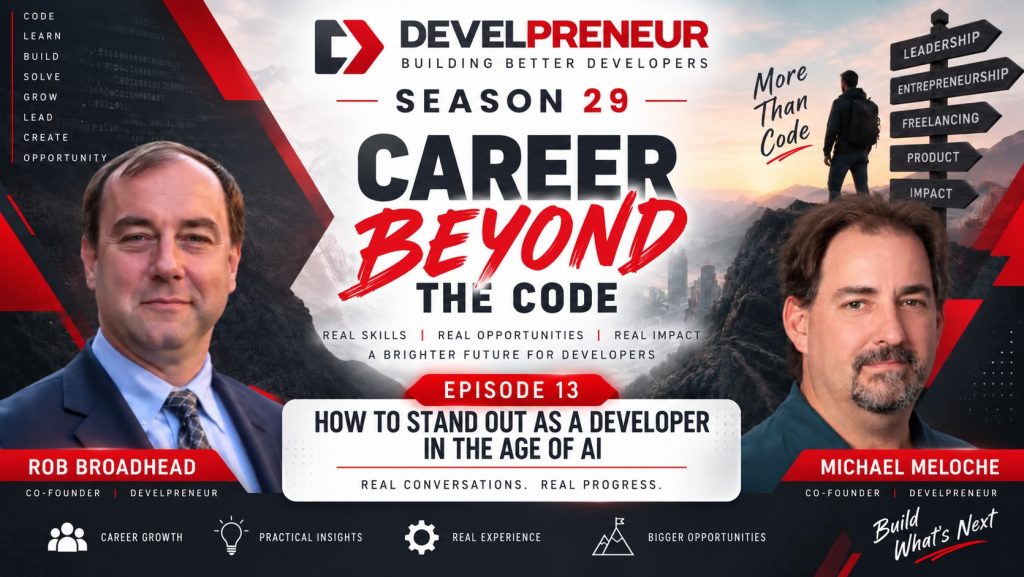
In Season 29, Episode 13 of the Develpreneur Podcast, co-hosts Rob Broadhead and Michael Meloche explore how AI is changing hiring, professional development, and the way developers communicate their value. As part of the season’s theme, Build a Career Beyond the Code, they discuss why technical skills alone are becoming less effective at setting candidates apart and why critical thinking, authentic experience, and demonstrated problem-solving abilities matter more than ever.
The Problem With AI-Generated Resumes and Proposals
AI has made it easier than ever to produce professional-looking resumes and proposals. A candidate can enter a job description into an AI tool and receive a document that addresses nearly every requirement. Similarly, consultants can generate detailed proposals that appear to align perfectly with a customer’s needs.
The problem is that these documents are becoming increasingly similar.
Rob compares this shift to the transition from standard-definition television to high-definition broadcasting. When everything became clearer, details that previously went unnoticed suddenly became obvious. AI is having a similar effect on professional communication. It has exposed how much of the traditional job application process relies on formulas and predictable language.
Recruiters and hiring managers are becoming familiar with AI-generated responses. A polished resume may help someone enter the hiring process, but it does not necessarily demonstrate that the candidate has the experience or judgment required to perform the job.
The real challenge is no longer simply getting someone to see your resume. It is convincing that person to have a meaningful conversation with you.
Your Technology Stack Is Not Your Entire Professional Story
Developers traditionally describe their experience through programming languages, frameworks, databases, and platforms. A resume might highlight Java, Spring Boot, AWS, React, Python, or dozens of other technologies.
While these skills remain relevant, they do not tell the complete story.
Knowing how to write code is only one part of being a successful developer. Employers and customers need people who can recognize problems, evaluate alternatives, make informed decisions, and deliver solutions that create measurable value.
Rob suggests shifting attention away from simply listing technologies and toward explaining the problems you have solved.
Consider the difference between stating that you developed a Java application and explaining that you redesigned a business process, eliminated repetitive manual work, addressed performance problems, or improved the reliability of a critical system.
The technology describes how you accomplished the work. The problem and its outcome explain why the work mattered.
Show Your Work: Critical Thinking Is the Differentiator
Michael draws an interesting comparison between software development interviews and solving math problems.
In school, students are often required to show their work rather than simply provide the final answer. The process demonstrates whether they understand the underlying concepts and can apply them to different situations.
Software development interviews should follow a similar approach.
AI can generate an answer to a coding problem almost instantly. However, that does not mean the person using AI understands the problem, recognizes potential limitations, or knows how to adapt when circumstances change.
A stronger interview focuses on the candidate’s reasoning.
What problem are they trying to solve? What information do they need? How would they approach the design? What happens when their initial solution fails? How would they explain their recommendation to someone without a technical background?
These questions reveal abilities that are difficult to evaluate through memorized answers or automated coding exercises.
Michael also emphasizes the importance of communicating with nontechnical stakeholders. Developers frequently work with business owners, managers, and customers who care more about results than implementation details. Being able to explain complex technical decisions in understandable language is an increasingly valuable skill.
AI Is Changing the Hiring Conversation
Both Rob and Michael discuss how AI is introducing new complexity into the hiring process.
Michael shares experiences with candidates relying heavily on AI during interviews. Instead of responding naturally, some applicants appear to be generating answers in real time. This makes it harder for interviewers to determine whether they are evaluating the candidate’s knowledge or simply the output of an AI tool.
At the same time, interviewers are becoming more sophisticated in how they evaluate applicants.
Rather than relying exclusively on technical questions, employers can ask candidates to explain previous projects, describe unexpected problems, and discuss how they adjusted their approach.
Those experiences provide a more authentic view of someone’s capabilities.
A developer who can explain a difficult production issue, describe why a design decision failed, and show how the team recovered demonstrates practical experience that goes beyond a collection of keywords.
Do Not Confuse AI Assistance With AI Dependence
AI can be an excellent tool for preparing resumes, practicing interviews, researching companies, and organizing professional experience. It can help developers identify gaps in their explanations and discover better ways to communicate their accomplishments.
However, the value comes from using AI to strengthen your own knowledge rather than replace it.
Rob points out that AI-generated suggestions must be evaluated carefully. A response may sound complete while including unsupported assumptions, unnecessary details, or information that does not accurately represent your experience.
Michael adds that newer AI tools and models are not always automatically better for every workflow. Developers need to evaluate the reliability of the tools they use rather than constantly adopting the newest model simply because it is available.
The key is maintaining control over the process.
Use AI to prepare, refine, and challenge your thinking, but make sure the final result accurately represents what you know and what you have accomplished.
Just Because AI Can Do Something Does Not Mean It Should
Rob closes the discussion with an example from his own AI-assisted development work.
While working on a project, an AI assistant began identifying additional improvements in related environments. Some recommendations involved security, infrastructure, and other technical areas. Although the suggestions might have been useful in another context, they were outside the project’s intended scope.
Rob had to explicitly instruct the AI not to make those changes.
This illustrates one of the most important responsibilities developers have when working with AI: determining which recommendations actually matter.
Without clear boundaries, AI can turn a relatively focused task into a much larger project. Developers must recognize when additional complexity creates value and when it creates unnecessary work or risk.
The ability to make those decisions requires experience, judgment, and a clear understanding of the intended outcome.
Building a Career Beyond the Code
The software industry is entering a period where simply producing code is becoming less distinctive. AI can assist with implementation, generate documentation, and automate repetitive tasks, but it still requires thoughtful direction and meaningful evaluation.
Developers who want to remain competitive need to strengthen the abilities that connect technical work to real-world results.
That means learning how to communicate, solve problems, evaluate tradeoffs, demonstrate experience, and explain the value of the work they perform.
The strongest professional story is not a list of technologies. It is a collection of problems solved, challenges overcome, lessons learned, and outcomes achieved.
Key Takeaways
- Use AI to improve your resume and interview preparation without allowing it to misrepresent your experience.
- Focus on the problems you have solved rather than relying exclusively on technical keywords.
- Be prepared to explain your reasoning, decisions, challenges, and lessons learned.
- Practice communicating technical solutions to nontechnical audiences.
- Evaluate AI recommendations instead of accepting them automatically.
- Document your accomplishments so you can provide real evidence of your professional value.
As AI continues to reshape software development, the ability to demonstrate genuine experience and sound judgment will help developers distinguish themselves from increasingly automated competition.
Your value is not simply that you know how to write code. It is that you know how to use technology to solve meaningful problems.
That is how you build a career beyond the code.
Stay Connected: Join the Developreneur Community
👉 Subscribe to Building Better Developers for more conversations on momentum, leadership, and growth. Whether you’re a seasoned developer or just starting, there’s always room to learn and grow together. Contact us at [email protected] with your questions, feedback, or suggestions for future episodes. Together, let’s continue exploring the exciting world of software development.