
Building a successful business requires more than developing a great product. As companies grow, they face new challenges involving customer expectations, operational efficiency, financial decisions, and the constant pressure to innovate. Artificial intelligence has made it easier to build software and experiment with ideas, but knowing which opportunities are worth pursuing remains an important skill.
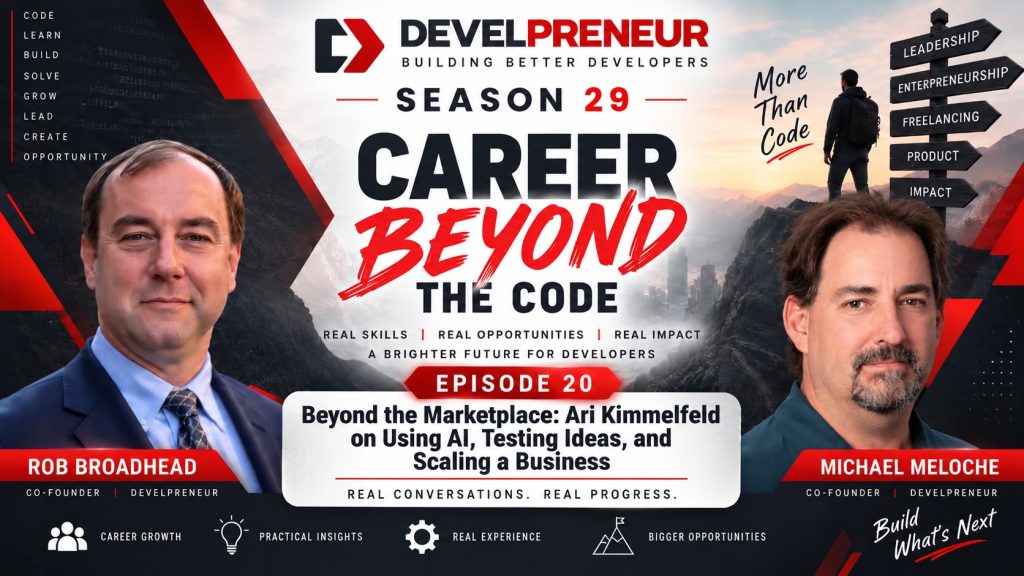
In this episode of Building Better Developers, hosts Rob Broadhead and Michael Meloche continue their conversation with Ari Kimmelfeld, founder of Commonplace, a nationwide marketplace specializing in large secondhand items. After exploring how Commonplace grew from a simple Peloton resale website into a full-service marketplace, the discussion turns toward AI, experimentation, financing, customer acquisition, and the challenges of scaling a technology-driven business.
Ari shares how his team uses AI to accelerate development, why some promising business ideas fail, and how Commonplace continues to find opportunities in markets where traditional online platforms leave customers with complicated problems to solve.
About Ari Kimmelfeld
Ari Kimmelfeld is the founder and CEO of Commonplace, a U.S.-based marketplace that makes buying and selling large secondhand items easier by coordinating inspections, payments, pickup, delivery, and installation.
The business evolved from TradeMySpin, an online service originally focused on used Peloton equipment. Ari and his wife, Naomi, expanded the concept into Commonplace to address the difficulties associated with purchasing and transporting expensive secondhand products.
Ari is a graduate of Macaulay Honors College at the City University of New York. His entrepreneurial approach combines customer-focused experimentation, logistics innovation, and practical software development to simplify transactions that traditional online marketplaces often leave customers to manage themselves.
Connect with Ari and Commonplace:
- Website: https://trycommonplace.com
- LinkedIn: https://www.linkedin.com/in/arikimmelfeld
Using AI to Build Faster Without Losing Control
Artificial intelligence is changing how developers build applications and how businesses approach software development. Tasks that once required significant time and resources can now be completed much faster, allowing smaller teams to experiment with capabilities that previously seemed unrealistic.
For Commonplace, AI has become an important part of maintaining and expanding the systems supporting its operations. Ari explains that the company develops much of its application functionality internally, including dispatch management, customer workflows, payment integrations, and logistics coordination.
Rather than depending entirely on third-party marketplace platforms, Commonplace builds the specialized functionality necessary to support its business model. However, this does not mean reinventing every technology component. The company uses established services such as Stripe for payment processing while developing its own integrations and workflows around those services.
This distinction is important for developers and entrepreneurs. Building custom software does not require creating every component from scratch. The goal is to maintain control over the processes that distinguish your business while using reliable existing technology where it makes sense.
AI helps Commonplace move faster, but the real advantage comes from understanding what needs to be built and how it fits into the larger operation.
Turning an Idea Into a Working Solution
One example Ari shares involves a program to help people donate unused fitness equipment to New York City fire stations.
According to Ari, Commonplace worked with the New York City Fire Department to create a way for individuals to donate exercise equipment rather than sell it. Because the company already had systems for listings, pickup, and delivery, its team could adapt those capabilities to support donations.
Ari explains that the new functionality was implemented in approximately 24 hours. He estimates that a comparable effort might previously have required several developers working for weeks.
While those estimates reflect Ari’s experience rather than a universal development benchmark, they illustrate how AI can change the economics of building software.
For developers, the opportunity is not simply generating code faster. It is being able to test worthwhile ideas that might previously have been postponed because of cost or limited development resources.
However, faster development also introduces another challenge: deciding which ideas deserve attention.
Experimentation: Why Not Every Good Idea Works
One of the most valuable lessons from Ari’s experience is that even promising business ideas do not always succeed.
During the interview, Michael asks about changes Commonplace has tested and ultimately abandoned. Ari explains that the company regularly experiments with new concepts, but only a small percentage become meaningful successes.
One example involved offering customers the ability to rent products such as ATVs on a daily, weekly, or monthly basis. On the surface, this seemed like a reasonable opportunity. Customers might want access to expensive equipment without committing to ownership.
However, the results revealed something different. Because the secondhand products were already available at significant discounts, customers often preferred purchasing them instead of renting them.
Rather than abandoning the broader concept of making products more affordable, Commonplace explored financing. Ari explains that offering financing options extending up to 48 months generated considerably stronger customer demand.
What initially looked like an unsuccessful rental experiment helped the business discover a more valuable purchasing option.
This is a useful reminder that experimentation should not be measured solely by whether the original idea succeeds. An unsuccessful test can still provide valuable information when it helps identify what customers actually want.
AI Creates More Opportunities, but Focus Still Matters
Developers have always struggled with deciding what to build next. There are usually more ideas than available resources, and priorities must be established around business value, customer needs, and technical complexity.
AI changes the equation by making it possible to implement more ideas with fewer resources. However, increased development capacity does not automatically create better products.
Ari discusses how quickly his team can now experiment with new functionality, but he also acknowledges that many ideas never produce meaningful results. Even when technology makes development easier, companies must still determine which changes are worth maintaining and supporting.
This connects directly to the broader theme of Season 29, Career Beyond the Code. Developers who want to advance their careers need to understand how technology decisions affect the business.
Writing code efficiently is valuable, but recognizing when something should not be built can be just as important.
Before committing to a feature, consider whether it solves a demonstrated customer problem, whether the expected benefit justifies the effort, and whether it supports the company’s larger objectives.
Scaling a Marketplace Through Real Customer Demand
As Commonplace grows, Ari sees opportunities in additional product categories, particularly those involving expensive, bulky items that are difficult to purchase through traditional peer-to-peer marketplaces.
However, expanding a marketplace introduces challenges beyond increasing the number of listings. Each category may require different inspection procedures, delivery equipment, installation capabilities, and customer expectations.
The business must also attract buyers and sellers who may approach secondhand shopping differently.
Ari explains that Commonplace initially reached customers through Facebook groups focused on Pelotons, Tonals, and other exercise equipment. Rather than attempting to convince everyone to change their shopping habits, the company focused on people who were already buying and selling those products.
That strategy continues as Commonplace promotes listings across other marketplaces where potential customers are already searching.
The company also faced a branding challenge when it expanded beyond fitness equipment. The original TradeMySpin name clearly communicated its initial purpose, but it became limiting as the business introduced appliances, furniture, saunas, and other categories.
Rebranding as Commonplace allowed the business to represent a broader market, but it also required explaining its value to new customer groups.
For entrepreneurs, this demonstrates why growth requires balancing specialization with flexibility. A narrow focus can help establish a business, but eventually, the company must decide how to expand without losing the value that made it successful.
Using Data to Improve Marketplace Pricing
Another important challenge in secondhand marketplaces is helping sellers understand what their products are worth.
Individual sellers often base asking prices on what they originally paid rather than what buyers are willing to spend. This can create unrealistic expectations and prevent transactions.
Commonplace addresses the problem with a pricing system that considers factors such as product brand, model, age, condition, and geographic location.
When sellers create listings, the platform can provide suggested prices based on market data. Sellers are not required to accept those recommendations, but the information helps them make more informed decisions.
Ari explains that prices can vary considerably between locations, reflecting differences in regional supply and demand.
For developers, this illustrates how data becomes more valuable when integrated into a practical business process. Collecting information is only the beginning. The real benefit comes from presenting it at the moment customers need to make a decision.
Building Better Developers: Technology Should Support the Business
Ari’s journey with Commonplace demonstrates how technology, experimentation, and business strategy must work together.
The company began by solving a narrowly defined problem and expanded through customer feedback, operational experience, and repeated testing. AI now helps its team build and maintain more sophisticated systems, but the underlying strategy remains focused on removing friction from secondhand transactions.
For developers, the lesson is that faster coding does not eliminate the need for thoughtful decisions. Every new feature introduces responsibilities involving maintenance, reliability, customer experience, and long-term business value.
As AI continues to lower the barriers to software development, the ability to understand customer needs, evaluate opportunities, and solve meaningful problems will become increasingly important.
The developers who stand out will not necessarily be those who generate the most code. They will be the ones who recognize which problems matter and deliver solutions that make a measurable difference.
That is what it means to build a career beyond the code.
Stay Connected: Join the Developreneur Community
👉 Subscribe to Building Better Developers for more conversations on momentum, leadership, and growth. Whether you’re a seasoned developer or just starting, there’s always room to learn and grow together. Contact us at [email protected] with your questions, feedback, or suggestions for future episodes. Together, let’s continue exploring the exciting world of software development.
Additional Resources
- Leveraging AI for Business: How Automation and AI Boost Efficiency and Growth
- Build a Business Beyond the Code: Glenn Poulos on Buying, Building, and Using AI
- AI Security for Developers: Protecting Your Code, Data, and Intellectual Property
- Building Better Developers Podcast Videos – With Bonus Content