

Artificial intelligence is changing how developers build software, but it is also changing how we think about security. AI can generate applications, analyze complex systems, and identify vulnerabilities much faster than traditional development processes. While these advancements provide tremendous opportunities, they also introduce new risks for developers, businesses, and anyone responsible for protecting sensitive information.
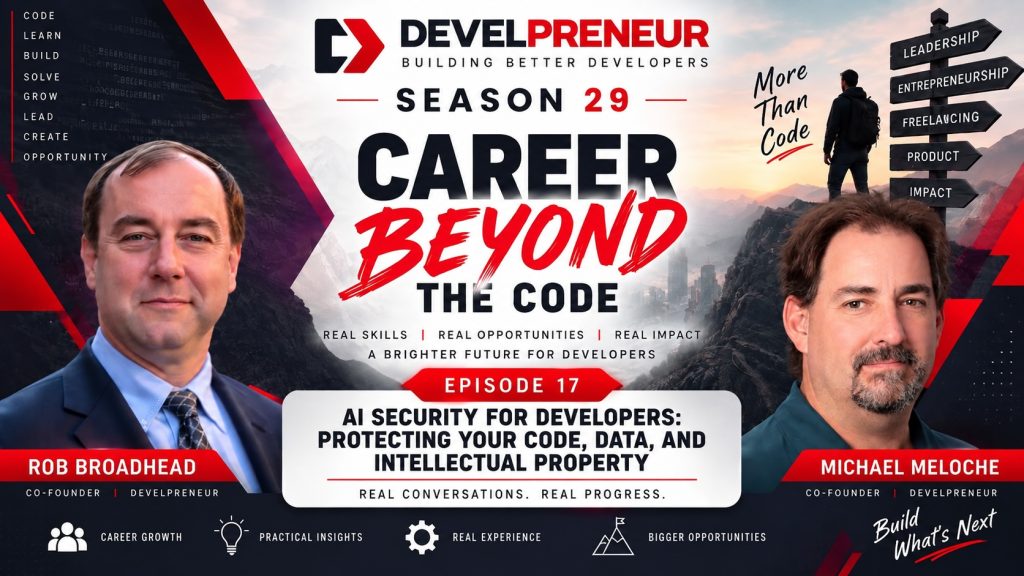
In this episode of Building Better Developers, co-hosts Michael Meloche and Rob Broadhead explore AI security for developers and the challenges of protecting code, data, and intellectual property in an increasingly connected world. As part of Season 29, Building a Career Beyond the Code, their discussion examines why developers must expand their skills beyond writing code and begin taking greater responsibility for the systems they create.
Why AI Changes Software Security
For years, developers relied partly on the complexity of software systems to discourage unauthorized access. Although security by obscurity was never a reliable security strategy, understanding or exploiting certain vulnerabilities often required significant time and technical knowledge. AI is changing that equation by making it easier to analyze code, automate tests, and explore potential weaknesses.
Rob explains that developers can no longer assume a system is secure simply because finding its vulnerabilities would take too much effort. AI-assisted tools allow someone to investigate far more possibilities than traditional manual testing, increasing the importance of deliberate security practices.
However, these capabilities are not limited to attackers. Developers can use AI to improve their own testing processes, examine unusual scenarios, and identify potential weaknesses before software reaches production. The same technology that creates new security concerns can become an important part of the solution.
Protecting Intellectual Property in the AI Era
Michael raises another significant concern: protecting proprietary software and business information when developers increasingly rely on external AI services. Many organizations have invested years in developing specialized applications, internal processes, and unique business logic that provide competitive advantages.
While common software components and established programming patterns are widely available, certain implementations and combinations of business rules may represent valuable intellectual property. Sharing that information with an external AI service requires careful consideration of the provider’s data-handling policies and the permissions granted to the tool.
The concern extends beyond source code. Technical documentation, customer records, internal processes, and business strategies may contain information that organizations cannot afford to expose. Developers must understand what information they are sharing and why an AI system needs access to it.
AI Security Starts With Data Protection
One of the central lessons from the conversation is that protecting information begins with limiting unnecessary access. Rob compares this approach to established security practices in regulated industries, where sensitive information must be handled according to specific requirements.
Developers should apply those same principles when working with AI. An application may need access to a database credential to perform a task, but the AI model helping build that application generally does not need to see the credential itself. Likewise, customer information can often be replaced with representative test data when debugging software.
Practical safeguards include:
- Keep passwords, API keys, and other secrets out of AI prompts.
- Limit AI access to the specific files and information required.
- Separate sensitive business data from application code.
- Review AI providers’ privacy, retention, and training policies.
- Use appropriate access controls for repositories and internal systems.
- Test applications for vulnerabilities before deploying them.
These practices reduce unnecessary exposure while allowing development teams to benefit from AI-assisted tools.
Local AI Versus Cloud-Based AI
Michael and Rob also discuss whether running AI locally provides additional protection. Local AI systems can offer greater control over where information is stored and processed, making them attractive for businesses handling proprietary or sensitive material.
However, building a private AI environment introduces additional considerations, including hardware expenses, maintenance, access controls, and network security. A locally hosted model is not automatically secure simply because it operates on internal hardware.
For many developers, a hybrid approach may offer a practical balance. Sensitive information can remain in controlled environments while less sensitive tasks use external AI services. The important decision is not whether every organization needs private AI, but whether developers understand the risks associated with each approach.
Use AI to Strengthen Your Security Practices
Rather than viewing AI exclusively as a potential threat, developers should consider how it can improve software quality and security. AI can assist with generating unit tests, reviewing code, examining authentication logic, and identifying scenarios that might otherwise be overlooked.
For example, instead of asking whether an application works under normal conditions, developers can ask AI to identify unusual inputs, possible permission failures, and unexpected interactions between components. These questions encourage a more comprehensive approach to development and testing.
AI-generated findings still require verification, but they can help developers investigate problems more efficiently and focus attention on areas that deserve closer examination.
Building a Career Beyond the Code
The changing security landscape reinforces the broader message of Season 29. Developers increasingly need the ability to evaluate systems, understand business requirements, recognize risks, and make informed technical decisions.
AI can accelerate programming, but it cannot remove the developer’s responsibility for the resulting product. Understanding what information should remain private, how components interact, and where vulnerabilities may exist becomes essential as software development grows more automated.
The future of development is not simply about generating applications faster. It is about building software responsibly, protecting the information that matters, and using AI as a tool to strengthen the entire development process.
Stay Connected: Join the Developreneur Community
👉 Subscribe to Building Better Developers for more conversations on momentum, leadership, and growth. Whether you’re a seasoned developer or just starting, there’s always room to learn and grow together. Contact us at [email protected] with your questions, feedback, or suggestions for future episodes. Together, let’s continue exploring the exciting world of software development.