
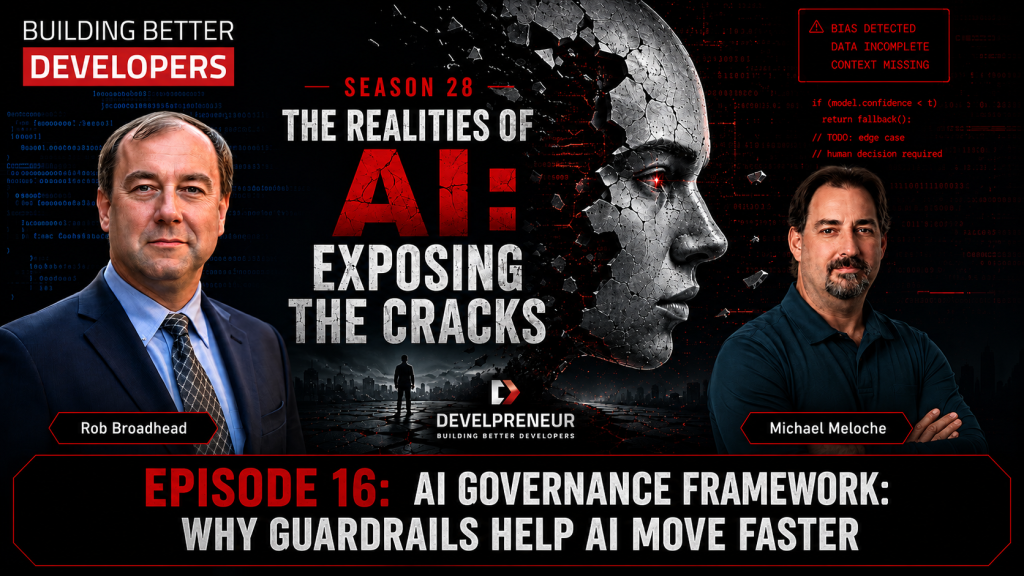

Artificial intelligence is advancing at an incredible pace, but without an AI Governance Framework, organizations risk creating systems that are difficult to trust, maintain, or scale. Many people assume that governance slows innovation, but in reality, the opposite is often true. The right guardrails allow teams to move faster by reducing uncertainty and preventing costly mistakes before they happen.
In Part 1 of our conversation with Dr. Latha Karthigaa, Co-Founder of the Global AI Certification Council (GAICC), we explored why AI governance is becoming a business necessity and why developers should view it as an enabler rather than a barrier.
About Latha Karthigaa
Dr. Latha Karthigaa is the Director & Head of AI Governance of the Global AI Certification Council (GAICC), where she helps organizations implement responsible AI through governance frameworks, certifications, and AI management systems. With a PhD in Software Engineering and experience in education, digital marketing, and AI strategy, she focuses on helping professionals and enterprises adopt AI responsibly.
Learn more:
- GAICC: https://gaicc.org
- LinkedIn: https://www.linkedin.com/in/lathakarthigaa/
AI Governance Framework Is Like Guardrails on a Highway
One of the best analogies from the discussion compared AI governance to the guardrails along a highway.
Drivers can safely travel at higher speeds because guardrails help keep them on course. Remove those barriers, and everyone naturally slows down because the consequences of a mistake become much greater.
AI works the same way.
Governance isn’t about preventing innovation. It’s about creating confidence that allows organizations to innovate responsibly. When developers know the boundaries, they spend less time reacting to unexpected issues such as biased outputs, hallucinations, data misuse, or compliance failures.
💡 Insight: Good governance doesn’t replace innovation—it gives innovation a safer road to travel.
Governance Builds on Existing Standards
One misconception is that AI governance replaces existing compliance programs.
In reality, organizations are extending what they already have.
Industries that already follow standards like ISO 27001, HIPAA, or SOC 2 are integrating AI governance into those existing management systems rather than creating an entirely separate process. AI introduces new risks, but those risks still involve familiar concerns such as privacy, security, documentation, and accountability.
For developers, this means AI shouldn’t become another isolated project. It should become another capability managed alongside security, quality assurance, and software development practices.
AI Governance Is Becoming a Competitive Advantage
Organizations are quickly discovering that AI governance is no longer optional.
Demand for AI governance professionals continues to grow while qualified talent remains limited. Companies are beginning to request governance expertise from employees and vendors alike, particularly in highly regulated industries such as banking and financial services.
Rather than waiting for regulations to force change, forward-thinking organizations are investing early.
This mirrors previous technology shifts. Companies that adopted cybersecurity practices before regulations became widespread were better prepared when compliance eventually became mandatory.
⚠️ Warning: Waiting until governance becomes a legal requirement often means playing catch-up while competitors already have mature processes.
Developers Play a Bigger Role Than They Think
Although governance is often discussed at the executive level, developers remain one of the most important pieces of the puzzle.
Every prompt, workflow, API integration, or autonomous agent introduces decisions that affect security, privacy, and reliability. Governance doesn’t remove responsibility from developers—it clarifies it.
As AI becomes embedded into products and business operations, development teams will increasingly work alongside governance professionals, risk managers, and business leaders to ensure AI systems behave as intended throughout their lifecycle.
The organizations that succeed won’t simply build smarter AI. They’ll build AI that customers, partners, and regulators can trust.
✅ Action: Start documenting AI projects today. Knowing where AI is used, who owns it, and what risks exist creates a strong foundation for future governance.
Building Trust Before Problems Appear
Many companies still see governance as something to worry about later.
History suggests that’s a mistake.
Security, privacy, and compliance have all followed similar paths. Organizations that established good practices early avoided many of the expensive lessons learned by everyone else.
AI governance follows the same pattern.
Creating policies, assigning ownership, documenting AI systems, and understanding risk are investments that become increasingly valuable as AI adoption grows.
The sooner those habits become part of everyday development, the easier it becomes to innovate confidently.
Conclusion
AI’s rapid evolution makes governance more important—not less.
Rather than limiting innovation, an AI Governance Framework gives organizations the confidence to build, deploy, and scale AI responsibly. Developers who embrace governance today won’t just reduce risk—they’ll help create AI systems that customers trust and that businesses can confidently expand.
As AI continues to reshape software development, governance will become one of the defining skills separating successful organizations from those constantly reacting to preventable problems.
Stay Connected: Join the Developreneur Community
👉 Subscribe to Building Better Developers for more conversations on momentum, leadership, and growth. Whether you’re a seasoned developer or just starting, there’s always room to learn and grow together. Contact us at [email protected] with your questions, feedback, or suggestions for future episodes. Together, let’s continue exploring the exciting world of software development.
[…] AI Governance Framework: Why Guardrails Help AI Move Faster […]