
Artificial intelligence is changing how businesses operate at an incredible pace. Teams are writing code with AI, generating reports, automating customer service, and even making strategic decisions with machine assistance. Yet many organizations are trying to adopt AI before they have an AI Governance Framework in place.
That approach creates unnecessary risk.
Governance isn’t about slowing innovation. It’s about creating the guardrails that allow innovation to happen safely, consistently, and at scale. Without those guardrails, every new AI implementation introduces uncertainty, inconsistent results, and potential security concerns.
If your organization wants to successfully adopt AI, governance shouldn’t be an afterthought—it should become part of the foundation.
Why an AI Governance Framework Matters
The word “governance” often sounds like bureaucracy.
People imagine paperwork, approval meetings, and unnecessary processes that delay projects.
In reality, governance serves a much different purpose.
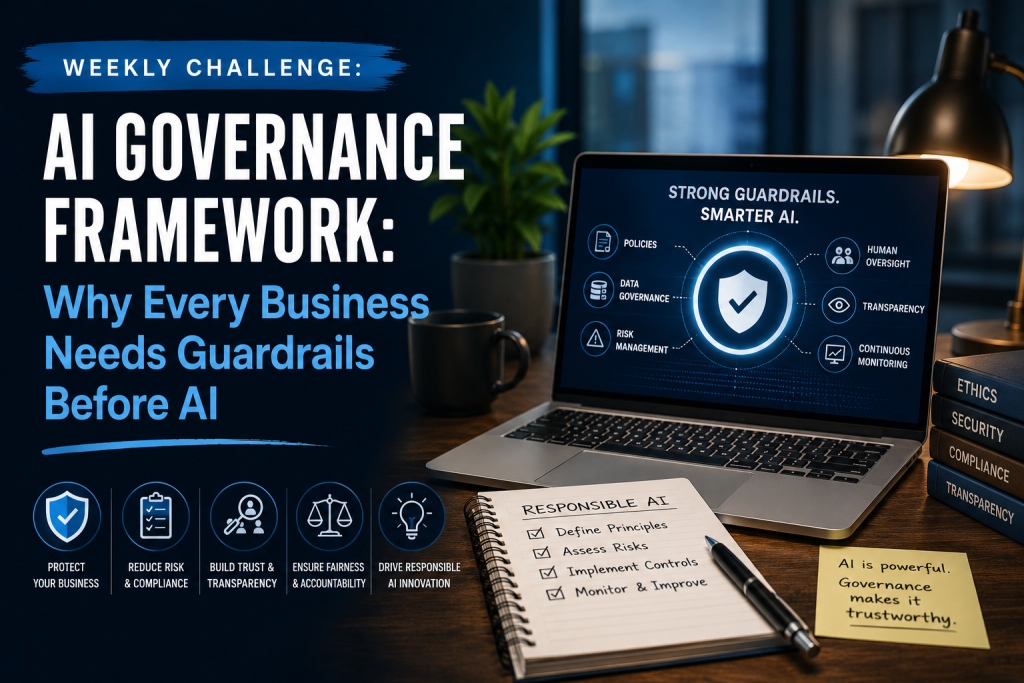
Good governance answers simple but critical questions:
- What are we trying to accomplish?
- What information can AI access?
- Who is responsible for reviewing AI-generated work?
- What risks exist before deployment?
- How do we know the results are accurate?
Without answers to those questions, AI becomes unpredictable.
Organizations frequently hesitate to adopt AI because they don’t trust it. More often than not, the issue isn’t the technology—it’s the lack of clearly defined business processes supporting it. The discussion emphasized that governance provides the guardrails organizations need to adopt AI with greater confidence.
Insight: Governance doesn’t limit innovation—it creates the confidence to innovate faster.
AI Doesn’t Expose New Problems—It Reveals Existing Ones
One of the most interesting ideas from the discussion is that AI often exposes problems that already existed inside an organization.
Businesses frequently have undocumented workflows.
Employees know how things actually get done, but those steps rarely exist in documentation.
Experienced team members fill in gaps through institutional knowledge.
AI can’t do that.
It follows instructions exactly as provided.
When those instructions are incomplete, AI doesn’t necessarily fail because it’s broken. Instead, it reveals inconsistencies, undocumented decisions, and missing processes that humans have quietly worked around for years.
Rather than viewing these situations as AI failures, organizations should see them as opportunities to improve operational maturity.
Build Guardrails Before Scaling AI
Every organization has external regulations.
Healthcare organizations follow HIPAA.
Financial institutions follow compliance requirements.
Public companies operate under strict reporting rules.
Those regulations provide high-level boundaries.
Internal governance is different.
It defines how your company specifically wants AI to operate.
That may include:
- Approved AI tools
- Data privacy rules
- Prompt standards
- Security reviews
- Code validation procedures
- Human approval checkpoints
- Documentation requirements
Without these internal standards, every employee develops their own process.
That inconsistency increases operational risk while making AI adoption far more difficult to scale.
Warning: If every employee uses AI differently, your organization has dozens of AI policies—even if none of them are written down.
Developers Are Becoming AI Supervisors
Software development is evolving.
Developers still write code, but increasingly they’re responsible for reviewing, validating, and improving code generated by AI.
That changes the required skill set.
Instead of simply asking:
“Can AI generate this function?”
Developers should ask:
- Is this secure?
- Does it follow our standards?
- Does it expose sensitive information?
- Does it introduce technical debt?
- What assumptions did AI make?
Senior developers become mentors—not only for junior engineers but also for AI systems.
Just as a junior developer requires review before code reaches production, AI-generated code deserves the same level of scrutiny.
The technology may accelerate development, but responsibility still belongs to the people deploying it.
Perspective: AI is becoming another member of the development team—but it still needs supervision.
The Best AI Strategy Starts with Better Questions
One practical exercise discussed during the Weekly Challenge encourages teams to rethink how they communicate with AI.
Instead of simply asking AI to complete a task, begin by documenting:
- The objective
- Business constraints
- Security requirements
- Expected outcomes
- Possible risks
Then ask AI:
“What am I missing?”
Even more importantly, ask:
“What risks have I overlooked?”
Those questions encourage deeper thinking while improving prompt quality.
Better prompts don’t simply generate better code.
They improve business decisions.
They force teams to clarify expectations before implementation begins.
That’s governance in action.
Action: Before using AI for an important task this week, write down your requirements first. Then ask AI to identify missing risks before generating a solution.
Governance Accelerates Innovation
Many organizations believe governance creates delays.
In practice, it often produces the opposite result.
When expectations are clearly documented, teams spend less time debating decisions.
Developers understand coding standards.
Project managers understand approval processes.
AI receives clearer instructions.
Leaders gain greater confidence in the results.
Instead of repeatedly solving the same problems, organizations establish repeatable systems that produce consistent outcomes.
Governance removes uncertainty.
That allows innovation to move faster—not slower.
Conclusion
An AI Governance Framework isn’t about controlling technology.
It’s about creating clarity.
As AI becomes part of everyday business operations, organizations that define their processes, document expectations, and establish meaningful guardrails will adopt AI faster while reducing operational risk.
The businesses that succeed won’t simply have the best AI tools.
They’ll have the best systems supporting those tools.
Build the framework first.
Innovation will follow.
Stay Connected: Join the Developreneur Community
👉 Subscribe to Building Better Developers for more conversations on momentum, leadership, and growth. Whether you’re a seasoned developer or just starting, there’s always room to learn and grow together. Contact us at [email protected] with your questions, feedback, or suggestions for future episodes. Together, let’s continue exploring the exciting world of software development.