

An effective AI Business Operating System is not about replacing people with automation. It is about creating a scalable structure that allows developers and business owners to execute consistently, think strategically, and adapt quickly as technology evolves.
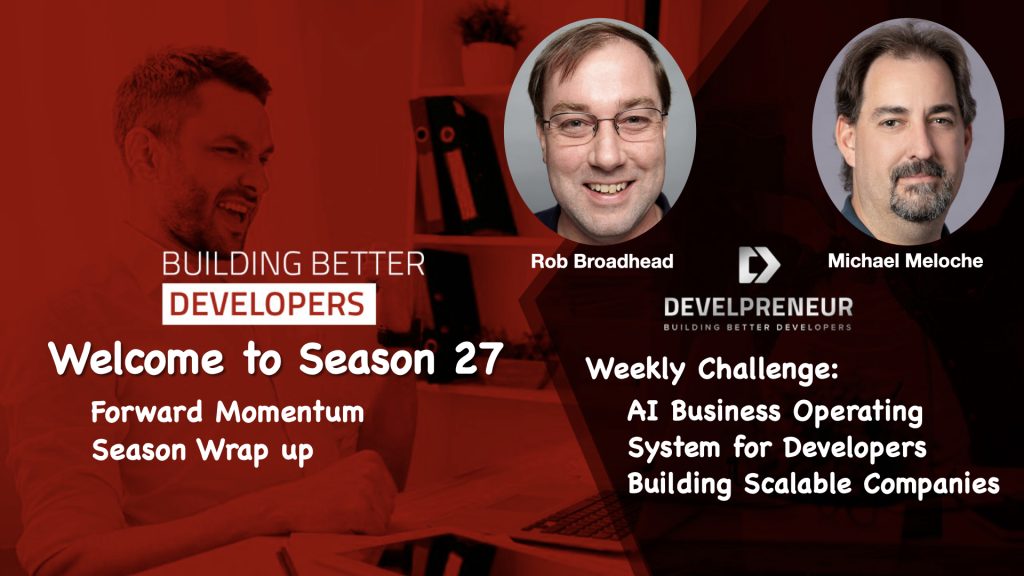
The weekly bonus episode between Seasons 27 and 28 pulled back the curtain on how Rob Broadhead and Michael Meloche are personally using AI to redesign the way they work, build businesses, and create operational leverage.
What made the discussion compelling was that it avoided the typical AI hype cycle. Instead of focusing on flashy demos, the conversation centered on systems, execution, resilience, and operational maturity.
This is where the real value of AI is emerging.
Why an AI Business Operating System Starts with Constraints
One of the most practical parts of the conversation was the acknowledgment that both hosts entered the season from difficult positions.
Michael discussed dealing with stress, toxic work environments, and feeling stuck professionally. Rob discussed balancing business growth, travel, and operational demands while trying to scale his consulting business.
These are not edge cases.
This is reality for many developers and founders.
The important insight is that constraints forced both of them to rethink how they worked.
AI became useful not because it was trendy, but because it reduced operational friction.
That distinction matters.
An AI Business Operating System should solve bottlenecks:
- repetitive work
- fragmented workflows
- disconnected information
- slow execution cycles
- inconsistent processes
The goal is not automation for its own sake.
The goal is operational clarity.
The best AI systems are not built around prompts. They are built around persistent operational problems.
AI Business Operating System Design Requires Process Thinking
A major theme throughout the episode was that AI only becomes powerful when connected to repeatable systems.
Rob described how his “CHIP” framework evolved from scattered scripts and pipelines into a structured operational platform.
That evolution mirrors how successful businesses scale.
The first phase is usually experimentation:
- testing tools
- generating content
- automating tasks
- exploring workflows
But experimentation alone does not create leverage.
Real scalability happens when teams:
- standardize processes
- define workflows
- centralize knowledge
- build reusable frameworks
- establish governance
This is why many businesses struggle with AI adoption. They focus entirely on tooling while ignoring operational design.
AI magnifies the quality of the underlying system.
Bad processes become faster bad processes.
Strong systems become scalable operational engines.
AI Business Operating System Thinking Changes Developer Roles
The episode also highlighted a significant shift happening inside software development.
Developers are no longer limited to implementation work. AI increasingly handles portions of:
- code generation
- testing
- scaffolding
- documentation
- automation
That means developers are moving higher into:
- architecture
- systems thinking
- orchestration
- strategic execution
Rob described how much of his current focus involves designing frameworks, workflows, governance layers, and scalable operational models rather than simply writing code.
This is a major industry transition.
Developers who understand systems will become significantly more valuable than developers focused only on isolated technical execution.
The modern competitive advantage comes from:
- connecting systems
- organizing knowledge
- improving operational efficiency
- reducing friction across workflows
Start documenting recurring workflows today. The workflows you document now become the automation opportunities you scale later.
Distributed Work Demands an AI Business Operating System
Another powerful section of the episode focused on decentralized work environments.
Michael discussed the importance of creating a work setup that remains functional regardless of location, disasters, or disruptions.
That conversation reflects a larger industry reality:
modern businesses must operate across:
- remote environments
- unstable connectivity
- distributed teams
- asynchronous communication
- shifting schedules
AI systems increasingly act as operational continuity layers.
Knowledge systems, searchable conversations, automated summaries, and centralized workflows make businesses less dependent on physical presence or individual memory.
This changes resilience entirely.
Organizations become more adaptive because information becomes:
- easier to access
- easier to organize
- easier to operationalize
The future operating system of business is likely not a single software product. It is an interconnected knowledge and execution layer powered by AI-assisted workflows.
AI Business Operating System Execution Still Requires Human Judgment
One of the most important lessons from the episode is that AI does not eliminate human responsibility.
In fact, the more automation expands, the more important human judgment becomes.
Rob repeatedly emphasized:
- intentional thinking
- process clarity
- governance
- scalable design
- strategic planning
Those are deeply human responsibilities.
AI accelerates execution.
Humans still define direction.
This is why businesses that blindly automate workflows often create instability instead of scale.
Without leadership:
- automation spreads errors faster
- unclear processes compound confusion
- weak communication creates operational drift
The organizations that benefit most from AI will likely be the ones that combine:
- technical capability
- operational maturity
- leadership discipline
- systems thinking
AI is becoming infrastructure. Strategic thinking remains the differentiator.
Conclusion
The weekly bonus episode revealed something important about the future of development and business operations.
AI is no longer just a productivity tool.
It is becoming an operational framework.
But successful AI adoption is not about replacing humans or chasing automation trends. It is about building systems that:
- reduce friction
- improve execution
- preserve knowledge
- scale operational consistency
The businesses that thrive over the next decade will likely be the ones that treat AI as part of a larger operating system rather than a standalone tool.
For developers, founders, and technical leaders, that means learning to think beyond implementation and toward architecture, workflows, systems, and strategic execution.
That shift is already happening.
Stay Connected: Join the Developreneur Community
👉 Subscribe to Building Better Developers for more conversations on momentum, leadership, and growth. Whether you’re a seasoned developer or just starting, there’s always room to learn and grow together. Contact us at [email protected] with your questions, feedback, or suggestions for future episodes. Together, let’s continue exploring the exciting world of software development.