
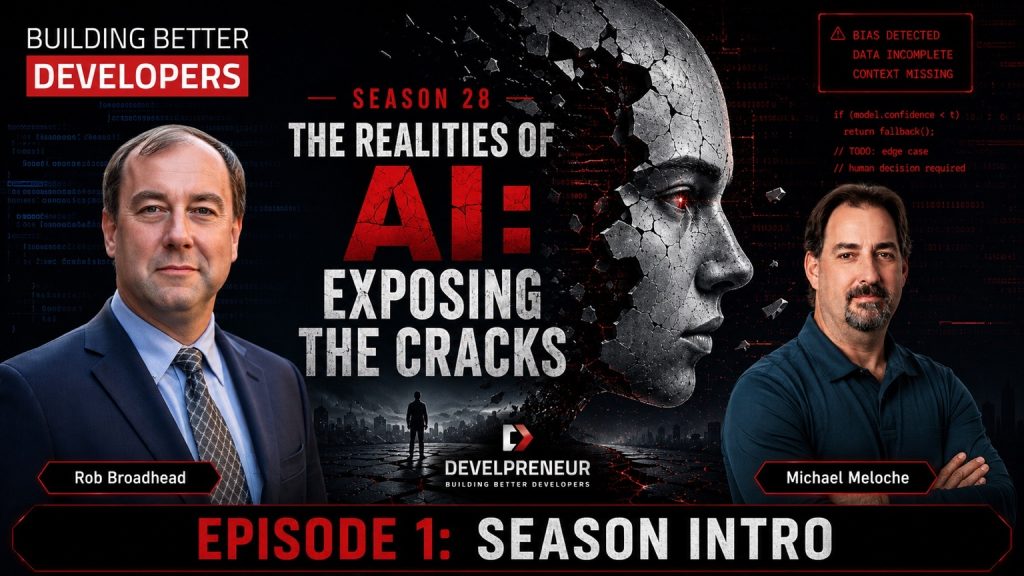

The conversation around AI often focuses on what the technology can do. But the more important discussion may be what AI is exposing. Across organizations, AI Reality Gaps are appearing everywhere—not because AI is failing, but because it is revealing problems that were already there.
Season 28 of Building Better Developers begins with a simple premise: AI is exposing the cracks.
For years, companies have carried technical debt, process inefficiencies, undocumented systems, siloed knowledge, and weak decision-making structures. Those issues often remained hidden because people compensated for them. AI changes that equation.
Why AI Reality Gaps Are Becoming Visible
Many organizations approached AI as a solution.
- Need faster development? Use AI.
- Need better documentation? Use AI.
- Need more productivity? Use AI.
The problem is that technology rarely fixes organizational dysfunction. It usually amplifies it.
- When teams introduce AI into poorly documented systems, AI inherits the confusion.
- When processes are unclear, AI accelerates inconsistency.
- When knowledge lives inside one person’s head, AI has nothing reliable to learn from.
The technology isn’t creating new problems. It’s making old problems impossible to ignore.
AI often functions as an organizational mirror. It reflects existing strengths and weaknesses back to the business.
AI Reality Gaps and the Documentation Problem
One theme discussed in the season kickoff was the challenge of tribal knowledge.
Many organizations operate on information that exists only in the minds of experienced employees. Systems work because certain people know how they work—not because anyone documented them.
This model has survived for years because humans are remarkably adaptable.
AI is far less forgiving.
When an AI system encounters undocumented architecture, unclear workflows, or missing business rules, it cannot compensate with institutional memory. The result is often inaccurate recommendations, incomplete solutions, or confidence built on bad assumptions.
The introduction of AI forces organizations to ask a difficult question:
Do we actually understand our own systems?
AI Reality Gaps Expose Process Weaknesses
One of the most dangerous assumptions in technology is that speed automatically creates value.
AI makes it easier to generate code, reports, summaries, and recommendations. But generating output faster doesn’t improve the quality of decisions behind that output.
- Organizations that already have disciplined processes benefit enormously.
- Organizations without those foundations simply create bad outcomes faster.
This creates a new reality for leaders:
Success with AI depends less on the tool and more on the maturity of the systems surrounding it.
Accelerating a broken process rarely fixes it. It usually increases the cost of failure.
The Difference Between Automation and Understanding
The season kickoff highlighted examples where AI produced misleading conclusions because it was given incomplete or poorly timed data.
This is an important lesson.
AI does not possess magical understanding.
It processes the information it receives and generates conclusions based on that information.
If the inputs are flawed, the outputs will be flawed.
This reality shifts responsibility back to the people using the technology.
The critical question becomes:
Are we using AI to replace thinking, or are we using it to improve thinking?
Organizations that treat AI as a decision-support system will generally outperform those that treat it as a decision-maker.
Building Stronger Foundations Before Scaling AI
As AI becomes embedded in software development, leadership, operations, and product management, foundational disciplines become more valuable—not less.
Teams need:
- Better documentation
- Clearer ownership
- Consistent workflows
- Strong communication
- Shared understanding of business goals
These capabilities may not feel innovative, but they create the conditions where innovation can thrive.
AI rewards organizations that already know how to operate effectively.
It punishes organizations that hoped technology would replace operational excellence.
Identify one process your team relies on that exists primarily through tribal knowledge. Document it this week.
The Future Isn’t About More AI
The future isn’t simply about adding more AI.
It’s about creating organizations capable of using AI effectively.
The companies that succeed won’t necessarily be the ones with the most advanced tools. They’ll be the ones with the strongest foundations.
AI isn’t exposing new problems.
It’s exposing old problems at a scale and speed we’ve never experienced before.
Conclusion
The biggest lesson from the Season 28 kickoff is that AI is not a shortcut around organizational discipline. Instead, it shines a spotlight on the areas businesses have neglected for years. The organizations that recognize and address these AI Reality Gaps today will be the ones best positioned to thrive tomorrow.
Stay Connected: Join the Developreneur Community
👉 Subscribe to Building Better Developers for more conversations on momentum, leadership, and growth. Whether you’re a seasoned developer or just starting, there’s always room to learn and grow together. Contact us at [email protected] with your questions, feedback, or suggestions for future episodes. Together, let’s continue exploring the exciting world of software development.