
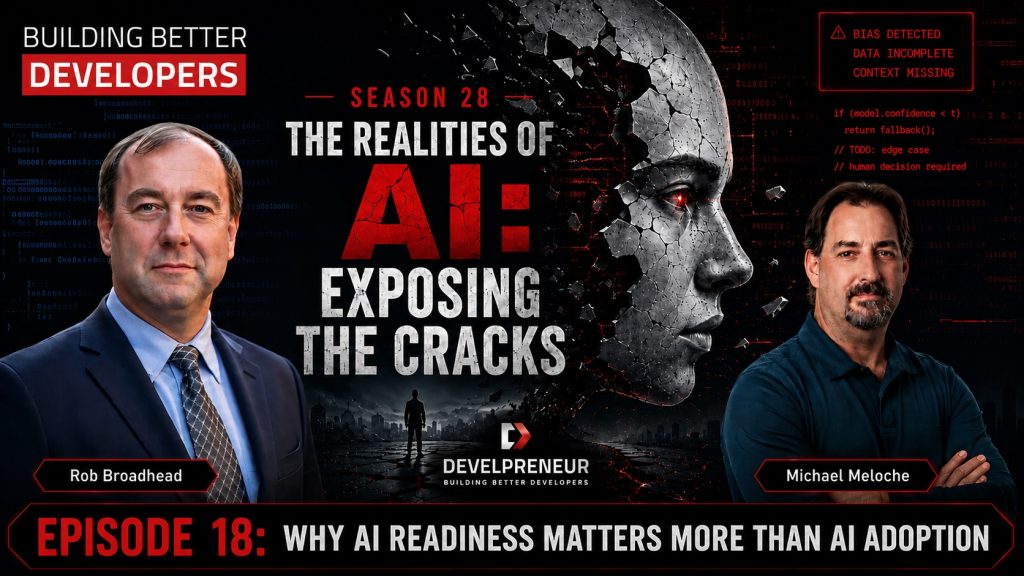

Artificial intelligence has become the centerpiece of countless business conversations. Every week brings another announcement promising faster development, cheaper operations, or a revolutionary new way to build software. Yet the organizations seeing the greatest long-term success aren’t necessarily the ones adopting AI the fastest — they’re the ones investing in an effective AI readiness strategy before expecting technology to solve their problems.
One of the most important ideas from our conversation with entrepreneur and investor Danny Carpio is that AI doesn’t create organizational weaknesses — it exposes ones that already existed. Companies with clear systems, documented processes, and strong decision-making use AI as a powerful accelerator. Organizations built on tribal knowledge, unclear ownership, and inconsistent execution find that AI magnifies every existing weakness instead.
About Danny Carpio
Danny Carpio is an organizational architect, systems builder, and the author of The Unfirm: The New Unit of Scale Is You. Over the past 13+ years, he has designed operating models, governance structures, and investment architectures for venture-backed startups, decentralized organizations, and multi-entity networks. His work has helped organizations raise and manage eight-figure capital pools, incubate new businesses, and build scalable systems where no established blueprint existed. A licensed attorney, Danny also brings legal and governance expertise to selected clients, integrating operational strategy with practical business execution. Learn more about Danny and his work on his LinkedIn profile: https://www.linkedin.com/in/danny-carpio-9703a043/.
AI Readiness Starts With Better Questions
Many organizations start their AI journey by asking, “Which AI tool should we use?” That’s the wrong first question. A better one is: “What business problem are we trying to solve?”
Throughout the discussion, Danny kept returning to first-principles thinking rather than chasing technology for its own sake. He emphasized understanding what you’re building, why you’re building it, and whether AI is actually the right solution before adding more complexity. Technology should support business strategy — not replace it.
When organizations skip this step, AI becomes another shiny object. Teams spend weeks experimenting with tools, generating code, creating content, and automating workflows without ever measuring whether any of it creates real business value. That leads to activity instead of progress. AI multiplies direction — and if your direction is unclear, AI just helps you move faster toward the wrong destination.
Strong Foundations Make AI Work
A recurring theme throughout the conversation was preparation. Preparation rarely feels exciting — customers don’t buy documentation, investors rarely celebrate internal process improvements, and teams often see planning as something that delays “real work.” But preparation becomes the competitive advantage once complexity increases.
An AI readiness strategy should start by examining questions like:
- Where does critical knowledge live?
- Which business processes depend on individual employees?
- What decisions are repeatable?
- Which workflows are documented?
- Where are the communication bottlenecks?
These aren’t AI questions — they’re business maturity questions. Organizations that answer them honestly create an environment where AI improves execution instead of adding confusion. Companies built around heroics and undocumented knowledge, on the other hand, often find that AI struggles because the organization itself lacks consistency.
AI Readiness Requires Humility
Perhaps the most overlooked lesson from the conversation is humility. Danny described today’s environment as one where assumptions become outdated faster than ever. Past experience still matters, but relying only on past success can create “phantom walls” — constraints that no longer exist because technology has changed what’s possible.
That doesn’t mean abandoning experience. It means questioning it. Successful organizations keep revisiting questions like:
- Why do we perform this process?
- Does this approval still provide value?
- Could this workflow be simplified?
- Is this limitation still real?
The companies winning in the AI era aren’t assuming they already have the answers — they’re getting exceptionally good at asking better questions. Experience remains valuable, but only when paired with a willingness to challenge yesterday’s assumptions.
AI Readiness Is About Optionality
The discussion also explored how volatility has become permanent. Markets move faster. Technology changes faster. Customer expectations evolve faster. That means organizations need to build optionality into their operations.
Instead of designing rigid systems optimized for one future, companies should build flexible systems that can adapt as conditions change. That applies equally to software architecture, product strategy, and organizational design.
An AI readiness strategy isn’t about predicting the future perfectly — it’s about building systems that stay effective even when predictions prove wrong. That requires continuous feedback loops, frequent reassessment, incremental improvements, and fast learning cycles. These traits have always defined resilient organizations; AI just raises the stakes for having them.
AI Doesn’t Replace Strategy — It Reveals It
One of the strongest takeaways from this conversation is that AI should never substitute for strategic thinking. AI can generate software, draft marketing content, analyze data, and automate repetitive tasks. But none of that determines whether a business solves an important problem. The competitive advantage still belongs to organizations that understand their customers, define meaningful objectives, and execute consistently.
Technology accelerates execution. Strategy determines direction. That’s why organizations should resist measuring AI success by the number of prompts written or automations deployed, and instead measure outcomes:
- Did customers receive more value?
- Did quality improve?
- Were decisions made faster?
- Did communication improve?
- Did the organization become easier to scale?
Those are business metrics — not AI metrics. Chasing every new AI capability without strategic clarity creates complexity faster than it creates value.
Conclusion
The companies that thrive during major technological shifts are rarely the ones chasing every new trend. They’re the ones strengthening their fundamentals while staying adaptable enough to embrace meaningful change.
An effective AI readiness strategy isn’t about finding the newest model or the latest automation platform. It’s about building an organization that can consistently learn, adapt, and execute regardless of which technologies come next. AI exposes strengths just as quickly as it exposes weaknesses — and the organizations investing in strong foundations today will be the ones positioned to move faster tomorrow. Not because AI made them successful, but because they built businesses capable of taking advantage of what AI makes possible.
Stay Connected: Join the Developreneur Community
👉 Subscribe to Building Better Developers for more conversations on momentum, leadership, and growth. Whether you’re a seasoned developer or just starting, there’s always room to learn and grow together. Contact us at [email protected] with your questions, feedback, or suggestions for future episodes. Together, let’s continue exploring the exciting world of software development.