
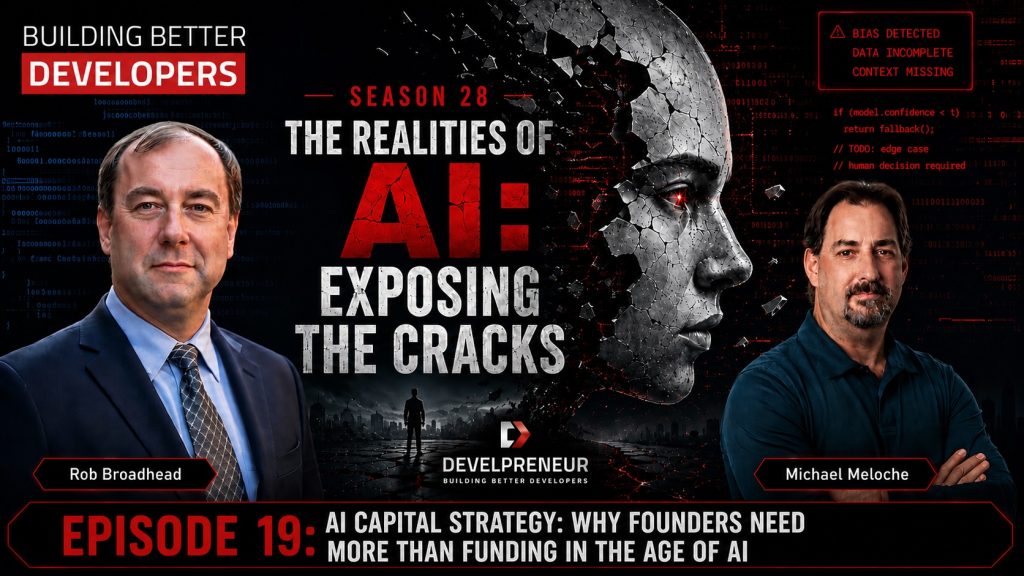

For decades, startup success followed a familiar path: build a prototype, raise venture capital, hire a team, develop a product, and hope to reach market before the money runs out. Artificial intelligence is rewriting that playbook. An effective AI capital strategy now requires founders to think beyond fundraising and focus on building systems that create value long before investors write a check.
In Part 2 of our conversation with Danny Carpio, we explored how AI is reshaping venture capital, startup economics, and software development. The discussion wasn’t about replacing investors — it focused on a much larger shift: AI is lowering the cost of building products while raising the importance of strategic execution. As development gets cheaper, founders have to prove they can build sustainable businesses, not just impressive technology.
About Danny Carpio
Danny Carpio is an organizational architect, systems builder, and the author of The Unfirm: The New Unit of Scale Is You. Over the past 13+ years, he has designed operating models, governance structures, and investment architectures for venture-backed startups, decentralized organizations, and multi-entity networks. His work has helped organizations raise and manage eight-figure capital pools, incubate new businesses, and build scalable systems where no established blueprint existed. A licensed attorney, Danny also brings legal and governance expertise to selected clients, integrating operational strategy with practical business execution. Learn more about Danny and his work on his LinkedIn profile: https://www.linkedin.com/in/danny-carpio-9703a043/.
AI Capital Strategy Changes the Role of Venture Capital
Traditionally, venture capital solved one primary problem: it gave startups enough money to build products that would otherwise be too expensive to create. That equation is changing.
Modern AI tools let small teams prototype applications, create marketing assets, automate operations, and validate ideas at a fraction of the historical cost. That means founders can test assumptions before they ever seek outside funding.
Danny described this shift as moving structural barriers farther downstream. Instead of requiring significant investment just to get started, entrepreneurs can now build meaningful proof before approaching investors. That doesn’t eliminate venture capital — it changes its purpose. Rather than financing basic product development, investors increasingly accelerate companies that have already shown traction, market understanding, and operational discipline.
Capital is becoming an accelerator instead of the starting line.
AI Capital Strategy Rewards Builders Who Reduce Risk
Investors have always looked for promising ideas. Today, they’re also looking for founders who understand uncertainty.
Throughout the discussion, Danny emphasized that markets are changing so fast that no one has a complete blueprint. Because of that, founders need to demonstrate adaptability rather than certainty. Successful entrepreneurs are no longer expected to predict the future perfectly — they’re expected to:
- Test assumptions quickly
- Learn from customer feedback
- Adjust direction intentionally
- Repeat the process continuously
An effective AI capital strategy demonstrates learning velocity. If a startup can validate assumptions every few weeks instead of every six months, it becomes far easier for investors to evaluate both the product and the leadership team.
AI Capital Strategy Depends on Cross-Functional Thinking
One of the strongest themes from the conversation was that technical excellence alone is no longer enough. Developers remain essential. Business leaders remain essential. Product thinkers remain essential. But AI lets each discipline contribute earlier than ever before.
Danny encouraged developers to partner with business-minded collaborators much earlier in the development cycle, instead of waiting until the software is nearly complete. Likewise, founders should involve technical experts before making major strategic commitments. This collaborative approach cuts expensive rework and improves product-market alignment.
In practical terms, modern startups benefit from combining:
- Technical expertise
- Customer understanding
- Business strategy
- Legal guidance
- Product design
AI accelerates each discipline individually. Systems thinking is what connects them into a competitive advantage.
The strongest startups don’t build faster because of AI — they make better decisions because the right people collaborate sooner.
AI Capital Strategy Requires Better Feedback Loops
One recurring idea throughout the interview was the importance of continuous feedback. AI dramatically shortens development cycles — but it also shortens the time it takes to make expensive mistakes. As founders produce prototypes faster, they have to evaluate them faster too.
Danny described this as building feedback loops that operate at every level of the business, from daily work to long-term strategy. That philosophy applies across an organization:
- Review customer feedback frequently
- Measure product adoption consistently
- Revisit strategic assumptions regularly
- Validate technical decisions continuously
Without these feedback mechanisms, AI just lets organizations scale poor decisions more efficiently. Businesses with disciplined review processes, on the other hand, gain the confidence to move quickly because they know problems will surface early.
AI Capital Strategy Is Really About Execution
One of the most valuable insights from the conversation challenged a common startup assumption. Many founders believe funding creates success. In reality, funding amplifies execution.
Money can’t:
- Compensate for unclear priorities.
- Replace customer understanding.
- Fix poor communication between technical and business teams.
Instead, investment magnifies whatever already exists inside an organization.
The same principle applies to AI. Founders who understand their customers, document their processes, and iterate intentionally get tremendous leverage from modern AI tools. Meanwhile, organizations chasing technology without operational discipline often produce more activity than meaningful progress.
AI makes it easier to build products. It does not make it easier to build successful businesses.
Conclusion
Artificial intelligence is transforming far more than software development. It’s redefining how startups are funded, how products are built, and how competitive advantages are created.
An effective AI capital strategy recognizes that funding alone is no longer the differentiator it once was. Today’s founders have unprecedented opportunities to validate ideas, build early traction, and demonstrate execution before approaching investors. Those who combine technical expertise with strategic thinking and continuous learning will stand out in an increasingly crowded marketplace.
The future belongs to organizations that treat AI as a force multiplier for disciplined systems — not as a shortcut around them.
Stay Connected: Join the Developreneur Community
👉 Subscribe to Building Better Developers for more conversations on momentum, leadership, and growth. Whether you’re a seasoned developer or just starting, there’s always room to learn and grow together. Contact us at [email protected] with your questions, feedback, or suggestions for future episodes. Together, let’s continue exploring the exciting world of software development.