
Artificial intelligence is changing what it means to be a software developer. Writing code remains valuable, but knowing a programming language is no longer enough to distinguish yourself in a competitive technology industry. As AI makes software generation faster and more accessible, developers must demonstrate something more important: the ability to understand problems, connect with people, and deliver meaningful solutions.
In this week’s Building Better Developers Weekly Challenge, hosts Rob Broadhead and Michael Meloche reflect on their conversation with Ryan Drumheller, author of From Firewalls to Fairways and co-founder of Dogleg Digital. Their discussion explores how developers can strengthen their professional relationships, move beyond narrowly defined technical roles, and use AI without losing the judgment required to build quality software.
Building a Career Beyond Technical Skills
Michael opens the discussion by examining how traditional developer career paths are changing. Junior and mid-level developers can no longer rely solely on learning another programming language or becoming proficient with a particular framework. Understanding DevOps, software testing, architecture, and the broader software development lifecycle is becoming increasingly important.
Rob compares this transition to the introduction of calculators and computers. Skills that once required specialized knowledge became easier to automate, but the underlying need to solve problems remained. Similarly, AI may change how developers write code without eliminating the value of understanding programming fundamentals.
The important question is no longer simply which language you know. It is whether you understand the principles well enough to apply them across different technologies and business environments.
Networking Builds Opportunities Beyond the Code
One of the strongest lessons from Ryan’s interview was the importance of networking and genuine conversations. Ryan turned his interest in golf into a business opportunity by speaking with golf course operators, understanding their challenges, and building relationships within the industry.
Michael discusses how remote work has changed professional networking. Traditional face-to-face events remain useful, but virtual meetings, LinkedIn, professional communities, and online networking groups provide additional ways to connect.
Rob points out that virtual breakout sessions can make networking easier by creating opportunities for focused, one-on-one conversations. Rather than immediately pitching your services, start by learning about another person’s work, asking questions, and contributing to discussions.
These relationships can reveal problems you would never discover by remaining focused exclusively on your technical responsibilities.
AI Makes Development Faster, but Not Always Better
The conversation also examines the growing importance of technical judgment when working with AI-generated software.
Michael emphasizes that developers must look beyond whether generated code appears to work. Security, testing, architecture, maintainability, and established coding standards still matter. AI can quickly produce large amounts of code, but that does not mean the implementation is efficient or appropriate.
Rob shares an example of using AI to generate hundreds of automated tests for an existing API. This allowed him to identify issues and improve stability without manually writing every test.
However, automated testing cannot replace human evaluation. Developers must still use the software, examine real workflows, and determine whether the finished product meets customer expectations.
AI can accelerate implementation, but developers remain responsible for deciding whether the solution is worth delivering.
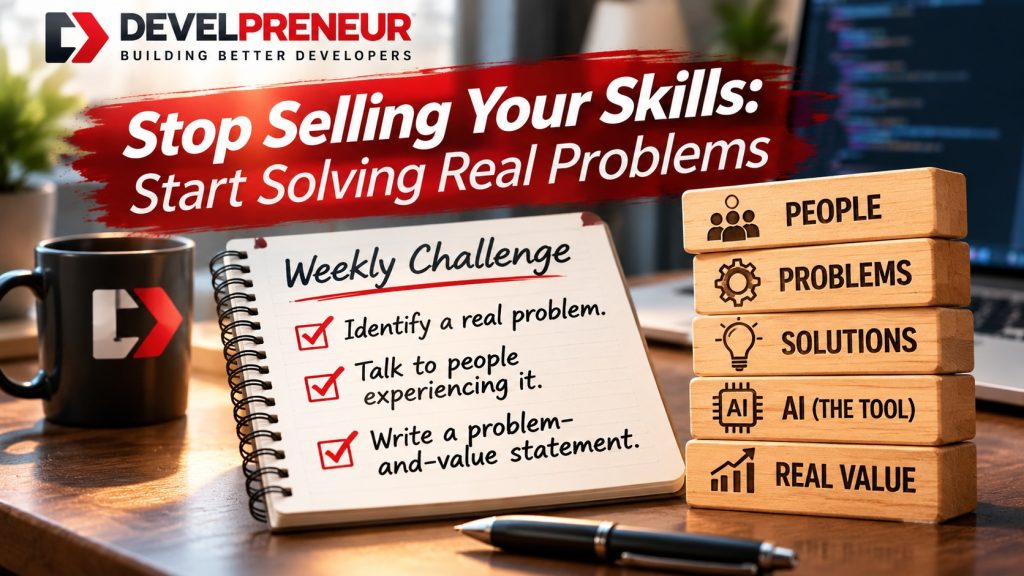
Weekly Challenge: Identify One Real Problem
This week’s challenge is designed to help developers practice the communication, research, and problem-solving skills that become increasingly valuable as AI changes the profession.
Spend 30 minutes this week completing three simple steps:
- Identify one real problem. Look for a recurring frustration affecting your coworkers, customers, employer, or someone in your professional network. Write down the problem without immediately jumping to a technical solution.
- Talk to people experiencing the problem. Reach out through a conversation, networking event, video call, or online community. Ask how the problem affects their work and whether others experience similar challenges. Listen carefully before offering recommendations.
- Write a problem-and-value statement. Summarize who experiences the problem, why it matters, and what an improvement could accomplish. Consider how a solution might save time, reduce costs, eliminate frustration, or improve results.
The goal is not to build an application, generate code, or create another AI-powered tool. It is to develop a better understanding of a real-world problem and determine whether solving it would create meaningful value.
Build Relationships Before Building Solutions
Ryan’s experience demonstrates that opportunities often begin with conversations rather than code. By developing relationships and understanding an industry’s challenges, he discovered problems that eventually influenced the direction of Dogleg Digital.
Developers can apply this same approach regardless of whether they want to start a business, improve their current organization, or advance their careers.
The ability to recognize problems, communicate with stakeholders, and evaluate possible solutions will remain valuable even as development tools continue evolving.
This week, challenge yourself to step away from the keyboard, start a conversation, and discover one problem worth solving.
Your next career opportunity may begin with a question rather than a line of code.
Stay Connected: Join the Developreneur Community
👉 Subscribe to Building Better Developers for more conversations on momentum, leadership, and growth. Whether you’re a seasoned developer or just starting, there’s always room to learn and grow together. Contact us at [email protected] with your questions, feedback, or suggestions for future episodes. Together, let’s continue exploring the exciting world of software development.