

AI is making it easier than ever to write code, generate documentation, summarize meetings, and move projects forward. However, faster execution creates another problem: we are generating information faster than most of us can remember it. Important decisions live in conversations, requirements get buried in emails and chat threads, and technical details remain in the heads of developers, founders, and subject matter experts.
When that knowledge is not captured, adding more people or more AI does not necessarily make an organization move faster. Sometimes it simply helps us create confusion faster.
Knowledge Is Becoming the Bottleneck
We have talked a lot recently about AI accelerating software development. Developers can generate code, create tests, build prototypes, and automate work faster than ever before. The problem is that AI can only work effectively with the information available to it.
If the architecture is poorly understood, business rules are not documented, and important decisions only exist in someone’s head, AI has the same fundamental problem as a new developer joining the project. It does not know what it has not been told.
I see this constantly when working with software teams. A company may bring several developers onto a project because the deadline is slipping, with management expecting more people to equal more output. Instead, the existing developers spend their time explaining how everything works while the new developers make assumptions because they do not have enough context. Integrations behave differently than expected, old business rules surface during testing, and before long the team is spending more time rediscovering the system than building it.
AI accelerates that same problem.
You Cannot Scale What Only Exists in Your Head
This is not just a developer problem. Founders often carry enormous amounts of organizational knowledge themselves. They know why customers buy, how projects get delivered, which exceptions matter, what promises have been made, and how dozens of small decisions fit together. That approach can work when the company is small, but it quickly becomes a bottleneck when the business tries to grow.
You can hire another employee, contractor, developer, or virtual assistant, but eventually someone has to explain how the work gets done. If there is not a repeatable process or accessible source of knowledge, every new person starts another round of discovery.
The same thing happens when using AI agents. You can give an AI agent access to your code and ask it to complete a task, but if important knowledge never made it into the repository, requirements, tickets, documentation, or conversations the AI can access, it has to guess. That is where speed becomes dangerous.
AI Gives Us Fewer Excuses for Poor Documentation
The good news is that AI can also help solve this problem. Writing documentation used to be one of those tasks everyone agreed was important but rarely had enough time to do properly. Today, much of the raw material already exists in our commits, pull requests, tickets, emails, meetings, chat conversations, code comments, and test results.
AI can help turn that activity into usable organizational knowledge. For developers, that might mean creating better commit summaries, improving pull request descriptions, documenting code, generating test documentation, or updating project notes. For business owners, it might mean transcribing meetings, extracting decisions, documenting workflows, and turning conversations into operating procedures.
The goal is not to document everything simply because we can. The goal is to stop valuable knowledge from disappearing.
One practice I have found useful is maintaining project information as I work instead of trying to reconstruct everything later. On fast-moving projects, I may have emails, meetings, code changes, testing results, production issues, and shifting requirements happening at the same time. Keeping all of that straight manually becomes almost impossible.
AI can help summarize what changed and update project documentation throughout the day. At the end of the day, I can review those changes, update documentation and comments, commit the work, and leave the project with a much clearer picture of where things stand. This becomes especially important when testing integrations or complex workflows because the code may look correct by itself, while the real question is whether the complete system still behaves correctly from the user’s perspective.
This Week’s Challenge: Compare Your Memory With AI
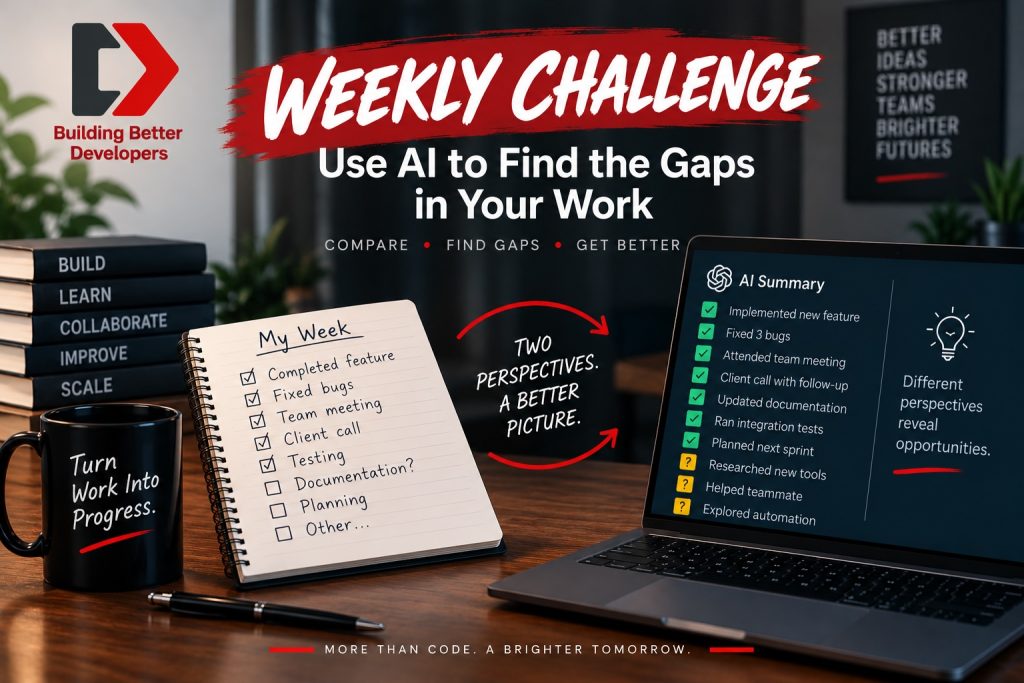
This week’s challenge is simple and should take only a few minutes. At the end of your week, write a short summary of what you accomplished. Do this yourself first, without asking AI to help. You can type it, but going old school with a pen and paper may make the exercise even more useful.
Write down the important things you believe you accomplished as though someone asked you for a weekly status update. Once you are finished, ask the AI system you have been working with to summarize your week based on the information it can access. Then compare the two versions.
Look at what AI remembered that you forgot, what you remembered that AI could not find, and what both of you missed because the information was never properly captured. That last category may be the most valuable part of the entire exercise.
Maybe AI identifies ten things you worked on and you only remembered six. That can show you that you are accomplishing more than you realize, which is useful for status reports, performance reviews, resumes, client updates, and simply understanding where your time goes.
The reverse is even more interesting. Suppose you remember an important architectural decision, customer conversation, bug investigation, or testing discovery that AI knows nothing about. Ask yourself why. Was the decision documented? Was there a meaningful ticket update? Did the commit explain why the change happened? Were the meeting notes captured somewhere accessible?
Those missing pieces represent exactly the kind of knowledge gaps that become expensive later.
Building Beyond the Code
As AI takes over more of the mechanical work of software development, the value of a developer increasingly comes from more than typing code. Understanding systems, communicating decisions, testing and validating outcomes, and capturing knowledge all become more important.
Developers who learn how to use AI while improving the quality of the information surrounding their work will have an advantage over those who simply use AI to produce more code. The same principle applies to founders and business owners. If everything important remains trapped in your head, your business cannot truly scale. When you start capturing that knowledge and making it usable by both people and AI, you begin building something that can operate beyond you.
Take five minutes at the end of this week and write down what you think you accomplished. Then ask AI what it thinks you accomplished and compare the results. Pay particular attention to the gaps because they can show you exactly where your documentation, communication, and processes need improvement.
The goal of this week’s challenge is not to see whether you or AI has the better memory. It is to discover what your organization is forgetting.
Stay Connected: Join the Developreneur Community
👉 Subscribe to Building Better Developers for more conversations on momentum, leadership, and growth. Whether you’re a seasoned developer or just starting, there’s always room to learn and grow together. Contact us at [email protected] with your questions, feedback, or suggestions for future episodes. Together, let’s continue exploring the exciting world of software development.