
Building an MVP with AI has become remarkably easy, but that does not mean every idea deserves to become a full application. AI can turn a concept into working software faster than most of us could have imagined a few years ago. That speed creates an opportunity to experiment, but it also makes it much easier to overbuild.
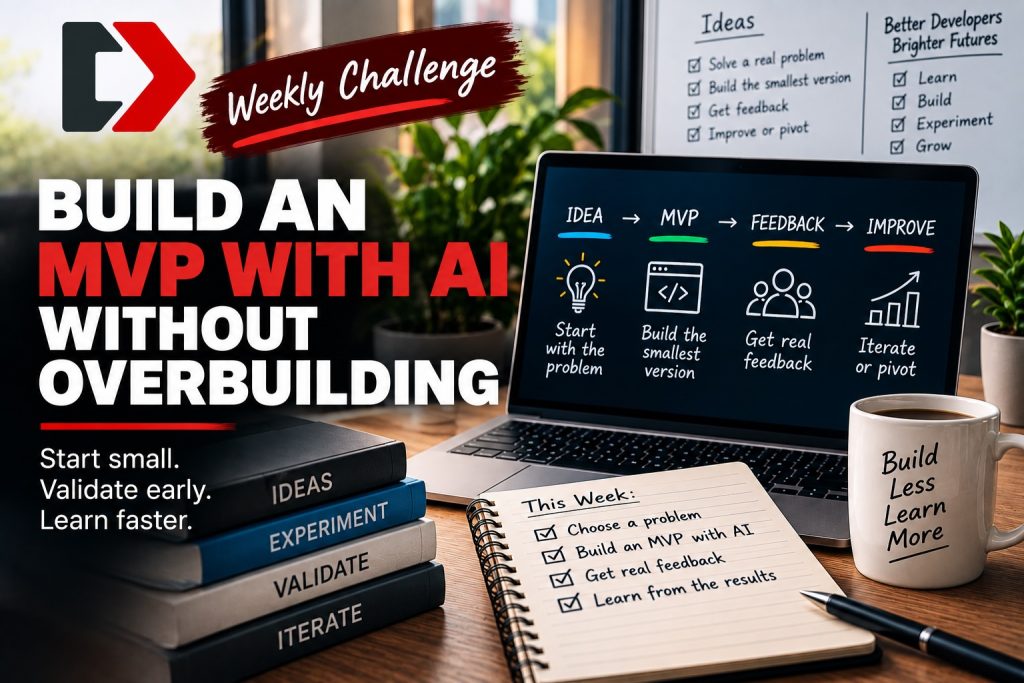
This week’s Develpreneur Weekly Challenge is about using that speed intentionally. Choose one real problem, build the smallest useful version of a solution, and learn from it before adding more. The goal is not to see how much software AI can generate. It is to determine whether you are solving the right problem in the first place.
Start Your MVP With AI From the Problem
It is easy to open an AI coding tool without knowing exactly where you are going. You have an idea, write a prompt, generate some code, and then ask for another feature. Before long, your simple experiment has authentication, reporting, notifications, an admin dashboard, and a database large enough to support a company that does not exist yet.
Developers were capable of over-engineering long before AI arrived. AI simply allows us to do it much faster.
Instead, start with the problem. Ask what you are trying to solve, who actually has that problem, and whether software is even the right answer. Then determine the smallest thing you could build to test your assumptions.
You also need to think beyond whether the application works today. Who will maintain it? Does your team understand the technology being used? If AI creates a solution using tools or languages nobody in the organization understands, that quick solution may create a much larger problem later.
Validate Before You Build Everything
One of the greatest advantages of building an MVP with AI is the ability to create inexpensive experiments. You no longer need to spend months developing a polished application before putting an idea in front of someone. You can create enough functionality to demonstrate the concept, test a workflow, or determine whether the proposed solution makes sense.
Then you need real feedback. The important word is real. Feedback from an AI tool telling you the idea sounds great does not validate the product. Neither does showing it to a few friends who want to encourage you. Validation should come from the people who would actually use the solution.
Does it solve their problem? Would they change their current process to use it? If this is a commercial product, would someone actually pay for it?
There is a significant difference between someone saying, “I would buy that,” and someone actually giving you money. The faster you discover that difference, the less time you spend developing something nobody needs.
Throwing Away an MVP Can Be a Success
Developers often have difficulty throwing away code because we become invested in what we create. We spent time building it, solved interesting technical problems, and may already be thinking about the next set of features. Surely there must be some reason to keep going.
Building an MVP with AI should change some of that thinking. When creating an experiment becomes dramatically faster and less expensive, discarding an unsuccessful experiment is not necessarily a failure. It may be exactly what the process was designed to accomplish.
Imagine quickly testing several ideas and discovering that most of them do not solve a meaningful problem. That may sound discouraging, but compare it with spending six months building one of those ideas before discovering nobody wants it. The purpose of an MVP is not to prove that your original idea was brilliant. Its purpose is to help you learn enough to decide what should happen next.
AI makes it possible to create and test far more ideas than before. The valuable skill is knowing which ones deserve additional investment.
Build the Smallest Useful Version
A good example is something as familiar as an email client. Email applications can become enormous. They can include folders, filters, search, signatures, formatting, rules, integrations, calendars, contacts, notifications, AI summaries, and countless other features. Trying to recreate everything at once would defeat the purpose of an MVP.
Instead, start with the basics. Can the application retrieve email, display a list of messages, and let you read one? If that works, test it before moving forward. Maybe the next requirement is marking messages as read or unread. Folders can come later if you discover you actually need them.
Each feature should be added because it becomes necessary, not simply because AI is capable of creating it.
This approach may seem slower, but AI changes the economics. You can spend a short amount of focused time adding and testing one useful capability instead of disappearing into a large development project. More importantly, every new feature has to earn its way into the application.
Keep Asking Whether You Actually Need It
Building an MVP with AI makes feature creep incredibly tempting because adding something can seem almost free. You can ask an AI coding assistant for another feature, and within minutes it may begin implementing it. However, the cost of a feature does not end when the code is generated.
Someone still has to understand it, test it, secure it, maintain it, and deal with the consequences when something changes. Before adding another capability, ask whether it helps solve the original problem. Consider whether you need it to test your assumption, whether an actual user has requested it, and whether your team can support what is being created.
Sometimes the best decision is to stop building. Test what you already have and determine whether the next feature is necessary before asking AI to create it.
That judgment is becoming an increasingly valuable development skill.
Protect Your Secrets While Building an MVP With AI
Speed does not eliminate the fundamentals of secure development. If you use AI-assisted development for this challenge, be careful with passwords, API keys, access tokens, and other sensitive information. Those values should not be casually placed into AI prompts or embedded directly into your source code.
Instead, use appropriate configuration and secret-management practices. Your application can reference securely stored values without requiring the AI tool to know the actual credentials.
An MVP may be temporary, but exposed credentials can create a much longer-lasting problem. Moving quickly should never mean ignoring basic security practices.
This Week’s Challenge: Build an MVP With AI
This week, choose a problem that has bothered you for a while. It can come from your business, development workflow, daily routine, or another area where a small application could make something easier. Then use AI-assisted development to turn that idea into an experiment.
- Write the problem down in one sentence.
- Define the smallest useful version of the solution.
- Build an MVP with AI-assisted development.
- Leave out features that are not necessary for the initial test.
- Use the MVP yourself or put it in front of a real potential user.
- Collect meaningful feedback.
- Decide whether to improve it, change direction, or throw it away.
Give yourself permission to build something imperfect. You do not need a polished interface, every possible feature, or a production-ready deployment. You need enough of a solution to determine whether your idea is worth pursuing.
Most importantly, give yourself permission to throw the experiment away. The goal of this challenge is not to create your next commercial application in a weekend. The goal is to practice turning a problem into an experiment and using what you learn to determine the next step.
Build Less and Learn Faster
AI gives developers enormous leverage, but leverage works both ways. It can help us solve the right problem faster, or it can help us create an enormous amount of unnecessary software faster. The difference comes down to judgment.
Building a career beyond the code means becoming the person who understands the problem, questions assumptions, validates ideas, protects the fundamentals, and knows when enough is enough. Coding remains part of the process, but our value increasingly comes from deciding where that code should be applied.
This week, do not try to build everything. Pick one problem and build an MVP with AI that is just large enough to test your idea. Put it in front of someone, learn from the result, and then decide what deserves to happen next.
Stay Connected: Join the Developreneur Community
👉 Subscribe to Building Better Developers for more conversations on momentum, leadership, and growth. Whether you’re a seasoned developer or just starting, there’s always room to learn and grow together. Contact us at [email protected] with your questions, feedback, or suggestions for future episodes. Together, let’s continue exploring the exciting world of software development.