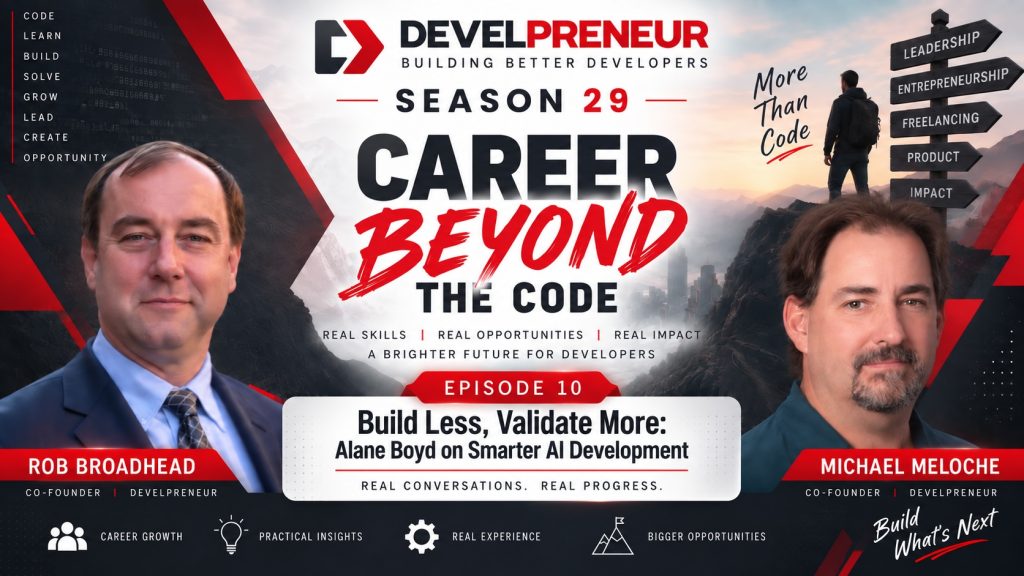

Smarter AI development is not about using the most advanced tool or building the most complicated solution. As AI makes software development faster and more accessible, developers and business owners face a different challenge: deciding what is actually worth building. The ability to create something quickly does not eliminate the need to validate the idea, maintain the finished product, or determine where human judgment still matters.
In part two of our conversation with Alane Boyd, Co-CEO of Biggest Goal, Develpreneur: Building Better Developers explores what happens after a company moves beyond basic AI experimentation. Rob Broadhead and Michael Meloche talk with Alane about AI agents, vibe coding, custom software, minimum viable products, human oversight, and the growing temptation to build simply because AI makes building easier.
For developers building a career beyond the code, the lesson is especially relevant. AI has dramatically reduced the effort required to turn an idea into working software, but the business questions surrounding that software have not disappeared. In many cases, those questions have become even more important.
About Alane Boyd
Alane Boyd is Co-CEO of Biggest Goal and a serial entrepreneur whose background spans technology, operations, sales, marketing, automation, and business growth. She has built SaaS businesses and describes herself as a two-time SaaS founder with successful exits. Biggest Goal’s current work focuses on hands-on AI training and implementation for leaders and teams, including helping organizations move from basic AI experimentation toward repeatable systems and practical business workflows.
Alane is also a published author, mentor, speaker, and podcast host. Her work increasingly focuses on practical AI fluency: helping businesses understand where AI belongs in their operations, how teams can use it consistently, and where human expertise should remain part of the process.
Learn more about Alane and her work through Biggest Goal and connect with her on LinkedIn.
Smarter AI Development Goes Beyond Chat
Many people still use AI primarily through a chat interface. They enter a prompt, receive an answer, copy the output somewhere else, and repeat the process. Alane sees organizations beginning to move beyond that model toward AI workflows, connectors, scheduled tasks, skills, and agents.
That progression can eliminate much of the manual movement between systems. Instead of repeatedly copying prompts and outputs, businesses can build processes that automatically trigger AI and move information where it needs to go.
At the same time, tools such as Claude Code have made development accessible to people who would not traditionally consider themselves developers. Alane sees value in that shift because people outside software development can finally see some of what happens behind the scenes when software is created.
However, creating an application is only one part of software development.
The excitement of building something can hide the long-term responsibility that follows. Someone still has to maintain the application, troubleshoot failures, adapt to changing requirements, manage dependencies, and determine what happens when the original creator no longer wants to spend time supporting it.
Michael sees the same issue when talking with people who have created applications using AI. They are excited because the application works, but they have not necessarily considered what comes next.
AI Makes Building Easier, Not Maintenance Optional
This creates one of the biggest challenges surrounding AI-assisted development. A founder can now describe an idea and begin creating software without fully understanding the lifecycle of the product being built.
The first version can feel almost magical. AI writes code, creates interfaces, troubleshoots problems, and helps someone move from an idea to something tangible much faster than traditional development allowed. That speed can create the impression that software has become a one-time project.
It has not.
Alane points out that maintaining what you build can become a significant burden. A founder who creates a custom platform may eventually discover that the software requires constant attention. What started as an exciting experiment can become another system the founder is personally responsible for keeping alive.
This is where smarter AI development requires thinking beyond the initial build. The important question is not simply, “Can AI build this?” It is also, “Do we want to own and maintain this after AI builds it?”
Build Versus Buy Still Matters
AI has made the traditional build-versus-buy decision even more interesting. If AI can create custom software faster and cheaper than before, building something yourself can look like the obvious choice.
Alane’s experience suggests otherwise.
Before selling one of her previous companies, she merged with a competitor. Both companies had developed software, but one had built a SaaS product that customers could purchase while the other had proprietary software designed primarily for internal use.
When the combined company eventually evaluated those systems, the proprietary software was the first to be shut down.
The reason was business value. Internal proprietary software had limited marketability compared with a product customers were willing to purchase. The company had invested resources into creating and maintaining something that ultimately had little independent value during the sale process.
That experience shaped an important principle in Alane’s approach: build what people want to buy.
For developers, that does not mean custom software is always the wrong decision. It means the ability to build something is not enough justification for building it. An existing platform may already solve the problem while another company absorbs the cost of maintenance, upgrades, security, and continued development.
AI changes the economics of building software, but it does not eliminate those considerations.
Validate the MVP Before You Keep Building
Developers like to build. That is one of the reasons many people become developers in the first place. Give a developer an interesting problem and enough time, and there will always be another feature worth adding.
AI can amplify that instinct.
Alane recommends returning to a familiar startup principle: the minimum viable product. Before investing heavily in development, determine the smallest version of the idea that can test whether somebody actually wants it.
That means asking practical questions early:
- Will someone pay for this?
- What is the smallest version we can put in front of a customer?
- Which features are actually required?
- Can we validate demand before investing more development time?
- Are we solving a real customer problem or simply enjoying the build?
Alane acknowledges that she has fallen into the same trap herself. It is easy to believe a product needs every feature before customers can see it. The problem is that developers can spend months or even years creating something without discovering whether there is a viable market.
Time is a resource. A product that consumes a year of development without generating revenue may eventually become difficult to justify, regardless of how technically impressive it is.
Talk to Customers Before Building in a Vacuum
Alane references the early Dropbox story as an example of validating demand before completing a product. Rather than waiting until every part of the platform existed, Dropbox demonstrated the concept and gathered interest from people who wanted the solution.
The broader lesson is more important than the specific example. Developers and founders need feedback from potential customers before disappearing into build mode.
Friends and family are not necessarily enough. The useful feedback comes from people who might realistically use or purchase the product. Those conversations can expose incorrect assumptions long before they become expensive features.
AI makes this even more important because the barrier to building has dropped dramatically. When a new feature can be generated quickly, it becomes easy to keep adding functionality without stopping to ask whether anyone needs it.
Smarter AI development requires resisting that momentum. Build enough to learn, talk to users, and then decide what deserves to be built next.
Do Not Make the Solution Harder Than the Problem
Developers and founders also have a tendency to make solutions more complicated than necessary. AI gives us even more ways to do that.
A developer can open an AI coding tool, create custom logic, and continue refining an increasingly sophisticated solution. However, the same problem might be solved with a scheduled task, an AI skill, a simple automation, or an existing product.
Alane encourages teams to focus on the job that needs to get done rather than the technology they want to use. The question becomes: What is the quickest, cheapest, and easiest reliable way to accomplish the goal?
Sometimes that answer will be custom software. Sometimes it will be an AI agent. Other times, the answer may be a much simpler workflow.
That distinction matters because every custom solution creates ownership. Someone has to maintain it. Someone has to understand it when it breaks. Someone has to modify it when the business changes.
Smarter AI development includes knowing when not to develop something.
Keep Human Judgment in the Loop
One of the clearest guardrails Alane provides is that judgment should not be handed entirely to AI. AI can process information, identify patterns, generate options, and perform repetitive tasks, but Alane draws a distinction between having data and exercising judgment.
People can fall into the habit of asking AI to provide the answer instead of using it to support their own decision-making. That becomes particularly risky when the result is going directly to a customer or influencing an important business decision.
Human review should remain at critical decision points. A person should determine whether the result is correct, whether it makes sense in context, and whether it represents the quality the organization expects.
That does not mean humans are perfect. People made mistakes before generative AI existed, and human review never guaranteed flawless results. The point is that organizations already needed quality control. AI does not remove that responsibility.
For developers, this resembles the testing and review processes that already exist around software. Automation can produce a result quickly, but speed does not prove correctness. Someone still needs to determine whether the output actually satisfies the requirement.
Process Mapping Before AI Automation
Knowing where humans belong in an AI workflow becomes easier when the organization understands the process being automated. Unfortunately, Alane frequently finds that teams cannot clearly explain their own processes.
Different employees may perform the same job in completely different ways. Information moves through different applications, folders, and manual steps depending on who completes the task. Trying to automate that environment creates unnecessary complexity.
Alane uses process mapping to make the workflow visible. One practical technique is asking someone to record a Loom video while completing the process. The recording creates a transcript and shows which systems the employee moves through along the way.
AI can then help transform that information into a process map.
Once the process is visible, the team can review it together. They can identify unnecessary steps, determine where AI can help, and decide where human review needs to remain.
This is another place where smarter AI development begins before anyone starts writing code or configuring an agent. Understanding the process first makes it much easier to choose the right technology.
Start Small with AI Automation
Alane is also a strong advocate for starting small rather than attempting to automate an entire business process at once. New client onboarding provides a useful example.
A complete onboarding process may involve creating billing records, scheduling meetings, building a presentation, creating shared folders, sending messages, and performing several other tasks. Trying to automate the entire workflow at once creates a large project with many failure points.
Instead, Alane recommends identifying one time-consuming piece.
Creating the onboarding deck might be an ideal starting point. The organization already has information from the sales call and an existing presentation template. AI can use the transcript and template to create a first draft of the onboarding deck.
A human then reviews it.
That final review matters because a transcript does not necessarily capture everything a person understood during the conversation. A customer may technically agree with something while their tone suggests it is not actually a priority. The person who participated in the conversation can recognize that nuance and adjust the final presentation.
Once that small automation works reliably, the organization can move to another piece of the process. Alane describes this as breaking implementation into phases instead of attempting to automate everything at once.
Smarter AI Development Is About Outcomes
One of the most useful themes from the conversation is the idea of focusing on the job rather than the technology. Developers naturally enjoy technology, and AI provides an almost endless collection of new tools to explore.
However, customers do not generally care whether a problem required an elaborate AI agent, a custom application, or a scheduled task. They care that the problem was solved.
That changes how developers should evaluate AI opportunities. The goal should not be to create the most impressive technical implementation. It should be to find the simplest reliable approach that produces the required result.
That may mean building less.
It may mean purchasing software instead of developing it. It may mean using AI for one step instead of automating an entire workflow. It may also mean leaving a human in the process because human judgment provides more value than another layer of automation.
Those decisions require skills that go beyond writing code, which is exactly why they matter for developers building a career beyond the code.
Build Less and Learn Faster
Smarter AI development requires a change in mindset. The question is no longer whether we can build something. AI has made the answer to that question increasingly likely to be yes.
The more important questions are whether we should build it, whether somebody wants it, who will maintain it, and whether a simpler solution already exists. Those questions force developers to look beyond implementation and consider the business surrounding the technology.
Start with the MVP. Talk to real customers. Map the process before automating it. Choose the simplest tool that can reliably complete the job. Keep humans involved where judgment and quality matter, and expand automation only after the smaller pieces work.
AI gives developers an extraordinary ability to build faster. The advantage will come from knowing what is worth building in the first place.
Stay Connected: Join the Developreneur Community
👉 Subscribe to Building Better Developers for more conversations on momentum, leadership, and growth. Whether you’re a seasoned developer or just starting, there’s always room to learn and grow together. Contact us at [email protected] with your questions, feedback, or suggestions for future episodes. Together, let’s continue exploring the exciting world of software development.