
Building an AI-ready organization requires more than giving employees access to ChatGPT, Claude, Copilot, or another AI platform. Without training, standards, and a clear understanding of where AI belongs, organizations can create more confusion and expense instead of improving productivity. The technology may be new, but many of the problems it exposes have been hiding inside businesses for years.
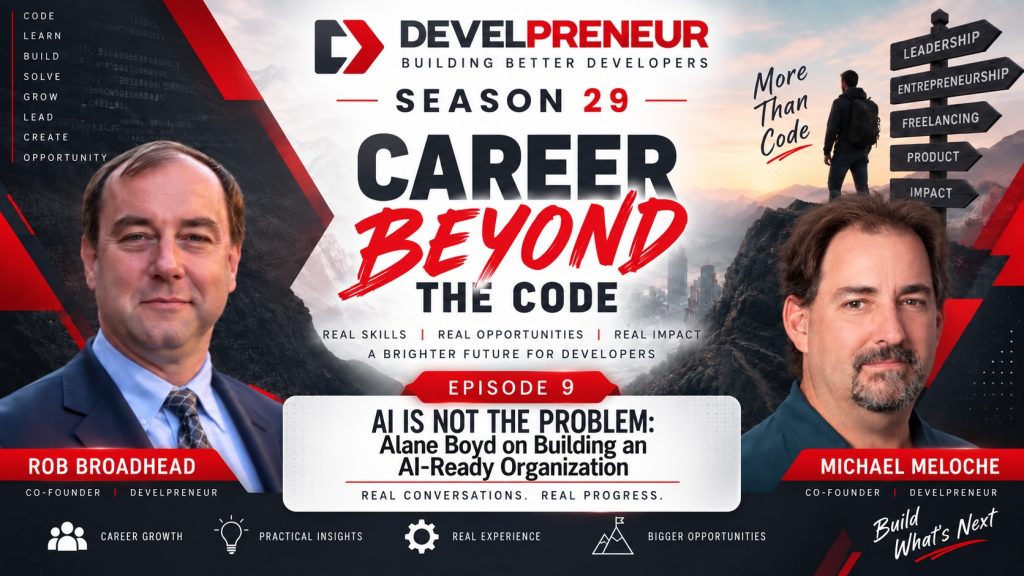
In this episode of Develpreneur: Building Better Developers, Rob Broadhead and Michael Meloche talk with Alane Boyd, Co-CEO of Biggest Goal, about what businesses are learning as they move beyond experimenting with AI. Alane has built and scaled technology companies, including two SaaS platforms and a social media agency. Today, much of her work focuses on helping organizations implement AI, train their teams, and create scalable systems that make work easier rather than simply adding another technology to the stack.
The conversation quickly reveals an important distinction. AI adoption is not really about purchasing AI tools. Building an AI-ready organization starts with understanding how work gets done and deciding where AI can genuinely improve that work.
About Alane Boyd
Alane Boyd is Co-CEO of Biggest Goal and a serial entrepreneur whose background spans technology, operations, sales, marketing, automation, and business growth. She has built SaaS businesses and describes herself as a two-time SaaS founder with successful exits. Biggest Goal’s current work focuses on hands-on AI training and implementation for leaders and teams, including helping organizations move from basic AI experimentation toward repeatable systems and practical business workflows.
Alane is also a published author, mentor, speaker, and podcast host. Her work increasingly focuses on practical AI fluency: helping businesses understand where AI belongs in their operations, how teams can use it consistently, and where human expertise should remain part of the process.
Learn more about Alane and her work through Biggest Goal and connect with her on LinkedIn.
Moving Beyond AI Experimentation
For many people, the first experience with generative AI was simple experimentation. They opened a chat window, entered prompts, generated content, summarized documents, or tried whatever interesting use case appeared online. That experimentation helped people become comfortable with the technology, but organizations are now asking a more difficult question: How do we turn that experimentation into a repeatable business process?
Alane sees this transition with both individuals and organizations. Solopreneurs may want to move beyond basic prompting and learn how tools such as Claude Cowork can become part of their workflow. Larger organizations face another challenge because they need multiple employees to use AI consistently. They also need policies that prevent AI adoption from becoming what Alane describes as the “wild, wild west.”
Many organizations already have employees using several different AI platforms. Those employees may be paying for separate subscriptions, developing their own prompting techniques, and solving similar problems without sharing what they have learned. Management eventually sees those subscriptions and begins asking what everyone is actually doing with them.
That is when AI stops being an individual productivity experiment and becomes an organizational challenge. It is also where the work of becoming an AI-ready organization really begins.
An AI-Ready Organization Needs Training
Michael shared an example that will probably sound familiar to many developers. One organization provided employees with AI development tools and effectively told them to use the technology to meet an aggressive deadline. There was no meaningful training, shared handbook, or established standard for how the tools should be used.
The AI helped the development team meet a deadline that likely would have been impossible otherwise. However, the lack of planning created another problem: consumption. Developers burned through available AI tokens quickly, forcing the organization to rethink how accounts and shared resources were allocated.
Alane has seen similar situations. One organization decided to skip training and purchase Claude subscriptions for its employees instead. Within days, employees exhausted their available usage and the company had to address the consequences.
The problem was not that the employees had access to AI. The problem was that nobody had taught them how to use it effectively.
Alane compares the situation to introducing any other workplace technology without establishing expectations. Give an organization Slack or Microsoft Teams without communication standards, and employees can quickly become overwhelmed with messages. AI follows the same pattern because employees naturally develop their own habits unless the organization provides guidance.
When Alane asks employees to share their screens and demonstrate how they use AI, she often discovers inefficient workflows that generate poor results while consuming unnecessary resources. Better tools do not automatically create better processes. Teams still need training.
Start with AI Champions
Organizations do not necessarily have to create an AI strategy from scratch. Alane recommends looking first at the people who are already experimenting with the technology.
Those employees can become AI champions. Instead of limiting AI adoption to the technology department, companies can create a cross-functional group of employees who already understand some of the possibilities. Representatives from sales, marketing, operations, development, and other departments can identify useful applications within their own areas while sharing what works across the organization.
This approach also helps companies address different comfort levels. Some employees naturally experiment with new technology and learn by trial and error. Others prefer structured instruction before changing how they work. Neither group represents an entire organization, so an implementation strategy needs to account for both.
Cross-department AI champions can help bridge that gap. They can demonstrate practical use cases, answer questions, and provide examples that are relevant to the work people actually perform. More importantly, they help an AI-ready organization develop shared practices instead of allowing every department to create its own isolated approach.
Not Every Task Needs AI
Another mistake is assuming that once an organization has AI, every task should involve it. Alane encourages companies to think carefully about where AI creates meaningful value.
Different teams also have different needs. Software developers may legitimately consume far more AI resources than employees performing other tasks because AI can dramatically accelerate certain areas of development. A content team, however, may not need the same allocation. In some cases, writing an email manually may actually be faster than prompting AI, reviewing its response, correcting it, and rewriting the result.
The goal is not maximum AI usage. The goal is better work. Organizations should ask where AI can handle repetitive processing, organize information, analyze transcripts, move data, or perform other behind-the-scenes tasks. They should also identify where human expertise still produces a better result.
That distinction matters because poorly implemented AI can actually increase costs. A company may purchase more subscriptions and consume more computing resources without gaining meaningful productivity. Training helps employees recognize which jobs are appropriate for AI and which jobs are better handled directly by a person.
AI Often Exposes Problems That Already Existed
One of Alane’s most important observations during the conversation is that many problems blamed on AI existed long before AI arrived. Companies frequently struggle with inconsistent processes, missing documentation, scattered files, and employees completing the same task in completely different ways.
AI does not create those problems. It makes them much harder to ignore.
Alane sometimes begins working with an organization only to discover that the company does not even have a consistent shared folder structure. Before building sophisticated AI agents or automations, the organization may need to solve much more basic operational problems.
This creates an important lesson for developers and business leaders. Automation works best when the underlying process is understood. If nobody can explain how a process is supposed to work, automating it may simply make the confusion happen faster.
In that sense, AI can act as a diagnostic tool. Attempting to implement it forces organizations to ask questions they should have asked already. Where does information live? Who owns a process? What is the standard procedure? Which version of a document is authoritative? Where should a human review occur?
Those are not AI questions. They are business process questions, and answering them is an important part of creating an AI-ready organization.
AI-Ready Organization Foundations Come First
Some organizations simply are not ready for advanced AI implementation. Alane has encountered companies whose technology and processes were so outdated that Biggest Goal ultimately determined it was not the right partner for them yet.
That does not mean those companies can never use AI. It means they have foundational work to complete first.
An organization may need to establish shared storage, document its standard operating procedures, modernize parts of its technology stack, or determine how information moves between departments. Once those foundations exist, AI becomes much easier to introduce because there is a stable process to improve.
This idea is especially important for developers. Technical teams are often asked to automate a process before anyone has clearly defined that process. The temptation is to start building immediately, but sometimes the correct first step is helping the business understand what it is actually trying to automate.
AI Can Reveal the Value of Automation
Alane shared an example from her own business that demonstrates what happens when a process is well suited for automation. Her company and business partner produce a podcast, and the production workflow previously required roughly 30 hours of human work each week.
Much of that work involved moving information from one place to another. A transcript needed to become a description, content needed to move into a blog, and information had to travel through several steps before publication. These tasks were necessary, but they did not require 30 hours of human judgment.
An AI agent workflow changed that equation. Removing repetitive data movement from a person’s workload did not eliminate the need for people. It allowed people to spend their time on work where their judgment, creativity, and expertise mattered more.
This is a much more useful way to think about AI adoption. Instead of asking, “How can we use AI?” organizations can ask, “Where are people spending time on work that does not require a person?” That question usually leads to better opportunities.
Build the Organization Before Building the Automation
For developers, the conversation with Alane highlights a familiar engineering principle: technology cannot compensate indefinitely for a broken process. AI may make development faster, accelerate research, automate repetitive tasks, and connect systems in ways that were difficult only a few years ago. However, those capabilities still depend on organizations knowing what they want to accomplish.
Before implementing AI across a team, businesses should establish several basic foundations:
- Identify the processes employees are already following.
- Determine where information and authoritative data should live.
- Establish policies for approved AI tools and appropriate usage.
- Train employees instead of simply purchasing subscriptions.
- Create AI champions across multiple departments.
- Identify tasks where AI creates measurable value.
- Preserve human review where judgment and quality matter.
These steps are not as exciting as building an AI agent, but they are essential to an AI-ready organization. Establishing them first makes agents and other automation far more useful when the organization is ready for them.
AI Is a Business Process Conversation
One of the biggest shifts happening with AI is that the conversation is moving beyond technology teams. Organizations are beginning to realize that AI adoption involves operations, leadership, training, culture, budgeting, and process design as much as software.
Developers have an important role in that transition. Technical professionals understand what these tools can do, but the most valuable developers will also understand when those capabilities solve a real problem. That means asking questions before building, understanding the workflow surrounding the technology, and recognizing when an organization needs process improvement before automation.
AI can make an efficient organization faster. It can also expose every inconsistency hiding underneath an inefficient one. The difference comes from what the organization does before it starts automating.
Building an AI-Ready Organization
Building an AI-ready organization does not begin with buying licenses. It begins with understanding how the organization works. Companies that skip that step may still get impressive short-term results, especially when motivated employees find creative ways to use AI. Over time, however, inconsistent processes, missing standards, uncontrolled costs, and fragmented workflows become increasingly difficult to manage.
The better approach is to treat AI as another part of the organization’s operating system. Train people, establish standards, identify useful processes, and give employees a way to share what they learn. Most importantly, fix the organizational problems that AI exposes instead of assuming another AI tool will solve them.
For developers building a career beyond the code, that creates an opportunity. The future is not only about knowing how to use AI. It is about understanding the business well enough to know where AI actually belongs.