
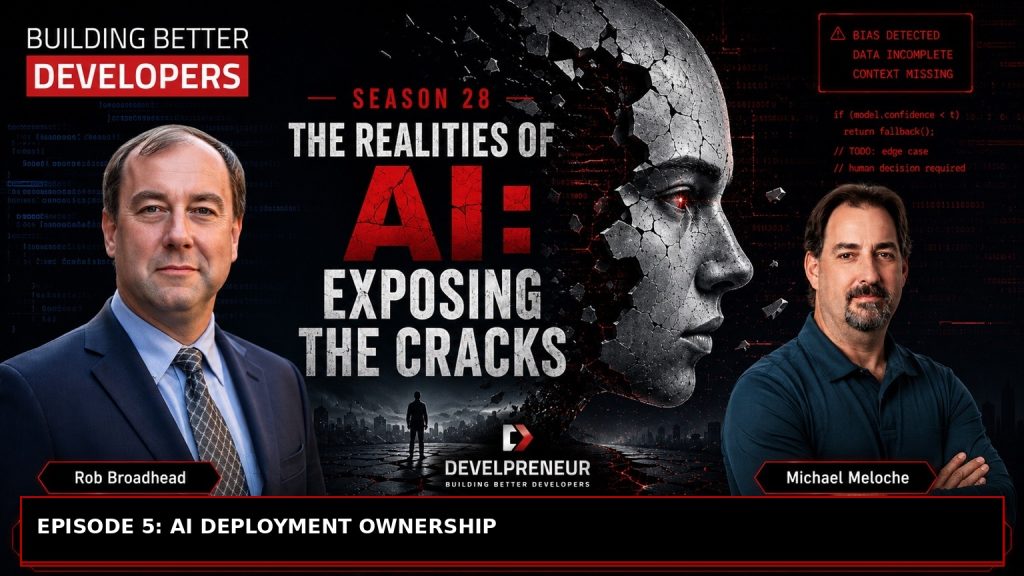

As AI becomes increasingly capable of generating code, many developers are asking the wrong question.
Instead of asking whether AI will replace developers, a better question is:
What skills become more valuable when code generation becomes easier?
The answer may be AI Deployment Ownership.
About Jason Sherman
Jason Sherman is a serial entrepreneur, filmmaker, author, and technology founder best known for building practical solutions that bridge the gap between emerging technology and real-world business problems. He is the founder and CEO of Vengo AI and has launched multiple technology platforms throughout his entrepreneurial career. Jason is known for his direct, hands-on approach to innovation, focusing on execution, product development, AI implementation, and helping businesses leverage technology without losing sight of operational realities.
His perspective combines startup experience, software development expertise, product strategy, and a strong belief that technology should solve actual business problems rather than chase trends.
Links: Facebook, Twitter / X, YouTube, LinkedIn, Website
AI Deployment Ownership Changes the Developer Role
Historically, many developers focused on implementation.
Their value came from translating requirements into working code.
Today, AI can assist with much of that work.
That shifts responsibility upward.
Developers are increasingly expected to understand:
- Architecture
- Infrastructure
- Security
- Deployment
- Automation
The ability to oversee an entire system becomes more important than writing every line manually.
Insight: AI raises the importance of systems thinking.
Why Building Is No Longer Enough
Many AI-created applications work perfectly in development environments.
Production introduces a different reality.
Organizations need:
- Monitoring
- Logging
- Security controls
- CI/CD pipelines
- Recovery procedures
These are areas where experience matters significantly.
An application that functions correctly in a demo environment may fail quickly when exposed to real-world usage patterns.
AI Deployment Ownership Requires Infrastructure Knowledge
One of the strongest themes from the conversation was ownership.
Developers who understand deployment gain an advantage by moving beyond simple application development.
Key capabilities include:
- Server management
- API security
- Automated deployments
- Version control workflows
- Environment management
These responsibilities cannot be delegated entirely to AI.
Action: Learn how applications move from development into production.
The Rise of the Technical Operator
The next generation of developers may resemble technical operators rather than pure coders.
Their responsibilities include:
- Reviewing AI output
- Managing architecture
- Protecting infrastructure
- Maintaining reliability
This shift mirrors previous technology transitions.
Tools become easier.
Responsibility becomes greater.
AI Deployment Ownership Creates Career Protection
Developers concerned about long-term career relevance should focus on areas where judgment matters.
AI can generate code.
It cannot reliably assume accountability.
Organizations still need professionals who can:
- Evaluate tradeoffs
- Assess risks
- Make deployment decisions
- Own outcomes
That ownership creates value.
Conclusion
The future belongs to developers who understand entire systems rather than individual code files. AI Deployment Ownership represents a practical path forward for developers looking to remain relevant in an increasingly automated environment.
Stay Connected: Join the Developreneur Community
👉 Subscribe to Building Better Developers for more conversations on momentum, leadership, and growth. Whether you’re a seasoned developer or just starting, there’s always room to learn and grow together. Contact us at [email protected] with your questions, feedback, or suggestions for future episodes. Together, let’s continue exploring the exciting world of software development.