
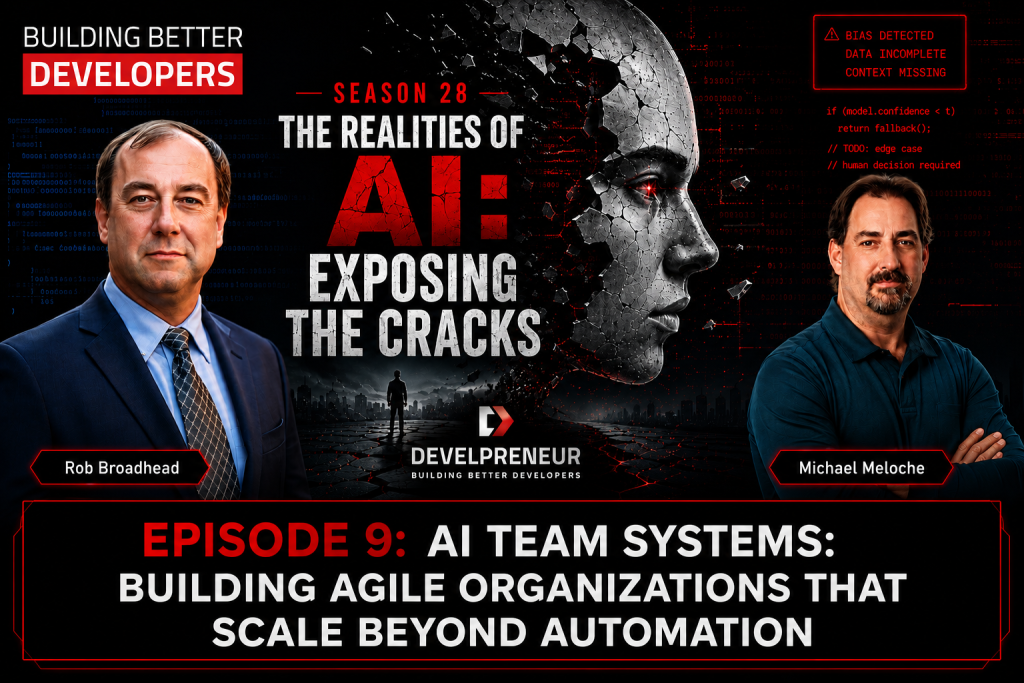

As AI becomes embedded in software development workflows, many leaders assume the biggest changes will happen in coding. The reality may be very different. The future belongs to AI Team Systems—the structures, feedback loops, and operational practices that transform rapid development into meaningful business outcomes. During Building Better Developers Season 28 Episode 9, Dave Borzillo explored how Agile principles may evolve in an AI-powered environment and why human collaboration remains essential.
About David Borzillo
David Borzillo is an Agile coach, author, speaker, and organizational improvement advocate with more than three decades of experience spanning software development, leadership, Agile transformation, and product delivery. Through his Better Ways of Working platform, he helps organizations improve collaboration, reduce operational friction, and create sustainable delivery systems. He is the author of Sanity at Scale and Who Killed Agile? (co-authored), and United Agility, and hosts the Better Ways of Working podcast.
Follow David at: https://betterwaysofworking.com/about.html
Bonus: Free Kindle Promotion
📚 David Borzillo’s new book: Sanity at Scale
Amazon Link:
https://www.amazon.com/dp/B0H41M87KJ
Free Kindle Weekend
June 26–28
- Download the Kindle edition free during the promotion period.
- If you’re a Kindle Unlimited subscriber, the book is available at no additional cost anytime.
If you download the book, David would appreciate an honest review on Amazon after reading it.
Why AI Team Systems Matter More Than Faster Coding
AI dramatically reduces implementation effort. That sounds like a technical breakthrough. But it creates a management challenge. When code can be generated quickly, organizations must decide:
- What should be built?
- Who benefits?
- How is quality maintained?
- How is feedback collected?
Dave suggested that Agile teams may move toward faster feedback cycles and even shorter sprint models. The key insight is that speed alone doesn’t create value. Feedback does.
AI Team Systems Depend on Continuous Customer Interaction
One of the most compelling parts of the discussion revisited ideas from Extreme Programming (XP). Dave highlighted the importance of close customer collaboration and immediate feedback rather than waiting for formal review cycles. In practice, this means:
- Showing completed work immediately
- Gathering stakeholder feedback continuously
- Validating assumptions early
- Reducing delays between learning and action
As development accelerates, waiting weeks for feedback becomes increasingly inefficient. The future may look less like faster Scrum and more like continuous collaboration.
AI Team Systems Still Need Human Leadership
A common misconception is that AI will eliminate many Agile roles. Dave strongly challenged that assumption, particularly regarding Scrum Masters. Administrative work may become automated. Leadership will not. Future Scrum Masters may focus less on scheduling meetings and more on:
- Team coaching
- Conflict resolution
- Organizational improvement
- Stakeholder alignment
- Quality assurance
These responsibilities require emotional intelligence, context awareness, and judgment. None is easily automated.
AI Team Systems Require Team Health Metrics
An especially valuable concept discussed during the episode was measuring team happiness. Dave referenced using simple happiness indicators to monitor team health over time. Declining trends often reveal problems before delivery metrics show warning signs. This matters because AI increases activity visibility but not necessarily team well-being. Organizations that focus exclusively on velocity risk are missing leading indicators of future performance issues.
Healthy teams:
- Communicate effectively
- Share knowledge
- Resolve conflicts quickly
- Adapt to change
Those capabilities become more important—not less—as automation increases. Faster delivery means little if team effectiveness is deteriorating underneath the surface.
AI Team Systems Create Better Onboarding
Another opportunity discussed was onboarding. AI can help new team members understand products, architecture, backlog history, and business context much faster than traditional documentation methods.
Imagine a new developer asking:
- Who uses this product?
- Why does this feature exist?
- What architectural dependencies matter?
- Which backlog items carry the most business value?
Well-structured AI systems can answer those questions immediately. The result is faster ramp-up and stronger organizational memory.
AI Team Systems Shifts the Developer Role
Perhaps the biggest long-term change is the evolution of the developer role itself.
Developers increasingly contribute to:
- Product thinking
- Quality strategy
- Test automation
- Architectural decisions
- Stakeholder conversations
The discussion emphasized that testing, architecture, and continuous learning remain critical responsibilities even as coding becomes easier. Success will come from understanding systems, not simply producing code. Invest in communication, product thinking, and collaboration skills alongside technical expertise.
Conclusion
AI is transforming software development, but its greatest impact may be organizational rather than technical. The winners will not be teams that generate the most code. They will be teams that build effective AI Team Systems—combining automation, customer feedback, strong leadership, and continuous learning into a sustainable operating model. Technology may increase speed. Systems determine results.
Stay Connected: Join the Developreneur Community
👉 Subscribe to Building Better Developers for more conversations on momentum, leadership, and growth. Whether you’re a seasoned developer or just starting, there’s always room to learn and grow together. Contact us at [email protected] with your questions, feedback, or suggestions for future episodes. Together, let’s continue exploring the exciting world of software development.