
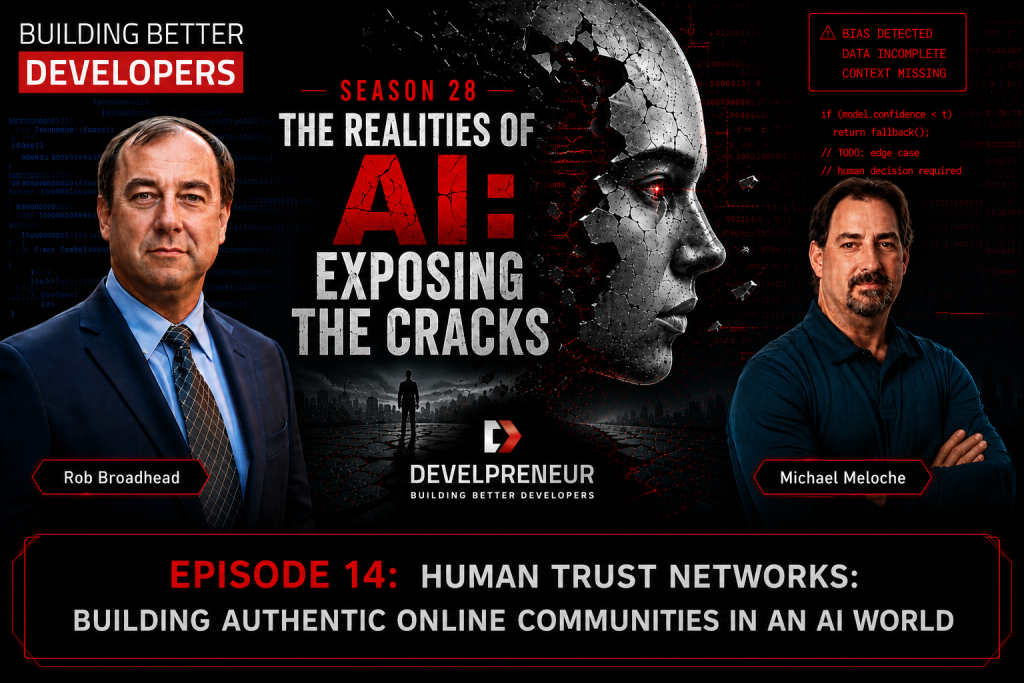

As AI-generated content continues to flood social platforms, the challenge is no longer creating information—it’s determining whether the person behind it is real. Human Trust Networks represent a different way of thinking about online interaction, one that focuses less on content moderation and more on verifying the humanity behind the conversation.
In this episode of Building Better Developers, Richard Kersey discussed the experiment behind Chirper, a platform designed around a simple but increasingly important question: Do people care enough about talking to real humans to accept a little friction in the process?
About Richard Kersey
Richard Kersey is the founder and developer behind Chirper, an experimental social platform focused on verifying human participation online while preserving anonymity. His work explores one of the most pressing questions in the AI era: how do we know we’re interacting with real people without sacrificing privacy? Through concepts such as trust chains, community verification, and decentralized accountability, Richard is testing new approaches to online identity, trust, and digital conversations.
Follow Richard on LinkedIn: https://www.linkedin.com/in/richardkersey/
Why Human Trust Networks Matter More Than Ever
For years, online communities have struggled with spam, fake accounts, coordinated influence campaigns, and automated content. The rise of AI has amplified the challenge. Today, a bot can generate comments, participate in discussions, and create content that appears remarkably human. In many situations, the average user has little chance of determining whether they are interacting with a person or a machine.
The result is a growing trust problem. People no longer question only the information itself. They question the source. That shift fundamentally changes how communities function. The problem isn’t simply misinformation. There is uncertainty about who—or what—is participating in the conversation.
Human Trust Networks Shift the Focus from Content to Identity
One of the most interesting ideas discussed during the episode was avoiding content policing altogether. Instead of deciding which opinions are acceptable, the goal is to determine whether the participant is human. This distinction is important. Many platforms attempt to solve trust issues through moderation, fact-checking, or content filtering. Human Trust Networks take a different route.
The question becomes:
- Is this account connected to a real person?
- Has another verified human vouched for them?
- Can accountability exist without revealing identity?
By moving the focus from what is being said to who is participating, communities can preserve open discussion while still creating trust.
Human Trust Networks and Anonymous Accountability
One of the biggest tensions online is balancing privacy with responsibility.
Traditional verification systems often require:
- Government IDs
- Personal photos
- Phone verification
- Extensive personal information
The problem is that stronger verification usually means less privacy. Richard’s concept introduces a middle ground. Users remain anonymous, but they become accountable through a trust chain. Each participant effectively vouches for another participant. If someone invites bad actors or automated accounts into the system, their trust score is affected as well. This creates a shared responsibility model.
Rather than relying on centralized verification, trust is distributed throughout the network. Accountability does not necessarily require public identity. It requires consequences connected to behavior.
How Human Trust Networks Create Community Quality
Every online platform faces the same challenge: How do you maintain quality as the community grows? The trust-chain concept introduces a natural filtering mechanism. When invitations carry responsibility, people become more selective. This changes user behavior in several ways:
More Intentional Invitations
Participants become stakeholders in community quality.
Better Signal-to-Noise Ratio
Users have incentives to bring in thoughtful contributors rather than random accounts.
Stronger Community Ownership
The health of the platform becomes everyone’s responsibility. These effects create something many platforms struggle to achieve: shared accountability without centralized control.
The Real Test for Human Trust Networks
The most important question raised during the discussion wasn’t technical. It was behavioral. Do people actually care? Many users complain about bots. Many users claim they want authentic interactions. But are they willing to spend extra time verifying themselves or participating in a trust-based onboarding process?
That question can only be answered through experimentation. The early response discussed in the episode suggests there is genuine interest, particularly among people already frustrated by automated interactions. Still, scaling that interest into a thriving community remains the real challenge. Users often say they want authenticity until authenticity introduces friction.
Human Trust Networks Could Change More Than Social Media
While Chirper currently focuses on discussion and social interaction, the broader implications are significant.
Trust-based verification could eventually support:
- Professional communities
- Expert forums
- Educational platforms
- Online marketplaces
- Decentralized identity systems
The common thread is trust. As AI becomes more capable, proving humanity may become increasingly valuable. The organizations that solve that challenge may create entirely new categories of online experiences. Consider where your business depends on trust. AI is making content easier to create, but trust remains difficult to earn.
Conclusion
Human Trust Networks represent a fascinating response to one of the biggest challenges of the AI era. Rather than fighting AI-generated content directly, they focus on verifying the people behind conversations. Whether this approach becomes mainstream remains to be seen. What is clear, however, is that the value of trusted human interaction is increasing as automated participation becomes more common. The future of online communities may depend less on what platforms allow people to say and more on how they establish that people are truly people in the first place.
Stay Connected: Join the Developreneur Community
👉 Subscribe to Building Better Developers for more conversations on momentum, leadership, and growth. Whether you’re a seasoned developer or just starting, there’s always room to learn and grow together. Contact us at [email protected] with your questions, feedback, or suggestions for future episodes. Together, let’s continue exploring the exciting world of software development.