
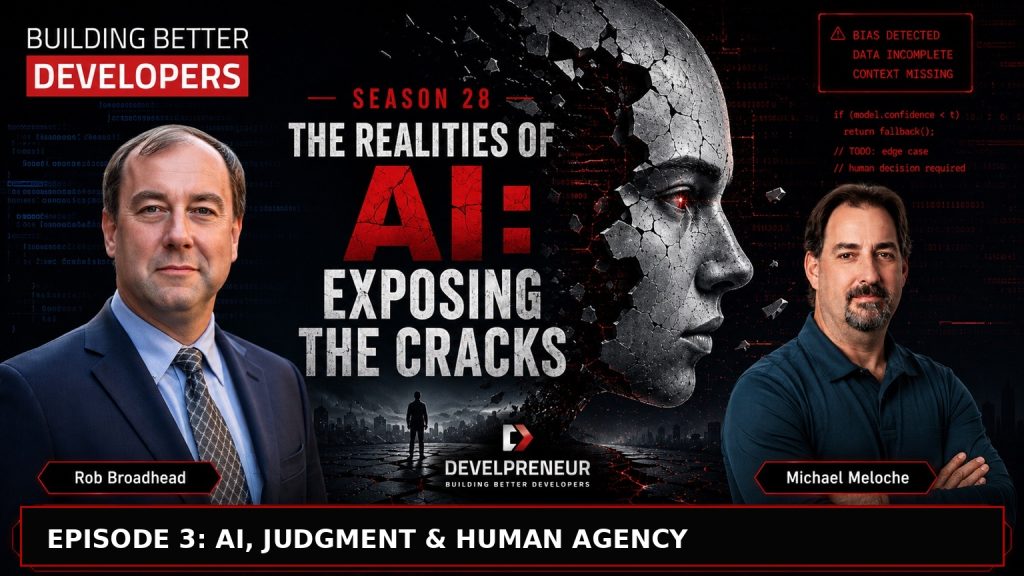

One of the biggest mistakes organizations make with AI is assuming that more automation automatically creates better outcomes. Daria Rudnik introduced a framework that challenges that assumption: the Human Agency Scale. Rather than asking whether AI should be used, the framework asks a more important question: How much human involvement should remain?
About Daria Rudnik
Daria Rudnik helps overloaded leaders build self-sufficient teams in an AI-driven world. Through her proprietary CLICK Framework, she works with fast-growing technology and finance organizations to improve team ownership, decision-making, knowledge sharing, and adaptability. Daria is the author of CLICKING (International Impact Book Awards – Leadership Category), co-author of The AI Revolution, and founder of Aidra.ai, an AI coaching platform designed to scale leadership development.
🔗 LinkedIn: https://www.linkedin.com/in/dariarudnik/
Understanding the Human Agency Scale
The scale ranges from highly automated environments to highly human-driven environments.
- At one end, AI performs nearly all work.
- At the other, humans retain primary responsibility while AI provides support.
- Between those extremes exists a partnership model where both contribute.
The value of the framework is not choosing one position permanently. The value comes from consciously deciding where each task belongs.
Why Teams Drift Toward Automation
People naturally prefer efficiency.
When AI produces acceptable results quickly, there is a strong temptation to automate everything possible.
The danger is subtle.
- As automation increases, judgment can decrease.
- Teams stop questioning recommendations.
- Critical thinking weakens.
- Understanding erodes.
Eventually, people become dependent on outputs they no longer know how to evaluate.
The greatest AI risk may not be bad answers. It may be losing the ability to recognize bad answers.
Human Agency Scale and Decision Quality
Daria shared an example where teams used AI-generated ideas but required individuals to present and defend them as if the ideas were their own.
This exercise forced people to:
- Understand the recommendation
- Evaluate supporting evidence
- Communicate reasoning
- Defend conclusions
The result was better engagement and stronger decisions.
AI provided the starting point.
Humans provided judgment.
Human Agency Scale and Team Collaboration
A common misconception is that AI reduces the need for collaboration.
The opposite may be true.
As AI generates more content, organizations need more discussion around priorities, tradeoffs, risks, and business context.
- The quantity of information increases.
- Human interpretation becomes more important.
Teams that collaborate effectively gain more value from AI than teams that operate independently.
Require team members to explain and defend major AI recommendations before implementation.
Human Skills Become More Valuable
Many fear AI will reduce the importance of people.
Daria argues the opposite.
- Critical thinking.
- Empathy.
- Communication.
- Strategic thinking.
- Collaboration.
These capabilities become increasingly valuable because they cannot simply be delegated.
The more AI handles execution, the more humans must focus on judgment.
Human Agency Scale as a Leadership Tool
Leaders should evaluate workflows using the Human Agency Scale.
Ask:
- Where should AI automate?
- Where must humans remain involved?
- Where does collaboration matter most?
- What skills are we trying to preserve?
These questions create intentional adoption instead of accidental dependency.
AI should expand human capability, not replace human responsibility.
Conclusion
The Human Agency Scale provides a practical framework for balancing efficiency and judgment. Organizations that consciously define the relationship between people and AI will build stronger teams than those that automate by default.
Stay Connected: Join the Developreneur Community
👉 Subscribe to Building Better Developers for more conversations on momentum, leadership, and growth. Whether you’re a seasoned developer or just starting, there’s always room to learn and grow together. Contact us at [email protected] with your questions, feedback, or suggestions for future episodes. Together, let’s continue exploring the exciting world of software development.