

AI is changing software development faster than most organizations can adjust their processes around it. Developers can generate code, tests, documentation, and prototypes in a fraction of the time those tasks once required. Business owners who have never written software can now describe an idea to an AI tool and have something working surprisingly quickly.
That creates tremendous opportunity, but it also changes where the real value in software development lives.
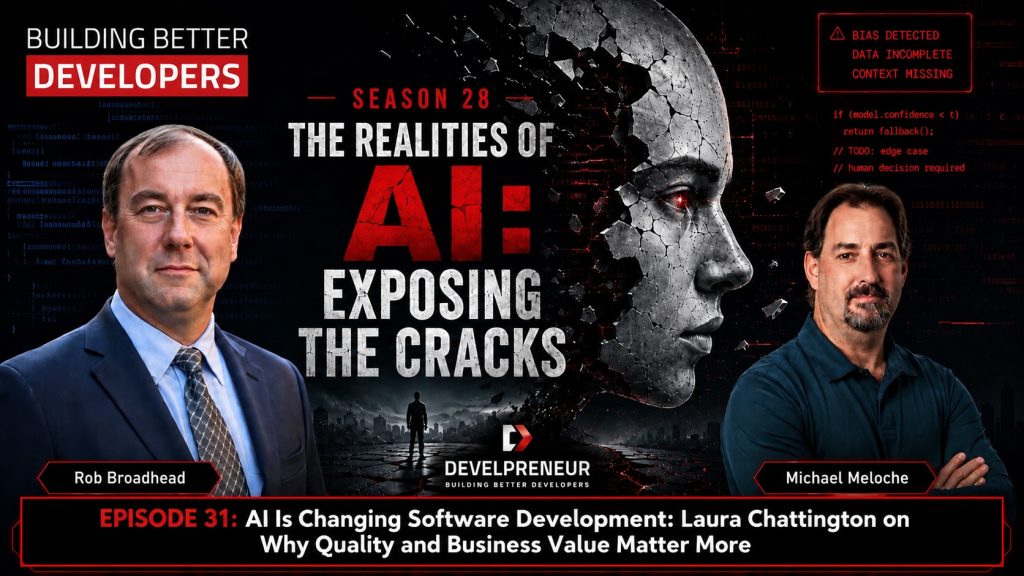
In the second half of our conversation with Laura Chattington, CEO of Rebalance Network Limited, we explored what happens when producing code is no longer the hardest part of building software. Laura argues that developers still have an important role, but the value they provide is shifting toward understanding the problem, managing risk, assuring quality, and connecting technology to business outcomes.
About Laura Chattington
Laura Chattington is the CEO of Rebalance Network Limited and works with established entrepreneurs and corporate leadership teams to turn AI capabilities into measurable business value.
Laura began her career as a software engineer and has more than 20 years of experience spanning technology, business, communications, and leadership. Her work includes AI strategy and transformation programs, executive AI workshops, AI CEO programs, the AI Evolution Multiplier, and the Four Levels of AI Value framework.
Learn more through Rebalance Network, connect with Laura Chattington on LinkedIn, or follow Laura Chattington on YouTube.
AI Has Lowered the Barrier to Building Software
One of the most significant changes AI has introduced is access. Entrepreneurs and other non-technical users can now experiment with software without immediately hiring a development team. They can create prototypes, automate workflows, connect systems, and build surprisingly capable applications by working directly with AI.
Laura sees this happening regularly with the businesses she works with. The challenge is determining where experimentation should stop and professional software engineering needs to begin.
An AI assistant will enthusiastically keep building when you ask it to. It may make an assumption, misunderstand a requirement, or introduce a problem that isn’t immediately obvious. Someone without a technical background may see a working application and reasonably assume everything underneath it is working correctly as well.
A software engineer sees a different set of questions. How is the data protected? What happens when an integration fails? How does the application handle unexpected input? Can it scale? How is it tested? What assumptions did AI make while generating the solution?
That knowledge hasn’t suddenly become irrelevant because AI can write code. In many ways, it has become more important.
Bad Scope on Rocket Fuel
Laura offered one of my favorite descriptions of this problem during our conversation: AI can become “bad scope on rocket fuel.”
Software teams have always struggled with poorly defined requirements. If the customer and development team don’t clearly understand the problem, developers can spend months building something before everyone realizes they were solving the wrong problem.
AI changes the speed of that mistake. A poorly scoped project can now generate a tremendous amount of code and functionality very quickly. That can create the illusion of progress because there is always something new to demonstrate. However, producing more software doesn’t necessarily mean you are getting closer to the correct solution.
This is something I’ve seen repeatedly from the testing and quality side of software development. Speed is valuable only when you maintain confidence in what you’re producing. Accelerating implementation while removing validation simply moves problems downstream, where they usually become more expensive to fix.
The goal shouldn’t be to slow AI down. It should be to build the right quality gates around that speed.
Quality Assurance Becomes More Important, Not Less
This led to one of the more interesting parts of our conversation. Laura believes AI may change the relationship between software development and quality assurance.
Traditionally, developers have often received most of the attention. Development creates the product, while QA can sometimes be treated as the group that appears later and tells everyone what is wrong with it.
AI disrupts that equation. If AI can generate large amounts of code quickly, simply producing code becomes less of a differentiator. The more important question becomes whether the generated software is correct, reliable, secure, maintainable, and actually solving the intended problem.
As Laura explained, the challenge becomes how we use the intelligence and speed AI provides while retaining high-quality assurance throughout the process.
That doesn’t mean developers disappear and testers take over. It means development and quality need to become much more tightly connected. Developers need to understand validation, testers need to become involved earlier, and teams need automated checks and human review positioned throughout the development process.
AI gives us speed. Quality gives us confidence that we’re moving quickly in the right direction.
Developers Need to Rethink the Value They Provide
This also raises an uncomfortable question for developers: if AI can write much of the code, what exactly are we being paid to do?
The answer can’t simply be typing faster.
Laura argued that software engineers need to think more creatively about the value they bring to the table. Knowing how software works remains important, but understanding what should be built and why becomes increasingly valuable as implementation gets easier.
A developer who understands the business can identify assumptions before they become expensive mistakes. They can recognize when a proposed AI solution creates unnecessary risk, determine where automation makes sense, and help leadership distinguish an impressive demo from something that can safely support the business.
That combination of technical understanding and business communication creates a significant opportunity.
Laura saw a similar pattern early in her own career as a Java developer. Her ability to communicate with the business pulled her toward management and leadership roles. She sees that opportunity emerging again for technical professionals who can bridge the gap between AI capabilities and business outcomes.
What Do You Do With the Time AI Gives Back?
The conversation then returned to a question from the first half of the interview: what happens when AI dramatically reduces the time required to perform work?
Suppose a task that once took a week now takes two hours. Saving that time sounds impressive, but the time savings alone aren’t necessarily business value. The real question is what happens to the rest of the week.
Laura believes relatively few businesses have figured this out. Organizations may purchase AI licenses and encourage adoption, but simply giving employees tools doesn’t create a strategy. Leadership needs to decide how the capacity created by AI will be used.
If a 100-person organization gives each employee several hours back every week, the combined capacity can be enormous. That time could improve customer service, accelerate product development, generate new revenue, reduce delays, or allow teams to solve problems they previously didn’t have time to address.
Without that next step, the company has optimized a task without necessarily transforming the business.
Look for the Biggest Pressure Points
Laura shared an example from working with a leadership team in the urgent healthcare sector. Before spending time with the organization, she could have arrived with a long list of sophisticated ways the company might use AI.
Once she understood how the organization actually worked, however, she discovered something much simpler: people were spending huge amounts of time in meetings.
Some meetings existed because people had missed previous meetings. Others were necessary to communicate information that had already been discussed elsewhere. Executives needed to catch up before attending another meeting, creating another cycle of lost time.
The valuable AI opportunity wasn’t necessarily an elaborate new application. It was using AI to capture meetings, summarize information, create executive reports, and prepare people before they entered the next conversation. That kind of workflow could return a substantial amount of time to the organization.
You don’t discover opportunities like that by starting with a list of AI tools. You discover them by understanding how people work.
Start With Pain, Then Apply AI
That example reinforces a principle we continue returning to throughout this season of Develpreneur: start with the problem.
Look at where the organization is spending its time. Find the repeated manual work, communication gaps, customer frustrations, delays, and bottlenecks. Determine which problems are actually expensive enough to solve, and then ask where AI can provide leverage.
Laura described two questions she looks at when working with organizations. First, where is the business spending large amounts of time that AI could reduce? Second, how could AI help customers reach their desired outcomes faster?
The second question is particularly important because it moves AI beyond internal productivity. Saving employees five hours is useful. Helping customers achieve an outcome twice as fast may fundamentally change the value of your product or service.
That’s where AI starts becoming a business strategy rather than another productivity tool.
Faster Iteration Changes How We Build
AI may also change some of the traditional assumptions around software planning.
Historically, implementation was expensive. Organizations could spend months designing a solution and creating detailed specifications because getting development wrong meant wasting months of work from an expensive development team.
When implementation becomes dramatically faster, the economics change. Laura’s approach is to maintain the necessary scope and fundamentals while recognizing that teams can now learn through much faster iteration.
Instead of spending months trying to document every possible detail before anything gets built, teams can create something smaller, validate it, learn from it, and iterate. That doesn’t mean abandoning requirements or planning. It means adjusting the amount of upfront work to the cost and speed of implementation.
From a quality perspective, that makes feedback loops critical. Faster iteration only works when teams can quickly determine whether the change actually works. Automated testing, monitoring, user feedback, and clearly defined outcomes become essential parts of an AI-accelerated development process.
The Opportunity Is Bigger Than AI
One of Laura’s strongest messages was that many business leaders know AI represents a significant competitive transition, but they still don’t know how to convert it into measurable value.
That’s an opportunity for developers.
The technical professionals who succeed in this environment won’t necessarily be the people who know every new model or AI framework. Those technologies are going to continue changing too quickly. The more durable skill is being able to walk into a business, understand how it operates, identify where technology can create leverage, build the appropriate solution, and establish enough quality assurance to trust the result.
For developers who can also communicate that value to business leaders, the opportunity becomes even larger.
AI can generate code, create tests, and automate processes. What businesses still need are people who understand what should be built, where the risks are, how to know whether it works, and how it creates value.
That may ultimately be one of the biggest changes AI brings to software development. It isn’t eliminating the need for good developers. It is forcing us to become much clearer about what being a good developer actually means.
Stay Connected: Join the Developreneur Community
👉 Subscribe to Building Better Developers for more conversations on momentum, leadership, and growth. Whether you’re a seasoned developer or just starting, there’s always room to learn and grow together. Contact us at [email protected] with your questions, feedback, or suggestions for future episodes. Together, let’s continue exploring the exciting world of software development.