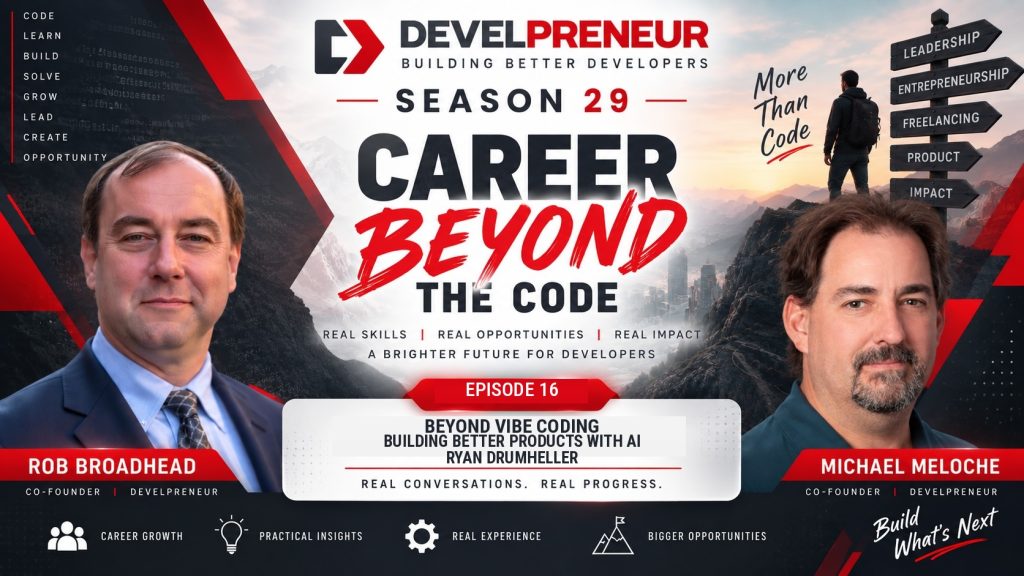

Artificial intelligence has dramatically reduced the time and effort required to develop software, but building a successful product still demands more than generating code. Developers must understand customer problems, evaluate technical decisions, maintain quality, and create solutions that people actually want to use. In Part 2 of their conversation with Ryan Drumheller, Building Better Developers hosts Rob Broadhead and Michael Meloche explore how AI is reshaping product development and what that means for developers looking to build a career beyond the code.
About Ryan Drumheller
Ryan Drumheller is a technology leader, entrepreneur, author, and co-founder of Dogleg Digital. With more than two decades of experience spanning IT operations, infrastructure, development, technical leadership, and business strategy, Ryan has focused much of his career on connecting technology with the people and organizations it serves.
He graduated from Western Governors University and advocates for professional education, mentorship, and continuous learning. His book, From Firewalls to Fairways: How a Career in IT Led Me to Golf, shares lessons from his career and explores how setbacks and unexpected opportunities can lead to personal and professional reinvention.
Connect with Ryan and learn more about his work:
- LinkedIn: https://www.linkedin.com/in/ryan-drumheller/
- Personal website and book: https://ryandrumheller.com/
- Dogleg Digital: https://doglegdigital.com/
Stop Selling Yourself and Start Solving Problems
Rob begins the second part of the interview by exploring an interesting observation from Ryan’s career. Despite years of technical expertise and leadership experience, Ryan found it difficult to confidently sell his consulting services. However, when he began developing a product designed to solve a specific problem, that hesitation largely disappeared.
The difference was not simply confidence in his technical abilities. It was confidence in the solution.
Rather than asking potential customers to believe in his experience, Ryan could demonstrate a product shaped by their needs. His team had spoken with people in the golf industry, identified operational challenges, and incorporated that feedback into its development decisions.
This shifted the conversation away from selling technical expertise toward explaining how a solution could improve a customer’s business.
For developers considering entrepreneurship or consulting, the lesson is significant. Customers are generally less concerned with the technologies used to build something than they are with whether it solves a problem that matters to them.
Finding Customers Through Genuine Conversations
Michael followed Ryan’s comments by asking how he identified and connected with his target audience, particularly when traditional networking and face-to-face business relationships can be difficult to establish.
Ryan explained that his interest in golf initially developed as an escape from professional burnout. After spending years immersed in technology, getting outside and playing golf provided an opportunity to disconnect from work.
However, his technical curiosity eventually followed him onto the course.
As Ryan visited different golf facilities, he began observing their operations, software, booking processes, and business challenges. What started as a recreational activity became an opportunity to understand an industry from the customer’s perspective.
He began asking questions, connecting with golf professionals on LinkedIn, publishing observations, and participating in industry discussions. Those conversations eventually helped shape Dogleg Digital’s product direction.
Rather than building something first and searching for customers afterward, Ryan and his team used customer relationships to identify which problems deserved attention.
The approach provided valuable feedback while also establishing connections with potential future customers.
AI Makes Experimentation Easier, but Quality Still Matters
Rob then shifted the conversation toward AI and its ability to reduce the cost of experimenting with new software ideas.
Ryan acknowledged that modern AI tools make it possible to build products that would have required significantly more time and resources only a few years earlier. His original idea for Dogleg Digital had existed for approximately three years, but the economics of traditional development made the project more difficult to pursue.
AI changed what his team could realistically accomplish.
However, Ryan cautioned against confusing development speed with product readiness. Generating functional code is only part of the challenge. Developers still need to consider security, usability, reliability, and the experience delivered to the customer.
He specifically distinguished AI-assisted development from simply accepting whatever code an AI tool produces.
Developers with strong technical foundations can use AI to accelerate implementation while recognizing weaknesses, correcting mistakes, and making informed architectural decisions. Without that expertise, organizations risk releasing products that appear complete but lack the quality required for real-world use.
For Ryan, speed to market is important, but it cannot come at the expense of proper testing and quality assurance.
The Human Advantage in an AI-Driven Industry
Michael expanded the discussion by asking whether faster AI-powered development could reduce demand for traditional services as businesses increasingly build solutions themselves.
Ryan acknowledged that some industries are already experiencing this pressure, particularly creative and marketing-related professions. Organizations may view AI as an opportunity to reduce costs, even when doing so sacrifices valuable human experience.
However, he argued that experienced professionals remain essential because they understand how to use technology effectively.
An AI tool can produce an output, but an experienced developer or business specialist can evaluate whether that output makes sense, identify missing requirements, and recognize problems that automated systems overlook.
Ryan recalled that his approach to AI consulting involved identifying the employees who provided an organization with its greatest competitive advantages. Those were the people he wanted involved in AI adoption because their expertise could make the technology more effective.
The same principle applies to software development. AI should enhance the capabilities of knowledgeable professionals rather than become an excuse to eliminate critical thinking.
Leading Development Teams Beyond Vibe Coding
Rob connected Ryan’s perspective to the responsibilities of effective leadership. A strong technical leader does not simply assign tasks and disappear. Leaders provide direction, participate in problem-solving, mentor their teams, and help ensure that the final work meets expectations.
Ryan described how Dogleg Digital combines traditional development expertise with AI-assisted processes.
His business partner creates detailed product requirements documents that outline functionality, interface expectations, and visual examples. These specifications provide developers with a clearer understanding of what needs to be built before implementation begins.
AI can then help accelerate the development process, allowing team members to spend more time refining functionality, improving security, and reducing defects rather than repeatedly interpreting incomplete requirements.
Ryan explained that this approach makes it easier for the entire team to understand development progress. It also allows a relatively small group to pursue an ambitious product roadmap that would have been substantially more difficult using traditional methods alone.
The result is not development without developers. It is a process where developers spend more of their time applying judgment and improving the finished product.
Building Better Developers Means Understanding the Entire Process
Ryan’s experiences reinforce a recurring theme throughout this season of Building Better Developers: Technical ability alone is no longer enough to define a successful development career.
AI may change how code is written, but it does not eliminate the need to understand customers, establish clear requirements, manage risk, or evaluate whether a product delivers meaningful value.
The developers who thrive in this environment will be those who can connect technical capabilities with business outcomes. They will know when to use AI, when to challenge its recommendations, and when human experience must guide the final decision.
Ryan’s journey from corporate technology leadership to building Dogleg Digital demonstrates how those skills can create opportunities beyond traditional employment.
The future of software development is not simply about writing code faster. It is about understanding the problem, building the right solution, and using AI to make the entire process better.
Follow Building Better Developers for more conversations with technology leaders, entrepreneurs, and professionals who are creating opportunities beyond the code.
Stay Connected: Join the Developreneur Community
👉 Subscribe to Building Better Developers for more conversations on momentum, leadership, and growth. Whether you’re a seasoned developer or just starting, there’s always room to learn and grow together. Contact us at [email protected] with your questions, feedback, or suggestions for future episodes. Together, let’s continue exploring the exciting world of software development.