

Online education has never been easier to access. You can learn almost anything through YouTube, Udemy, online communities, independent creators, coaches, and specialized training programs.
Access isn’t the problem anymore.
Trust is.
There’s a big difference between spending $10 on a course and investing $2,000, $5,000, or more in a mentor, mastermind, or coaching program. When the investment gets larger, a five-star testimonial on a sales page doesn’t cut it.
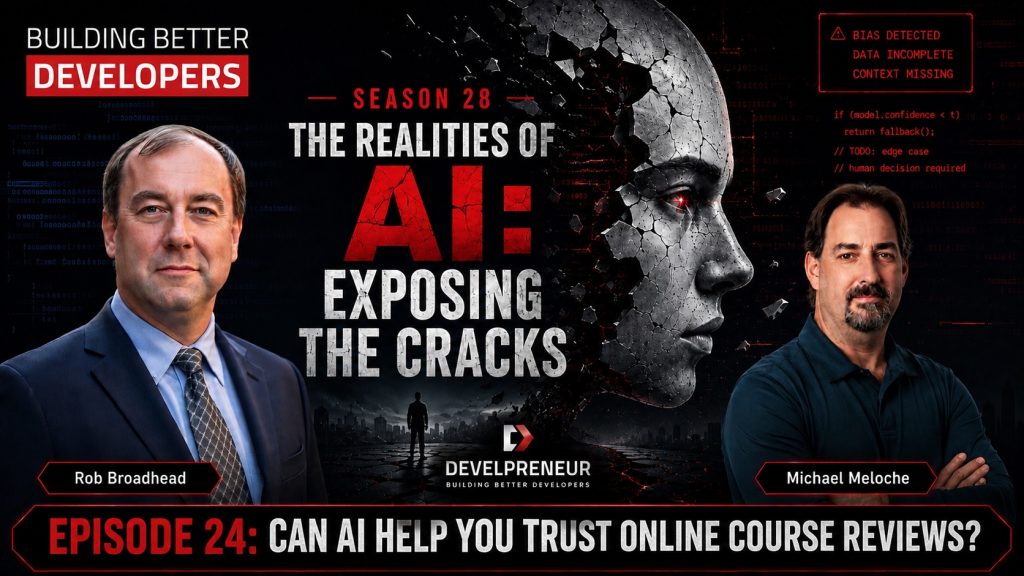
In this episode of Building Better Developers, Rob Broadhead and Michael Meloche talk with Amit Zandberg about the challenge of creating trustworthy AI course reviews and helping people evaluate online mentors and high-ticket educational programs.
The conversation quickly moves beyond online courses into a bigger question:
Can AI help us establish trust, or does it make the trust problem even harder?
About Amit Zandberg
Amit Zandberg is an entrepreneur focused on bringing greater trust and transparency to online education.
Through his work building a review platform for online mentors, creators, courses, and high-ticket educational programs, Amit is tackling a growing problem in the creator economy: helping potential students determine whether an expensive program is actually a good fit before they invest.
His approach combines detailed learner feedback with AI-assisted analysis to identify patterns, pros and cons, mentor quality, learning experiences, and results while also addressing the growing challenge of fake and AI-generated reviews.
Amit’s work sits at the intersection of online education, entrepreneurship, artificial intelligence, consumer trust, and the creator economy. His experience provides a practical look at both sides of AI: using it to make businesses more efficient while building safeguards around the new problems AI can create.
The Problem With High-Ticket Online Education
Reviews exist almost everywhere. Before buying software, booking a hotel, choosing a restaurant, or ordering a product, we expect to find them.
High-ticket online education works differently.
A creator can spend months building an audience on LinkedIn, Instagram, TikTok, or YouTube. Eventually, they launch a coaching program, mastermind, or specialized course—and someone who’s been consuming free content is suddenly asked to spend thousands of dollars.
Amit ran into this problem himself.
The issue isn’t necessarily whether the mentor is good or bad. A highly rated mentor can still be the wrong mentor for you.
Instead of asking: “Is this course good?”
A better question is: “Is this course good for someone with my goals, experience, expectations, and problems?”
That takes a lot more than a star rating to answer.
Better Reviews Require Context
Amit’s approach favors detailed reviews over short comments.
“This course was great” doesn’t tell a potential student much.
A useful review explains the person’s situation, the problem they were solving, what they experienced, and what results they received.
Context changes the value of a review—and what AI can do with it.
Instead of asking reviewers to produce structured data by hand, Amit’s approach is to collect detailed human experiences and use AI to extract useful information such as:
- Common pros and cons
- Patterns across multiple reviews
- Who a program may be best suited for
- The learning experience
- Results reported by students
- Mentor quality
- Differences between positive and negative experiences
The goal isn’t simply for AI to write another summary.
It’s to turn a large collection of human experiences into information a potential buyer can actually use.
AI Should Analyze the Evidence, Not Replace It
This became one of the more interesting parts of our conversation.
AI can process hundreds of reviews much faster than a person can. But feeding those reviews into a model and simply asking, “Is this course good?” creates another trust problem.
What did the model prioritize?
- Did it lean too heavily on recent reviews?
- Did negative experiences get buried?
- Did it exaggerate positive feedback?
- Did it reach conclusions the underlying reviews didn’t actually support?
Amit’s approach breaks the analysis into specific parameters rather than relying on one generalized AI-generated summary.
That’s a useful lesson for anyone building AI-enabled products:
Don’t ask AI to make one giant judgment when you can have it analyze smaller, measurable pieces of information.
AI works better as an analytical layer over the evidence than as a replacement for the evidence itself.
The Fake Review Problem Gets Harder With AI
If AI can analyze reviews, it can also create them.
Fake reviews aren’t new. Businesses have been gaming review platforms for years. Generative AI simply lowers the amount of effort required to produce convincing content.
- Someone could potentially generate dozens of realistic-looking reviews in minutes.
- That means review platforms need multiple signals to determine what’s legitimate.
Amit described several approaches his platform uses or is developing, including detailed review questions that increase the effort required to submit feedback, account requirements that make it harder to create mass fake identities, and timing analysis that can identify suspicious activity, such as a sudden burst of positive reviews.
His team also uses AI-related detection techniques and manual review when activity appears suspicious. In some cases, reviewers can be contacted directly and asked to provide additional verification that they actually purchased a program. None of these methods guarantees authenticity on its own. Together, however, they increase the cost and difficulty of manipulating the system.
Security Often Comes From Layers
Amit compared the strategy to preventing theft in a store. A determined person may still find a way around an individual safeguard, but stores don’t rely on one control. They use cameras, employees, alarms, inventory controls, security tags, and other signals. The goal isn’t necessarily to make theft mathematically impossible. It’s to make manipulation difficult enough that it becomes rare—and detectable enough that a small amount of bad data doesn’t overwhelm the legitimate information.
The same principle applies to AI systems. We often search for the perfect AI detector, perfect security control, or perfect validation rule. It usually doesn’t exist. Resilient systems combine multiple imperfect controls.
Use AI to Make Humans Faster
Amit’s company also uses AI internally, not just in the customer-facing product. AI helps collect and organize information, summarize large amounts of review data, analyze SEO information, and identify areas that need human attention. Work that previously required hours of manual effort can be significantly reduced.
That’s where many businesses can find immediate value from AI.
The right question usually isn’t: “How can AI replace this job?”
A better question is: “Which repetitive parts of this job can AI handle so the person can spend more time making decisions?”
That’s augmentation rather than replacement. For many organizations, it’s also a safer and more productive path toward AI adoption.
Testing AI Means Testing the Business Too
As a QA professional, Michael pushed the conversation toward another important question:
- How do you know the system is actually working?
- That’s not just an AI testing question.
- It’s a business testing question.
For a platform built around search traffic, reviews, and user behavior, success depends on a stack of assumptions.
Will people search for a mentor before buying?
- Will they click?
- Will they trust the information?
- Will they stay on the site?
- Will the review data actually help them make a decision?
- Will AI analysis make the experience better, or will it simply add another layer of technology?
Some of those answers take time, particularly when SEO is involved.
Amit described an iterative approach: make an assumption, measure what happens, determine whether it works, and then move forward or try again.
It’s simple to describe, but it’s one of the most important habits in both software development and entrepreneurship.
Don’t Automate an Assumption You Haven’t Validated
AI makes building fast. That’s useful. It also makes it remarkably easy to scale the wrong idea.
- Before automating a process, ask whether the process itself works.
- Before scaling content, determine whether people actually want it.
- Before trusting an AI summary, determine whether the underlying information is trustworthy.
And before spending thousands of dollars on a mentor, make sure you understand enough about the subject—and yourself—to recognize whether that mentor can actually deliver something valuable.
Technology can make decisions faster.
The foundation still matters:
Good data. Clear assumptions. Real validation. Human judgment.
Those become more important, not less, as AI becomes easier to use.
Stay Connected: Join the Developreneur Community
👉 Subscribe to Building Better Developers for more conversations on momentum, leadership, and growth. Whether you’re a seasoned developer or just starting, there’s always room to learn and grow together. Contact us at [email protected] with your questions, feedback, or suggestions for future episodes. Together, let’s continue exploring the exciting world of software development.