

Finding information is no longer difficult. Finding information you can trust is.
That was one of the central themes of our conversation this week with Amit Zandberg. Reviews are everywhere, but a five-star rating does not necessarily tell you whether a course, coach, or mentor is right for you. Artificial intelligence can analyze hundreds of reviews and identify patterns, but even AI cannot answer an important question until you answer it first: What does a good mentor look like for you?
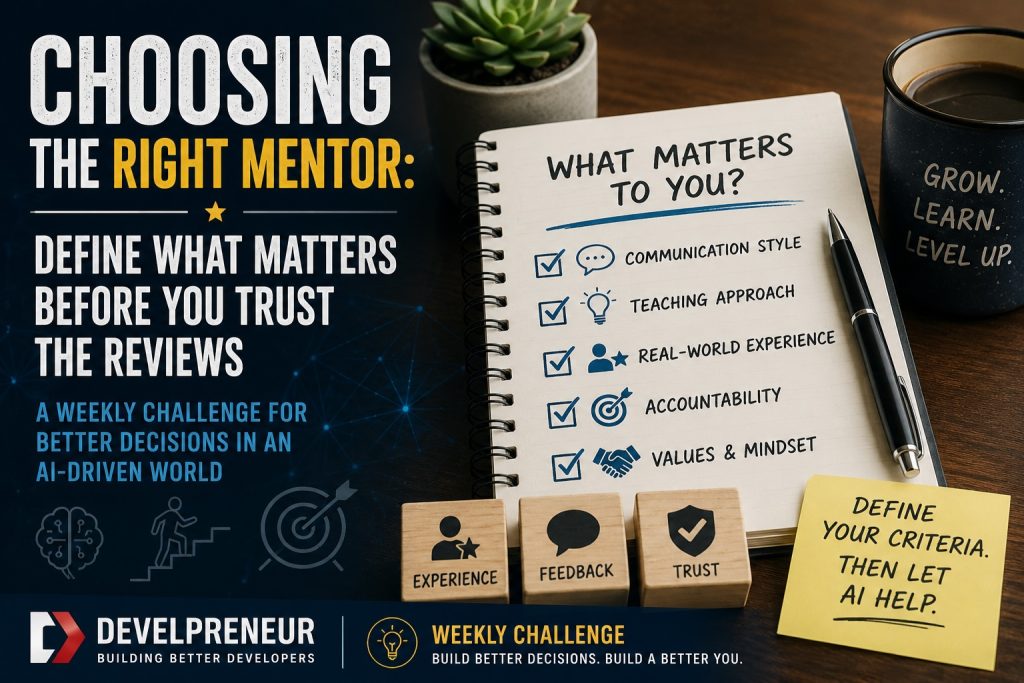
That brings us to this week’s challenge. Instead of searching for another mentor, course, or collection of reviews, spend a few minutes defining the three to five qualities that actually matter when you are choosing the right mentor.
It sounds simple, but the exercise exposes a much larger problem with how we make decisions and how we ask AI to help make them.
Good Reviews Do Not Always Mean a Good Fit
Most review systems are designed to answer a relatively simple question: Did people like this product? That works reasonably well for many purchases. If thousands of people say a particular product works reliably, that information can help you decide whether to buy it.
Mentorship, coaching, and education are different because the person receiving the service is part of the equation. One student may want a highly structured instructor who provides assignments, deadlines, and direct feedback. Another may prefer a mentor who asks difficult questions and expects the student to find the answer independently.
Neither approach is necessarily better. They are simply different.
A mentor who receives a poor review because someone disliked a hands-on teaching style might be exactly what another student needs. A coach criticized for being too direct may be valuable to someone who wants accountability and straightforward feedback.
The review alone does not provide the answer. You also need to understand the reviewer, the mentor, and yourself.
Sometimes You Have to Review the Reviewer
One of the more interesting ideas that came out of our discussion was the concept of reviewing the reviewer. A negative review does not automatically mean a course, coach, or mentor is bad. The reviewer may simply have wanted something different.
Consider someone who complains that a course contains too many hands-on exercises. If you learn best by doing, that criticism could actually be a positive signal. The same issue applies to communication preferences, technical depth, pace, structure, accountability, and teaching style.
This is why reducing complicated human experiences to a one-to-five-star rating can be misleading. The number tells you how someone felt, but it does not necessarily explain why they felt that way or whether their expectations match yours.
Before deciding whether a review matters to you, you need context.
AI Can Find Patterns, but You Still Have to Define What Matters
This is where AI becomes useful, but also where its limitations become important.
AI is very good at processing large amounts of information. Give it hundreds of reviews and it can identify recurring complaints, common strengths, frequently mentioned topics, and other patterns that would take a person hours to uncover manually.
The problem comes when we ask AI to decide what those patterns mean without first defining what matters. If you ask an AI system to find the “best mentor,” what does best actually mean? Does it mean the highest rating, most experience, lowest price, strongest student results, most structured curriculum, or most personalized feedback?
The answer depends on what you need.
Before AI can reliably help with a subjective decision, the requirements have to be clear enough for the system to evaluate them. That is not fundamentally an AI problem. It is a requirements problem.
Labels Are Not Requirements
Developers encounter this problem constantly. A customer asks for an application to be “easy to use.” A manager wants software to be “fast.” A team wants to “add AI.” A business wants a system that is “scalable.”
Those labels sound meaningful until someone asks what they actually mean.
How fast is fast? What makes something easy to use? What AI capability is actually required? How much growth does the application need to support before it qualifies as scalable?
The same problem exists when choosing a mentor. Words such as experienced, successful, knowledgeable, and helpful sound useful, but they are still broad labels. To make a meaningful decision, you need to understand the qualities underneath those labels.
The content underneath the label matters more than the label itself.
This Week’s Challenge: Define Your Mentor Fit
Think about the best teachers, coaches, managers, or mentors you have worked with. Then think about the ones who were not a good fit. Identify three to five qualities that made the difference.
Do not start by searching online or looking at ratings. Start with your own experience. Your qualities might include communication style, practical experience, accountability, technical depth, willingness to challenge assumptions, structured learning, accessibility, or the ability to explain complicated ideas clearly.
Your list does not need to match anyone else’s. That is the point.
Once you have your list, make each quality more specific. Instead of writing “good communicator,” you might define it as someone who explains complex ideas with practical examples and gives direct feedback when you misunderstand something.
Instead of writing “experienced,” you might define it as someone who has personally solved the type of problem you are facing and can explain both what worked and what failed.
Now you have criteria you can actually evaluate.
Turn Your Preferences Into Questions
Once you identify the three to five qualities that matter, turn them into questions you could use when evaluating a mentor.
If practical experience matters, ask what problems that person has personally solved. If accountability matters, ask how the coaching relationship handles goals, deadlines, and missed commitments. If hands-on learning matters, determine how much of the program involves exercises, projects, or direct application.
If communication style matters, watch interviews, webinars, videos, or other material from the person before making a significant investment.
This changes the process from finding the mentor with the highest rating to finding the mentor who best matches your requirements.
That is a much better problem to solve.
Then Let AI Help
Once you have defined your criteria, AI becomes considerably more useful.
Give an AI tool your three to five qualities and ask it to help create an evaluation framework. You could use that framework to develop questions, compare programs, analyze reviews for evidence of the qualities you care about, or identify information that is still missing before you make a decision.
The important difference is that you are no longer asking AI, “Who is the best mentor?” You are asking it to evaluate evidence against criteria you have already defined.
That gives AI requirements instead of asking it to fill in the blanks itself.
Apply the Same Thinking to Your Software
There is another reason this challenge matters for developers: the same thinking applies directly to building software with AI.
Before asking AI to implement a feature, define what success looks like. Before asking it to evaluate something, determine what criteria should be used. Before automating a decision, understand the rules behind that decision. Before trusting an AI-generated answer, identify which assumptions the system should not be allowed to make on its own.
This connects directly to the guardrail problem Michael raised during the discussion. AI can help filter noise and identify useful patterns, but without enough governance and clearly defined requirements, it can also emphasize the wrong information or fill gaps in ways you never intended.
AI can help us move quickly, but unclear requirements allow it to fill in blanks that may matter. The better we become at defining the problem, the more useful AI becomes as a tool for solving it.
Your Weekly Challenge
Set aside 15 minutes this week. Think about one teacher, mentor, coach, or manager who was a great fit for you and one who was not. Identify three to five qualities that explain the difference, and then define those qualities in terms you could actually observe or evaluate.
Turn each quality into a question you could ask before choosing your next mentor, coach, or course. Then, if you want to take the exercise one step further, give those criteria to an AI tool and ask it to create a simple evaluation framework.
The goal is not to find the perfect mentor this week. The goal is to become better at defining what the right mentor means for you.
Stay Connected: Join the Developreneur Community
👉 Subscribe to Building Better Developers for more conversations on momentum, leadership, and growth. Whether you’re a seasoned developer or just starting, there’s always room to learn and grow together. Contact us at [email protected] with your questions, feedback, or suggestions for future episodes. Together, let’s continue exploring the exciting world of software development.