
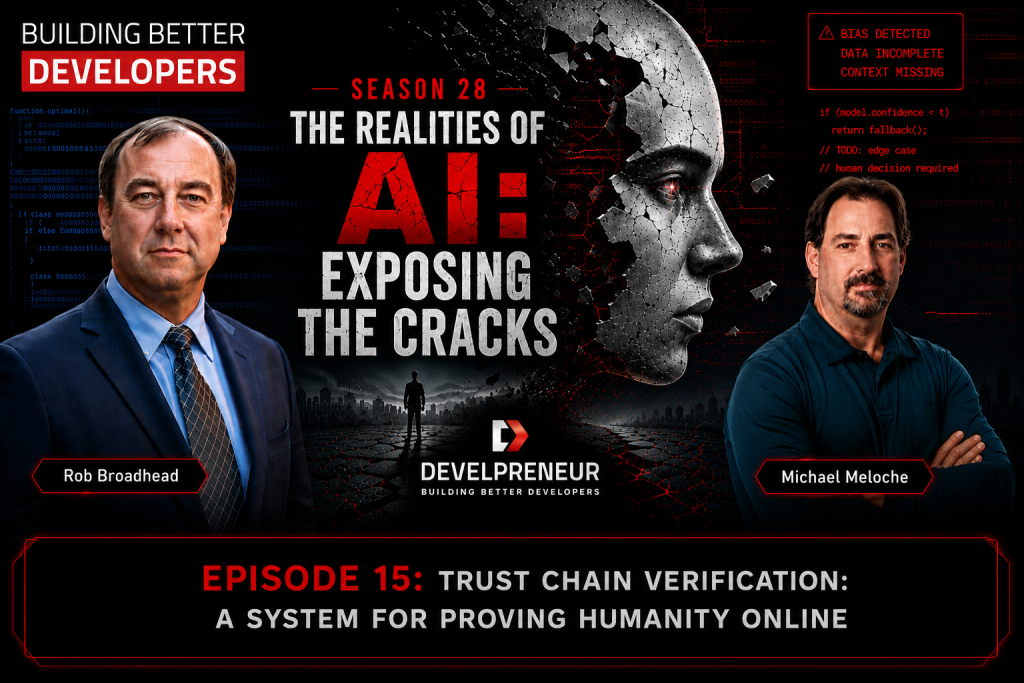

As artificial intelligence becomes increasingly capable of generating content, a new problem emerges: proving that a participant is human without requiring them to surrender their privacy. Trust Chain Verification offers a systems-based approach to solving that challenge. During Part 2 of the conversation with Richard Kersey, the discussion moved beyond the concept itself and into the mechanics of how a trust-based platform could function at scale. The result was a deeper exploration of digital trust, community design, and the future of online participation.
About Richard Kersey
Richard Kersey is the founder and developer behind Chirper, an experimental social platform focused on verifying human participation online while preserving anonymity. His work explores one of the most pressing questions in the AI era: how do we know we’re interacting with real people without sacrificing privacy? Through concepts such as trust chains, community verification, and decentralized accountability, Richard is testing new approaches to online identity, trust, and digital conversations.
Follow Richard on LinkedIn: https://www.linkedin.com/in/richardkersey/
Understanding Trust Chain Verification
Most platforms verify users through centralized systems.
- The platform decides who is legitimate.
- The platform stores identity information.
- The platform becomes the source of authority.
Trust Chain Verification distributes that responsibility.
Instead of a central authority validating everyone, users validate one another through invitations and accountability. A verified participant can invite another participant. That invitation carries responsibility. If the invited user becomes a bad actor, the trust relationship is affected. The trust chain becomes both a verification system and an accountability system.
Why Trust Chain Verification Creates Better Incentives
Traditional social platforms reward growth. Trust Chain Verification rewards judgment. That difference changes behavior. When invitations have consequences, users become more selective. Rather than maximizing numbers, they maximize quality.
This creates a powerful incentive structure:
- Invite carefully
- Protect your reputation
- Maintain community quality
- Encourage responsible participation
The system naturally aligns personal incentives with community health. Strong systems are built around incentives, not rules.
Scaling Trust Chain Verification Beyond Early Adoption
Every community faces a scaling challenge. A system that works with fifty people may fail with fifty thousand. This reality was a major theme in the discussion. Early-stage verification can be handled manually. Eventually, however, growth requires delegation. Potential solutions discussed included:
Distributed Verification
Trusted members help verify new participants.
Layered Trust Systems
Different levels of trust create graduated responsibilities.
Community Participation
Verification becomes part of the platform itself rather than a centralized task. The challenge is maintaining trust quality while avoiding concentration of power.
Trust Chain Verification and Reputation Decay
One of the most intriguing system concepts discussed was trust degradation. Without some balancing mechanism, early participants could accumulate disproportionate influence. That creates gatekeepers. Gatekeepers eventually create barriers. To avoid that outcome, trust systems may need decay mechanisms. Trust remains valuable, but influence naturally decreases over time.
Benefits include:
- Preventing entrenched power structures
- Encouraging ongoing participation
- Creating opportunities for new contributors
- Maintaining a dynamic ecosystem
This concept mirrors successful reputation systems in many decentralized environments. Any trust system that never resets eventually becomes a hierarchy.
Trust Chain Verification and Content Diversity
Another fascinating aspect of the discussion involved diversity scoring. Online communities often evolve into echo chambers. People interact primarily with those who already agree with them. Trust Chain Verification creates opportunities to measure conversation diversity in new ways.
Instead of only analyzing content, a platform could evaluate:
- Diversity of trust chains
- Diversity of participant backgrounds
- Diversity of interaction patterns
- Diversity of viewpoints entering discussions
The goal isn’t moderation. The goal is visibility. Users gain context about whether a discussion reflects broad participation or a narrow circle of connected contributors. Transparency often solves problems that moderation cannot.
The Future of Trust Chain Verification
The long-term potential extends beyond discussion platforms. Trust Chain Verification could support:
Professional Communities
Proof of human participation without exposing personal details.
Expert Networks
Reputation built through trusted relationships.
Digital Identity Systems
Human verification independent of government-issued identification.
AI-Dominated Environments
Clear distinction between automated and human participants.
As AI becomes increasingly indistinguishable from people, systems that establish human authenticity may become foundational infrastructure.
Conclusion
Trust Chain Verification represents more than a solution to bots. It represents a new framework for building online trust. By combining accountability, anonymity, distributed validation, and community participation, the model offers an alternative to centralized identity systems. The experiment is still evolving. But the questions it raises are increasingly important. In a world where AI can generate convincing content at scale, proving humanity may become one of the most valuable signals available online.
Stay Connected: Join the Developreneur Community
👉 Subscribe to Building Better Developers for more conversations on momentum, leadership, and growth. Whether you’re a seasoned developer or just starting, there’s always room to learn and grow together. Contact us at [email protected] with your questions, feedback, or suggestions for future episodes. Together, let’s continue exploring the exciting world of software development.