
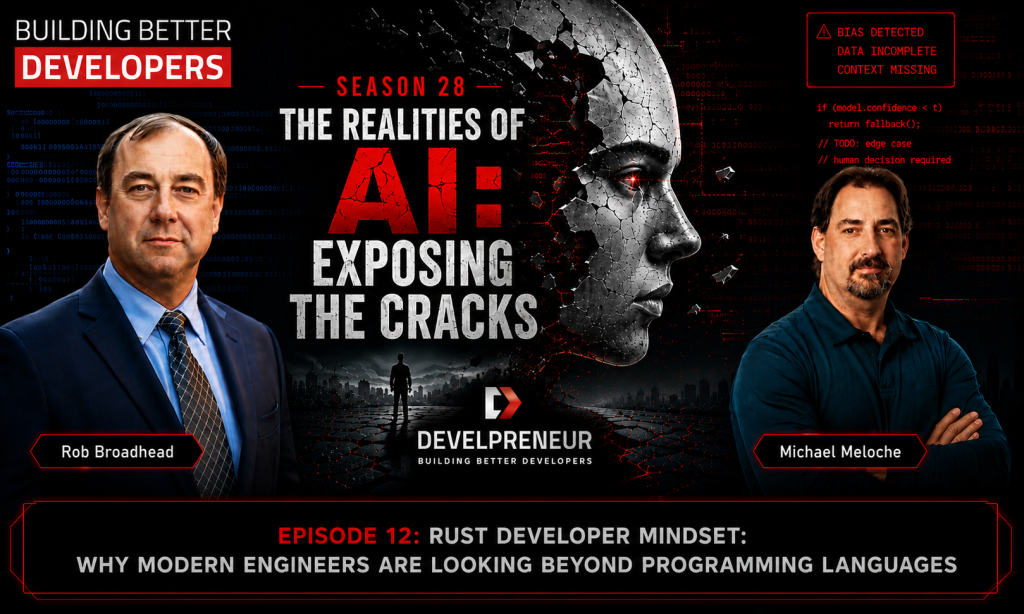

In this episode of Building Better Developers, Jim Hodapp and Bob Belderbos discuss why Rust continues to gain momentum among experienced developers. The conversation explores software craftsmanship, memory safety, AI-assisted development, and why language choice is becoming less important than understanding how software actually works.
Key Discussion Points
- Why Rust attracted both systems programmers and Python developers
- The relationship between AI coding tools and strongly typed languages
- How Rust improves software reliability
- The importance of understanding software fundamentals
- Why developer growth often requires embracing discomfort
The Rust Developer Mindset is not really about Rust.
That may sound strange coming from two developers actively teaching the language, but one of the strongest themes from the discussion with Jim Hodapp and Bob Belderbos was that successful software development starts with understanding systems, not syntax.
As AI generates code faster than ever, developers who understand architecture, performance, and reliability are becoming increasingly valuable. Rust simply happens to be one of the best environments for developing those skills.
About our Guests
Jim Hodapp
Jim Hodapp is a veteran software engineer, engineering leader, and technical coach with deep roots in systems programming. His background spans C, C++, Linux, embedded systems, software architecture, and engineering management. In recent years, he has become a recognized Rust advocate, helping developers transition from traditional systems languages into modern, memory-safe development practices. Through RefactorCoach and his Rust training initiatives, Jim focuses on improving engineering effectiveness, software quality, and developer growth.
Follow Jim on LinkedIn: https://www.linkedin.com/in/jim-hodapp/
Bob Belderbos
Bob Belderbos is a software developer, educator, coach, and co-founder of PyBites. Originally coming from a finance background, Bob transitioned into software through automation, scripting, and Python development. He has spent years helping developers improve their coding skills through practical challenges, mentoring, and community-based learning. More recently, Bob has expanded his focus into Rust, combining his Python expertise with modern systems programming practices to help developers build faster, safer, and more maintainable software.
Follow Bob on LinkedIn: https://www.linkedin.com/in/bbelderbos/
Why the Rust Developer Mindset Starts with Fundamentals
Many developers begin their careers with languages that allow rapid progress. Python is an excellent example. Developers can create useful applications quickly, automate repetitive work, and see results almost immediately. That accessibility explains much of Python’s popularity. The challenge appears later. The Rust Developer Mindset encourages developers to move beyond writing code that works and toward building systems that remain reliable over time.
Great developers eventually become students of systems, not just programming languages.
How Rust Forces Better Engineering Habits
One reason both guests spoke so positively about Rust is that the language encourages deliberate thinking. Rust’s ownership model, compiler checks, and strict type system often prevent entire categories of bugs before software ever runs. For developers accustomed to highly dynamic environments, this can feel restrictive at first. Eventually, however, the restrictions become guardrails.
Instead of discovering issues in production, developers discover them during compilation. That shift changes how software gets built. The language rewards planning, understanding data flow, and thinking carefully about how components interact. Those are valuable skills regardless of which language a developer uses professionally.
Rust Developer Mindset in the Age of AI
One of the most interesting topics from the episode was AI-assisted development. A common assumption is that AI reduces the importance of programming expertise. The opposite may be true. Modern AI tools can generate large amounts of code rapidly. However, generated code still requires evaluation, validation, testing, and architectural oversight. Strongly typed languages create an interesting advantage.
When AI generates imperfect code, the compiler immediately becomes part of the feedback loop. The compiler identifies errors, exposes assumptions, and forces corrections. This creates a collaborative cycle between the developer, AI, and compiler that often produces more reliable outcomes. The Rust Developer Mindset embraces this reality by treating AI as a productivity multiplier rather than a replacement for engineering judgment. Faster code generation does not eliminate the need for software design expertise.
Learning Through Productive Friction
Bob described his transition from Python to Rust as a challenge. That challenge turned out to be valuable. Many developers plateau because they remain inside familiar environments. They become highly productive but stop expanding their understanding.
Learning Rust introduces concepts that many scripting languages intentionally hide:
- Ownership
- Borrowing
- Memory management
- Concurrency considerations
- Compiler-guided design
These concepts can initially feel uncomfortable. Yet that discomfort often signals growth. Developers gain a deeper appreciation for what their software is doing beneath the surface. The result is not merely Rust knowledge. It is a broader engineering capability.
Why Performance Still Matters
The conversation also highlighted a topic that often gets overlooked in modern development. Performance still matters. Cloud resources may be abundant, but inefficient software still creates costs. Applications that consume excessive memory, waste CPU cycles, or scale poorly eventually impact users and businesses. Rust provides developers with low-level control while maintaining modern safety guarantees.
This combination helps engineers build software that remains efficient without sacrificing maintainability. The Rust Developer Mindset recognizes that performance is not about optimization for its own sake. It is about creating software that respects resources and scales effectively. Identify one application you currently maintain and investigate where performance bottlenecks originate before attempting optimization.
The Future Belongs to Software Engineers
The strongest takeaway from the episode is that language debates are becoming less important. AI can help generate syntax. Documentation can explain APIs. Tutorials can teach frameworks. What remains difficult is understanding how systems behave.
Developers who can reason about architecture, reliability, performance, and maintainability will continue to stand out regardless of tooling trends. That is ultimately what Rust helps reinforce. The future belongs to engineers who understand systems deeply enough to guide both AI and software toward better outcomes.
Conclusion
The Rust Developer Mindset is not simply about adopting a new language. It is about developing a stronger understanding of software itself.
By encouraging developers to think more carefully about correctness, performance, and system behavior, Rust creates opportunities for long-term growth that extend far beyond any individual technology stack.
Stay Connected: Join the Developreneur Community
👉 Subscribe to Building Better Developers for more conversations on momentum, leadership, and growth. Whether you’re a seasoned developer or just starting, there’s always room to learn and grow together. Contact us at [email protected] with your questions, feedback, or suggestions for future episodes. Together, let’s continue exploring the exciting world of software development.