
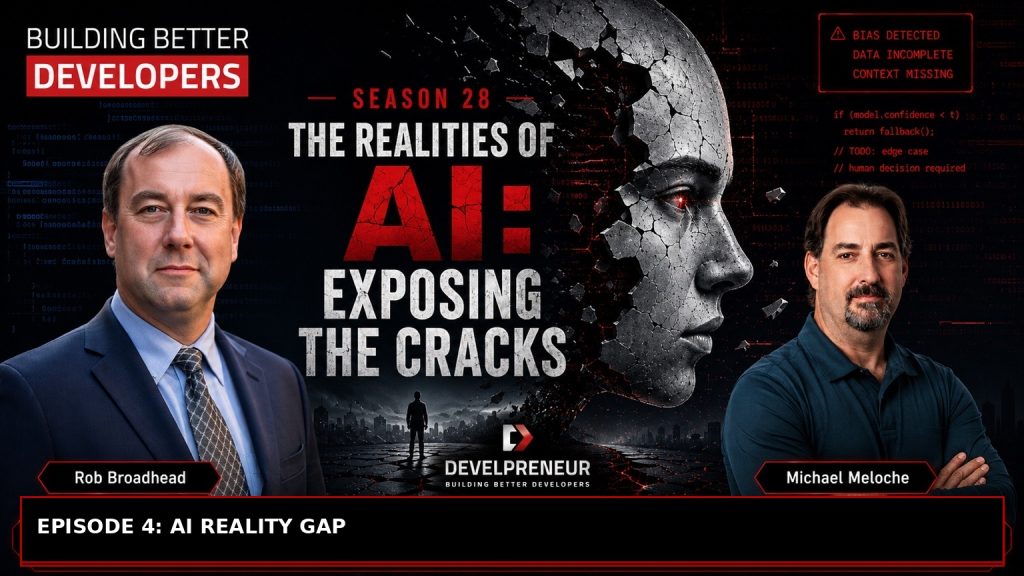

The AI Reality Gap is becoming one of the most important concepts for developers, founders, and business leaders to understand. Every day, social media is filled with examples of applications being built in minutes, products launched overnight, and entire workflows automated through AI tools.
What rarely gets discussed is what happens after the demo.
A working prototype is not the same thing as a production-ready system. The moment an application encounters real users, security requirements, scaling concerns, integrations, and operational demands, the true complexity begins to emerge.
Building something is easier than operating it reliably.
About Jason Sherman
Jason Sherman is a serial entrepreneur, filmmaker, author, and technology founder best known for building practical solutions that bridge the gap between emerging technology and real-world business problems. He is the founder and CEO of Vengo AI and has launched multiple technology platforms throughout his entrepreneurial career. Jason is known for his direct, hands-on approach to innovation, focusing on execution, product development, AI implementation, and helping businesses leverage technology without losing sight of operational realities.
His perspective combines startup experience, software development expertise, product strategy, and a strong belief that technology should solve actual business problems rather than chase trends.
Links: Facebook, Twitter / X, YouTube, LinkedIn, Website
Understanding the AI Reality Gap
The AI Reality Gap exists between what AI can generate and what organizations actually need.
A generated application may look complete on the surface. It can create forms, databases, dashboards, and workflows. Yet underneath that polished interface are questions that AI alone cannot currently solve consistently:
- Is the infrastructure secure?
- Are APIs protected?
- Is data handled correctly?
- Can the system scale under load?
- Is deployment repeatable and reliable?
These questions have always existed in software development. AI simply exposes them faster.
Why AI Is Revealing Existing Problems
Many organizations assume AI is creating new challenges.
In reality, AI is exposing old ones.
Businesses have always struggled with:
- Poor documentation
- Weak processes
- Inconsistent requirements
- Fragile infrastructure
- Knowledge silos
AI accelerates development so rapidly that these weaknesses appear sooner than before.
Faster development magnifies existing organizational problems.
AI Is a Tool, Not Magic
One of the strongest themes from the discussion was viewing AI as a tool rather than a replacement for expertise.
Electricity transformed industries.
Automobiles transformed transportation.
The internet transformed communication.
AI belongs in the same category.
The value comes from how people use the technology, not from the technology itself.
Organizations that treat AI as a productivity tool tend to achieve better results than organizations expecting autonomous solutions.
The Human Responsibility Layer
The excitement around AI often creates the impression that human oversight is becoming less important.
The opposite may be true.
As AI handles more implementation work, humans become increasingly responsible for:
- Architecture
- Governance
- Validation
- Security
- Business alignment
The challenge is shifting from creating code to directing systems.
The future developer may spend less time writing code and more time validating outcomes.
Building Beyond the Demo
Successful AI adoption requires organizations to think beyond proof-of-concept projects.
Questions leaders should ask include:
- How will this be maintained?
- Who owns the deployment process?
- How will security be managed?
- What happens when requirements change?
These concerns may seem less exciting than AI-generated applications, but they determine whether a solution survives in production.
Conclusion
The AI Reality Gap isn’t a flaw in AI. It’s a reminder that software success has always depended on more than code generation. Organizations that understand infrastructure, security, deployment, and human oversight will benefit most from AI’s acceleration.
Stay Connected: Join the Developreneur Community
👉 Subscribe to Building Better Developers for more conversations on momentum, leadership, and growth. Whether you’re a seasoned developer or just starting, there’s always room to learn and grow together. Contact us at [email protected] with your questions, feedback, or suggestions for future episodes. Together, let’s continue exploring the exciting world of software development.