
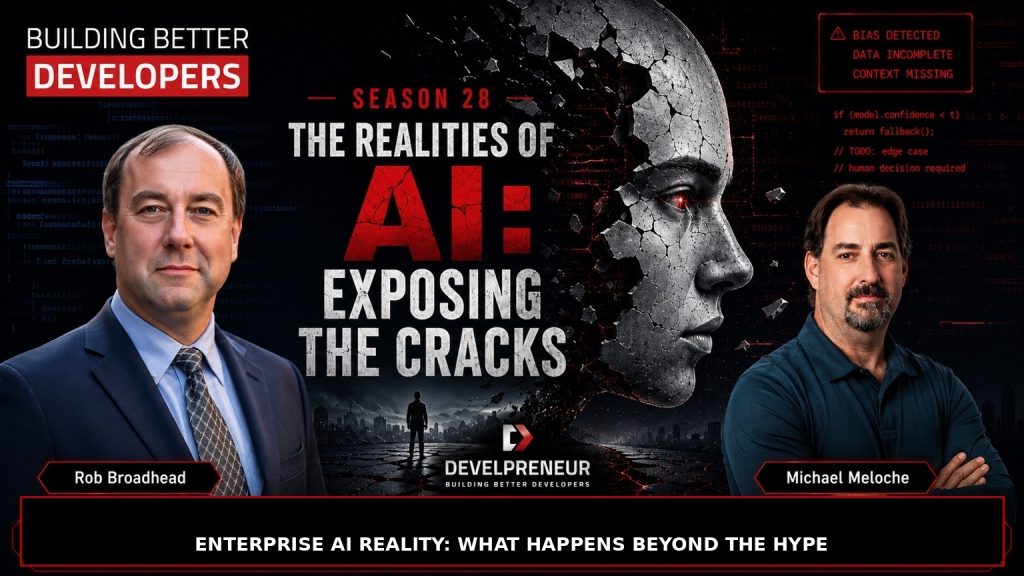

The conversation around artificial intelligence often creates the impression that software development has already been transformed beyond recognition. Social media feeds are filled with stories about AI agents replacing teams, generating applications automatically, and eliminating the need for traditional development processes.
The Enterprise AI Reality is much more nuanced.
While AI has become a valuable tool inside software organizations, large enterprises are approaching adoption far differently than many public conversations suggest. The gap between experimentation and production remains significant, especially when millions of dollars, regulatory requirements, and customer trust are involved.
About Samuel Otero
Samuel Otero is a Software Solutions Specialist with Deloitte US and a technology consultant with nearly 14 years of experience spanning enterprise software development, government projects, commercial consulting, and large-scale digital transformation initiatives. His career began with an early Microsoft internship that shaped his approach to continuous learning and technical humility. Since then, he has worked across media, public-sector, and enterprise environments, helping organizations deliver complex software solutions while mentoring the next generation of developers. Based in Puerto Rico, Samuel is also an advocate for developer growth, career development, and practical AI adoption in modern software engineering.
Links LinkedIn
Enterprise AI Reality Is Different from Social Media
One of the strongest observations Samuel shared was the contrast between what people see online and what happens inside large organizations.
Social media often highlights extreme success stories. Teams appear to build entire products using AI agents. Individual developers showcase impressive workflows that dramatically accelerate delivery.
Those examples are real.
However, enterprise software operates under different constraints. Systems support financial transactions, critical business processes, compliance requirements, and large customer bases. Mistakes carry significant consequences.
As a result, organizations are adopting AI incrementally rather than replacing existing development practices overnight.
Enterprise AI Reality Requires Trust Before Automation
Every technology faces a trust curve.
Before organizations automate critical workflows, they need evidence that systems perform reliably under real-world conditions.
Samuel described how enterprises often use AI first in lower-risk scenarios before allowing it to influence more critical components of a platform. Features with limited business risk become testing grounds for new approaches.
This pattern mirrors previous technological shifts.
Cloud adoption happened gradually.
DevOps adoption happened gradually.
AI adoption is following a similar trajectory.
The technology may be powerful, but trust must be earned through consistent results.
Enterprises don’t adopt technology because it’s impressive. They adopt it because it’s reliable.
Enterprise AI Reality Still Depends on Human Expertise
One misconception surrounding AI is that generated code eliminates the need for technical understanding.
In practice, the opposite may be true.
The more organizations rely on AI-generated outputs, the more important validation becomes. Developers must understand architecture, business requirements, security concerns, and implementation details well enough to verify what AI produces.
Samuel emphasized a simple but powerful habit: asking AI to explain exactly what it did and why it made certain decisions.
That approach transforms AI from an answer machine into a learning tool.
Developers who understand generated solutions become more effective.
Developers who blindly accept generated solutions create risk.
Never merge AI-generated code until you can explain its behavior to another developer.
Enterprise AI Reality Is Creating New Skill Gaps
The rise of AI is changing how developers gain experience.
Historically, growth came from solving difficult problems manually. Developers researched documentation, struggled through debugging sessions, and built mental models through repetition.
AI reduces much of that friction.
While this increases productivity, it also creates new challenges. Developers may complete tasks successfully without fully understanding how those tasks were accomplished.
Over time, this can create a dangerous gap between perceived capability and actual expertise.
Organizations must address this by emphasizing understanding rather than output alone.
The future belongs to developers who combine AI acceleration with deep technical comprehension.
Enterprise AI Reality May Increase Software Complexity
An interesting prediction from the discussion involved software quality.
As AI accelerates development, more software will be produced. More features will be released. More experiments will reach production environments.
That acceleration creates opportunity.
It also creates risk.
Samuel suggested that many organizations are still learning where AI performs exceptionally well and where it struggles under enterprise-scale conditions. During that learning period, users may experience more bugs, patches, and corrective updates as teams discover limitations.
This isn’t evidence that AI has failed.
It’s evidence that every transformative technology goes through a maturation phase before reaching stability.
Faster development cycles can produce bugs faster if organizations don’t maintain engineering discipline.
Enterprise AI Reality Still Comes Back to Problem Solving
Perhaps the most important lesson from the entire conversation is that technology itself is rarely the source of professional value.
Languages change.
Frameworks change.
Platforms change.
AI models will change.
The underlying business need remains consistent: solving problems.
Samuel’s closing advice focused on developing problem-solving skills rather than attaching identity to a specific technology stack.
That mindset provides resilience regardless of how quickly tools evolve.
Developers who can understand problems, communicate solutions, and create business value will remain relevant long after today’s AI tools are replaced by tomorrow’s innovations.
The most durable technical skill isn’t coding. It’s problem-solving.
Conclusion
The Enterprise AI Reality is neither the dystopian future predicted by skeptics nor the fully automated paradise promised by enthusiasts.
Instead, it’s a period of careful experimentation, measured adoption, and ongoing learning.
Organizations are discovering where AI delivers value, where human expertise remains essential, and how both can work together to build better software.
The developers who succeed during this transition won’t be the ones who resist AI or blindly trust it. They’ll be the ones who learn how to use it responsibly while continuing to strengthen the problem-solving skills that define great engineers.
Stay Connected: Join the Developreneur Community
👉 Subscribe to Building Better Developers for more conversations on momentum, leadership, and growth. Whether you’re a seasoned developer or just starting, there’s always room to learn and grow together. Contact us at [email protected] with your questions, feedback, or suggestions for future episodes. Together, let’s continue exploring the exciting world of software development.