

Every entrepreneur loves building. Developers build software. Founders build products. Business owners build relationships with customers. What often gets overlooked is building protection around those efforts.
That was one of the biggest takeaways from this week’s discussion with Phil Crowley and the follow-up Weekly Challenge. While the conversation covered legal structures, intellectual property, contracts, and startup risk, the challenge itself comes down to execution. Can you identify the hidden risks in your business before they become expensive problems?
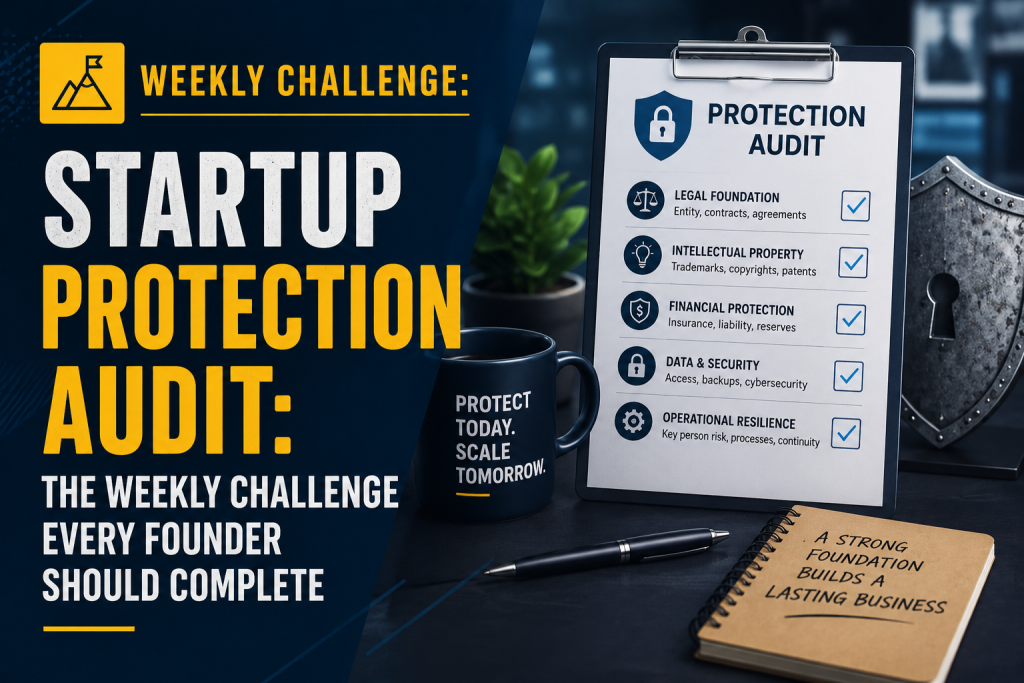
This week’s challenge is simple: conduct a Startup Protection Audit and identify the areas where your business is operating on assumptions rather than documented agreements, processes, or protections. The goal isn’t to create fear. The goal is to create awareness.
Why a Startup Protection Audit Matters
Many founders assume legal problems happen to other businesses. Until they happen to theirs. The challenge with startup risk is that most problems remain invisible until circumstances change.
- A founder leaves.
- A customer disputes a contract.
- An investor asks for documentation.
- A contractor claims ownership of the code.
- A partnership becomes strained.
At that point, you’re no longer planning. You’re reacting. A Startup Protection Audit helps shift your business from reactive decision-making to proactive preparation. The best time to solve a business problem is before it becomes a business problem.
Startup Protection Audit Area #1: Business Structure
The first place to examine is your company structure. Many businesses form an LLC or corporation and never think about it again. However, formation is only the beginning.
Ask yourself:
- Is the company active and compliant?
- Are contracts being signed in the company’s name?
- Are the required filings current?
- Are ownership records accurate?
- Are corporate records maintained?
Phil Crowley emphasized that many founders unknowingly weaken their liability protections simply by operating incorrectly after formation. Creating an entity isn’t enough. You must operate it properly.
Startup Protection Audit Area #2: Contracts and Agreements
One of the strongest messages from the podcast was the importance of written agreements. Too many startups rely on verbal understandings. That works when everything is going well. It breaks down when circumstances change.
Review:
- Client contracts
- Vendor agreements
- Contractor agreements
- Partnership arrangements
- Confidentiality agreements
The purpose is not legal complexity. The purpose is clarity. A good agreement ensures everyone understands expectations before disagreements arise.
Startup Protection Audit Questions for Contracts
Ask yourself:
- Is every important business relationship documented?
- Do contracts accurately reflect current services?
- Are payment terms clear?
- Are ownership rights clearly defined?
If the answer is “I’m not sure,” that area deserves attention. The absence of a contract does not eliminate risk. It usually increases it.
Startup Protection Audit Area #3: Intellectual Property
For many technology businesses, intellectual property is the company. Yet ownership documentation is often incomplete.
Consider:
- Who owns the source code?
- Who owns designs and branding?
- Were contractors involved?
- Were assignment agreements signed?
- Has confidential information been protected?
This area becomes particularly important if your company plans to pursue funding, partnerships, or acquisition opportunities. Investors frequently examine intellectual property ownership during due diligence. Missing documentation can delay or even derail opportunities.
Startup Protection Audit Area #4: Founder Expectations
This is often the most uncomfortable part of the audit. It’s also one of the most important. When businesses begin, founders focus on possibilities. Few spend time discussing difficult future scenarios.
Questions worth reviewing include:
- What happens if someone leaves?
- How is equity earned?
- Who makes final decisions?
- What happens during disputes?
- What happens if contributions become unequal?
The challenge is not predicting every situation. The challenge is establishing a framework before emotions become involved. Good founder agreements protect friendships as much as they protect businesses.
Startup Protection Audit Area #5: AI and Legal Assumptions
The Weekly Challenge discussion also highlighted a growing risk for modern entrepreneurs. AI makes legal information more accessible than ever. That accessibility is valuable. But it can also create false confidence.
AI can help:
- Research concepts
- Generate draft language
- Explain terminology
- Organize information
AI cannot:
- Replace legal counsel
- Understand your unique circumstances
- Guarantee compliance
- Accept liability for mistakes
A useful audit question is: “Where am I relying on AI-generated information that has never been professionally reviewed?” The answer may reveal hidden risks.
Turning the Audit Into Action
The purpose of a Startup Protection Audit is not to create a massive project. Start small. Identify one area that needs improvement. Then create a plan.
Examples include:
- Updating a founder agreement
- Reviewing contractor contracts
- Scheduling a legal consultation
- Organizing corporate records
- Conducting an intellectual property review
Small improvements compound over time. Just as technical debt grows when ignored, business and legal debt grow when left unresolved. Choose one protection gap this week and schedule a specific action to address it within the next 30 days.
Conclusion
This week’s challenge is ultimately about execution. Every founder understands the value of protecting software, products, and revenue. The next step is protecting the business itself.
A regular Startup Protection Audit helps identify risks before they become obstacles, strengthens the foundation of the company, and supports long-term growth. The businesses that survive and thrive are rarely the ones that avoid challenges completely. They’re the ones who prepare for them early.
Stay Connected: Join the Developreneur Community
👉 Subscribe to Building Better Developers for more conversations on momentum, leadership, and growth. Whether you’re a seasoned developer or just starting, there’s always room to learn and grow together. Contact us at [email protected] with your questions, feedback, or suggestions for future episodes. Together, let’s continue exploring the exciting world of software development.